Tuesday, August 06, 2013

President Obama Speaks on Restoring Security to Homeownership


Text courtesy The White House -

THE PRESIDENT:  Hey!  Hello, Phoenix!  (Applause.)  Hello, Arizona!  (Applause.)  It is --
AUDIENCE MEMBER:  We love you, Obama!
THE PRESIDENT:  I love you back.  It is good to be here.  (Applause.) 
I want to say thank you to the Thunder for hosting us here today.  (Applause.)  Well, we are so glad to be here.  I want you to give it up for somebody who’s been fighting for homeowners and working families every single day, who’s with me today -- Secretary Shaun Donovan, Secretary of HUD.  There he is right there.  Give him a big round of applause.  (Applause.)  We’ve got Congressman Ed Pastor who’s here as well.  (Applause.)  We’ve got your Mayor, Greg Stanton, here.  (Applause.)  Doing an outstanding job.  And to all the mayors and state legislators and tribal leaders who are here today, thank you.  (Applause.) 
Give Jorge a big round of applause for his introduction.  (Applause.)  To your superintendent, Dr. Kenneth Baca.  (Applause.)  Your principal, Dr. Anna Battle.  (Applause.)  And I appreciate everybody at Desert Vista for having me here today.  (Applause.)  It is good to see the students are pretty enthusiastic about being back in school.  (Laughter.)  I’m not sure I would have been that enthusiastic starting on the 6th.  (Laughter.) 
And I know this isn’t your typical school -- second day of school.  So I want to give a special shout-out to the new seniors, class of 2014.  (Applause.)  You are aware that you’re not finished yet.  (Laughter.)  Senior year, that’s sometimes tempting.  I want you all to stay focused.
Over the past couple weeks, I have been --
AUDIENCE MEMBER:  Happy birthday, Mr. President!
THE PRESIDENT:  Thank you very much.  Thank you.  (Applause.)  It was my birthday two days ago.  (Laughter.)  Got some singers here.
AUDIENCE:  Happy birthday to you, happy birthday to you, happy birthday, Mr. President.  (Applause.)
THE PRESIDENT:  Thank you.  Thank you.  Thank you.  (Applause.)  I am now 52, and Michelle says that I don’t look a day over 51.  (Laughter.)
So over the last few weeks, I’ve been visiting towns all across the country, talking about what we need to do to secure a better bargain for the middle class -- a national strategy to make sure that everybody who works hard has a chance to succeed in the 21st century economy.
And I think people in Arizona especially understand the challenges that are out there, because for the past four and a half years, together, we fought our way back from a devastating recession that cost millions of jobs for Americans.  A lot of folks lost their homes; a lot of folks lost their savings.  And what the recession showed was the long erosion of middle-class security that had been taking place for decades. 
But we fought back.  We took on a broken health care system. We took on a housing market that was in free fall.  We invested in new technologies to reverse our addiction to foreign oil.  We changed a tax code that had become tilted a little bit too much in favor of the wealthiest Americans at the expense of working families.  (Applause.)  We saved the auto industry.  We’ve now got GM that plans to hire a thousand new workers right next door in Chandler to make sure we’re building some of the best cars in the world right here in the United States of America.  (Applause.) 
Our businesses have created 7.3 million new jobs over the past 41 months.  We now sell more products made in America to the rest of the world than ever before.  Our exports are way up.  We produce more renewable energy than ever before, more natural gas than anybody else.  Health care costs have been growing at the slowest rate in 50 years.  And our deficits are coming down at the fastest rate in 60 years.  So we’re making progress.  (Applause.)
So thanks to the efforts of a lot of people like you, we’ve cleared away the rubble of the financial crisis.  We’re starting to lay the foundation for more stable, more durable economic growth.  But as any middle-class family will tell you, we’re not yet where we need to be.  Because even before the crisis hit, we had lived through a decade where a few at the top were doing better and better, but most families were working harder and harder just to get by. 
And reversing this trend should be -- must be -- Washington’s highest priority.  It’s my highest priority.  (Applause.)  I want to make sure that in America, it doesn’t matter what you look like, where you come from, who you love -- you should be able to make it when you try.  You should be able to make it.  (Applause.) 
Now, unfortunately, for the last year or so, we’ve had an endless parade of distractions and political posturing and phony scandals that shift focus away from what do we need to do to shore up middle-class families and create ladders of opportunity for folks to get into the middle class.  And as Washington heads towards another budget debate, the stakes could not be higher. 
And that’s why I’m traveling around, laying out my ideas for how we have to build the cornerstones of what it means to be middle class:  a good job with good wages; a home to call your own; a good education;  affordable health care that’s there for you when you get sick; a secure retirement even if you’re not rich; the opportunity -- the ladders of opportunity for people to earn their way into the middle class, to work their way out of poverty.  Those are the elements that I think all of us believe in, but right now we're not delivering as much as we should on those promises.
Now, last Tuesday, I went to Tennessee to talk about the first cornerstone, which is how do we make sure that we're creating good middle-class jobs here in the United States of America.  Today I've come to Phoenix to talk about the second component, which is the most tangible cornerstone that lies at the heart of the American Dream, at the heart of middle-class life -- and that's the chance to own your own home.  (Applause.) The chance to own your own home. 
  
We've got a lot of young people here who are thinking about college, they're going to get a higher education, they're going to find a job, they're going to find somebody they love, they're going to want to own a home.  And the reason they will is because a home is the ultimate evidence that here in America, hard work pays off, that responsibility is rewarded.
I think about my grandparents’ generation.  When my grandfather served in World War II, he fought in Patton's Army -- when he got back, this country gave him a chance to go to college on the G.I. Bill, but it also gave him the chance to buy his first home with a loan from the FHA.  To him, and to generations of Americans before and since, a home was more than just a house. It was a source of pride and a source of security.  It was a place to raise kids, to put down roots; a place where you could build up savings for college, or to start a business, or to retire with some security.
And buying a home required responsibility on everybody’s part.  You had to save up to buy a home.  And then banks were supposed to give you a fair deal, with terms you could understand, and buyers were supposed to live within their means and make sure that they could make their payments.  So in that earlier generation, houses weren’t for flipping around, they weren’t for speculation -- houses were to live in, and to build a life with.
And unfortunately, over time, responsibility too often gave way to recklessness.  You had reckless lenders who sold loans to people they knew couldn’t afford them.  And let's face it, we also had some reckless buyers who knew they couldn’t afford them and still took out loans.  And all this created a housing bubble. And especially in some places like Arizona, it was devastating  when that bubble finally burst -- triggered a recession.  Millions of Americans who had done everything right were hurt badly by the actions of other people.  Housing prices plummeted.
By the time I took office, home values had fallen almost 20 percent from the year before.  New housing starts had fallen nearly 80 percent from their peak.  Hundreds of thousands of construction workers had lost their jobs.  A record number of people were behind on their mortgage payments.  And a lot of people here in Phoenix, they saw that devastation.  This was part of Ground Zero for the housing bubble bursting.
So less than a month after I took office, I came here to Arizona and I laid out steps to stabilize the housing market and help responsible homeowners get back on their feet.  And the truth is it's been a long, slow process.  The housing market is so big that it was going to take some time to heal when it got hurt that badly.  It's taken longer than any of us would like.  But during that time, we helped millions of Americans save an average of $3,000 each year by refinancing at lower rates.  We helped millions of responsible homeowners stay in their homes, which was good for their neighbors because you don't want a bunch of foreclosure signs in your neighborhood.
Where Congress wouldn’t act, we went ahead and acted, so over the past few years, we had the Department of Justice stand up for buyers who had been discriminated against or conned by predatory lending.  And we won a settlement that gave more money to victims of discrimination in one year than in the previous 23 years combined.  (Applause.)
   
We worked with states to force big banks to repay more than $50 billion to more than 1.5 million families -- largest lending settlement in history.  (Applause.)  We extended the time that folks who had lost their jobs could delay their payment on their mortgages while they kept looking for work.  We cracked down on the bad practices that led to the crisis in the first place.  I mean, you had some loans back there in the bubble that were called “liar’s loan.”  Now, something that's called a liar's loan is probably a bad idea.  (Laughter.) 
So because of all these actions we've been taking, our housing market is beginning to heal.  Home prices are rising at the fastest pace in seven years.  Sales are up nearly 50 percent. Construction is up nearly 75 percent.  New foreclosures are down by nearly two-thirds.  Millions of families have been able to come up for air -- they’re no longer underwater on their mortgages.  (Applause.)
   
And just like the crisis hit Phoenix very hard, thanks to some great leadership here locally, Phoenix has also led one of the biggest comebacks in the country.  (Applause.)  So you should be proud of what you've done here.  Home prices in Phoenix have risen by nearly 20 percent over the last year.  New home sales are up by more than 25 percent.
This morning, right before I came here, I visited Erickson Construction -- (applause.)  We've got some Erickson folks here. And they were explaining how right when the bubble hit, Erickson shrank to less than a hundred workers.  Today they're employing 580 people -- and they’re hiring even more people -- (applause)  -- because the housing market is bouncing back.
   
So that's one of the things about housing.  It's not just important for the person who owns the house; our economy is so impacted by everything that happens in housing.  Consumers feel better when their home values are in a better place, so they're more willing to spend.  A lot of people who want to start a business, their savings may be locked up in their house.  Construction workers, contractors, suppliers, carpet makers, all these folks are impacted by the housing industry.
So we've made progress, and that's helped to move the economy forward.  But we've got to build on this progress.  We're not where we need to be yet.  We've got to give more hardworking Americans the chance to buy their first home.  (Applause.)  We have to help more responsible homeowners refinance their mortgages, because a lot of them still have a spread between the rates they're paying right now on their mortgage and what they could be getting if they were able to refinance.
And we’ve got to turn the page on this kind of bubble-and-bust mentality that helped to create this mess in the first place.  (Applause.)  We got to build a housing system that is durable and fair and rewards responsibility for generations to come.  That's what we’ve got to do.  (Applause.)
So I’ve already put forward a bunch of ideas that will help accomplish that.  And, look, the fact of the matter is Congress hasn’t enacted all of them, so I’d like you to encourage members of Congress to take some of these actions.  (Applause.)
But like the other actions that we’ve taken, these will not help the neighbors down the street who bought a house that they couldn’t afford, and then walked away from it and left a foreclosed home behind.  We don't want to help speculators who bought multiple homes just to make a quick buck. 
What we want to do is put forward ideas that will help millions of responsible, middle-class homeowners who still need relief.  And we want to help hardworking Americans who dream of owning their own home fair and square, have a down payment, are willing to make those payments, understand that owning a home requires responsibility.  And there are some immediate actions we could take right now that would help on that front, that would make a difference.  So let me just list a couple of them.
Number one:  Congress should pass a good, bipartisan idea to allow every homeowner the chance to save thousands of dollars a year by refinancing their mortgage at today’s rates.  (Applause.) We need to get that done.  We’ve been talking about it for a year and a half, two years, three years.  There’s no reason not to do it.  (Applause.) 
Step number two:  Now that we’ve made it harder for reckless buyers to buy homes that they can’t afford, let’s make it a little bit easier for qualified buyers to buy the homes that they can afford.  (Applause.)  So Shaun Donovan has been working with the finance industry to make sure we’re simplifying overlapping regulations; we’re cutting red tape for responsible families who want to get a mortgage but keep getting rejected by the banks.  We need to give well-qualified Americans who lost their jobs during the crisis a fair chance to get a loan if they’ve worked hard to repair their credit.
And step three is something that you don’t always hear about when it comes to the housing market, and that is fixing our broken immigration system.  It would actually help our housing market.  (Applause.)
It’s pretty simple:  When more people buy homes and play by the rules, home values go up for everybody.  And according to one recent study, the average homeowner has already seen the value of their home boosted by thousands of dollars just because of immigration.  And the good news is, with the help of your Senators, John McCain and Jeff Flake, the Senate has already passed a bipartisan immigration bill.  It’s got the support of CEOs and labor and law enforcement.  (Applause.)   This could help homeownership here.
So I want you to encourage Republicans in the House of Representatives to stop dragging their feet.  Let’s go ahead and get this done.
     
Step number four:  We should address the uneven recovery by rebuilding the communities hit the hardest by the housing crisis, including many right here in Arizona.  Let’s put construction back -- construction workers back to work repairing rundown homes, tearing down vacant properties so that the value of homes in those surrounding areas start picking up.  We can put people to work right now and improve the remaining housing stock that's out there.  (Applause.)  Places that are facing a longer road back from the crisis should have their country’s help to get back on their feet.
Step five:  We should make sure families that don’t want to buy a home or can’t yet afford to buy one still have a decent place to rent.  (Applause.)   It’s important for us to encourage homeownership, but a lot of people rent and there’s nothing wrong with renting.  And we got to make sure that we are creating affordable opportunities when it comes to rental properties.
In the run-up to the crisis, banks and governments too often made everybody feel like they had to own a home, even if they weren’t ready and didn't have the payments.  That’s a mistake we should not repeat.  Instead, let’s invest in affordable rental housing.  Let’s bring together cities and states to address local barriers that drive up rents for working families.  (Applause.)
  
So if we help more Americans refinance their homes, if we help qualified families get a mortgage, we reform our immigration system, we rebuild the hardest-hit communities, we make sure that folks have a decent place to rent if they're not yet able to buy -- all these steps will give more middle-class families the chance to either buy their own home now or eventually buy their own home.  It's going to give more relief to responsible homeowners.  It gives more options to families who aren’t yet ready to buy.  All that is going to improve the housing market and will improve the economy.
But -- and this is the last key point I want to make -- as home prices rise, we can’t just re-inflate another housing bubble.  I hope everybody here in Arizona learned some hard lessons from what happened.  Housing prices generally don't just keep on going up forever at the kind of pace it was going up.  It was crazy.  So what we want to do is something stable and steady. And that's why I want to lay a rock-solid foundation to make sure the kind of crisis we went through never happens again.  We've got to make sure it doesn't happen again.  (Applause.)
  
And one of the key things to make sure it doesn't happen again is to wind down these companies that are not really government, but not really private sector -- they're known as Freddie Mac and Fannie Mae.  For too long, these companies were allowed to make huge profits buying mortgages, knowing that if their bets went bad, taxpayers would be left holding the bag.  It was “heads we win, tails you lose.”  And it was wrong.  And along with what happened on Wall Street, it helped to inflate this bubble in a way that ultimately killed Main Street.
So the good news is, right now there’s a bipartisan group of senators working to end Fannie and Freddie as we know them.  And I support these kinds of reform efforts.  And they're following four core principles for what I believe this reform should look like. 
First, private capital should take a bigger role in the mortgage market.  I know that sounds confusing to folks who call me a socialist -- I think I saw some posters there on the way in. (Laughter.)  But I actually believe in the free market.  And just like the health care law that we put in place, Obamacare -- (applause) -- which, by the way, if you don't have health insurance or you're buying it at exorbitant rates on the individual market, starting on October 1st, you can join a marketplace and be part of a pool that gives you much lower premiums, saves you a lot of money.  (Applause.)
But in the same way that what we did with health care was to set up clear rules for insurance companies to protect consumers, make it more affordable, but still built on the private marketplace, I believe that our housing system should operate where there's a limited government role and private lending should be the backbone of the housing market.  And that includes, by the way, community-based lenders who view their borrowers not as a number, but as a neighbor.  So that's one principle.
A second principle is we can't leave taxpayers on the hook for irresponsibility or bad decisions by some of these lenders or Fannie Mae or Freddie Mac.  (Applause.)  We've got to encourage the pursuit of profit, but the era of expecting a bailout after you pursue your profit and you don't manage your risk well -- well, that puts the whole country at risk.  And we're ending those days.  We're not going to do that anymore.  (Applause.)
The third principle is we should preserve access to safe and simple mortgage products like the 30-year, fixed-rate mortgage.  That’s something families should be able to rely on when they're making the most important purchase of their lives.  (Applause.)
  
Number four, we've got to keep housing affordable for first-time homebuyers -- like all these young people.  When they're ready to buy a house, we've got to make sure it's affordable.  Families who are working to climb their way into the middle class, we've got to do what we can to make housing affordable.  And that means we've got to strengthen the FHA so it gives today’s families the same kind of chance it gave my grandparents to buy a home, and it preserves those rungs on the ladder of opportunity. 
And we've got to support, as I said, affordable rental housing.  And, by the way, we've also got to keep up our fight against homelessness.  (Applause.)  The Mayor of Phoenix has been doing a great job here in Phoenix on that front.  We've got to continue to improve it.  (Applause.)
   
Since I took office, we helped bring one in four homeless veterans off the streets.  (Applause.)  We should be proud of that.  Here in Phoenix, thanks to the hard work of everyone from Mayor Stanton to the local United Way to US Airways, you’re on track to end chronic homelessness for veterans, period, by 2014. (Applause.)
But we've got to keep going, because nobody in America, and certainly no veteran, should be left to live on the streets.  (Applause.)
So here's the bottom line:  Put all these principles together, that's going to protect our entire economy and it will improve the housing market not just here in Phoenix, but throughout the state and throughout the country.
We're also going to need to make sure, though, that we're protecting individual homeowners.  We've got to give them the tools that they can protect themselves.  So we've got a Consumer Finance Protection Bureau that we created.  (Applause.)  And it's laying down new rules of the road that everybody can count on when they’re shopping for a mortgage.  They’re designing a new, simple mortgage form that will be in plain English, so you can actually read it without a lawyer -- (applause) -- although, you may still want a lawyer obviously.  I'm not saying you don't.  I'm just saying you'll be able to read it.  (Laughter.)  There won't be a lot of fine print.  That way you know before you owe. (Laughter and applause.)
And the Senate finally confirmed Richard Cordray as the head of this -- head watchdog for the CFPB.  (Applause.)  So he's out there aggressively protecting consumers and homeowners. 
When it comes to some of the other leaders we need to look out for the American people, the Senate still has a job to do.  Months ago, I nominated a man named Mel Watt to be our nation’s top housing regulator.  He is an outstanding member of Congress. And during that time, he was on the Housing Committee -- worked with banks, worked with borrowers to protect consumers, to help responsible lenders provide credit.  He is the right person for the job.  Congress and the Senate should give his nomination an up or down vote without any more obstruction or delay.  We don't have time for those kinds of games.  (Applause.)
So I want to be honest with you.  No program or policy is going to solve all the problems in a multi-trillion dollar housing market.  The housing bubble went up so high, the heights it reached before it burst were so unsustainable, that we knew it was going to take some time for us to fully recover.  But if we take the steps that I talked about today, then I know we will restore not just our home values, but also our common values.  We’ll make owning a home a symbol of responsibility, not speculation -- a source of security for generations to come, just like it was for my grandparents.  I want it to be just like that for all the young people who are here today and their children and their grandchildren.  (Applause.)
And if we stay focused on middle-class security and opportunities to get into the middle class, if we take the strategy that I'm laying out for the entire economy -- for jobs and housing and education, health care, retirement, creating ladders of opportunity -- then we will secure that better bargain for all Americans, where hard work is once again rewarded with a shot at a middle-class life, which means more Americans will know the pride of that first paycheck.  More Americans will know the satisfaction of flipping the sign to “Open” on their own business.  More Americans will know the joy of scratching the child’s height on the door of their new home -- with pencil, of course.  (Laughter.) 
We can do all this if we work together.  And it won’t be easy.  But if we take just a few bold steps -- and if Washington will just end the gridlock, set aside the slash-and-burn partisanship -- (applause) -- actually try to solve problems instead of scoring political points, our economy will grow stronger a year from now, five years from now, 10 years from now. (Applause.)
And as long as I've got the privilege to serve as your President, that's what I'm going to be fighting for.
Thank you very much, everybody.  God bless you.  (Applause.)

Monday, August 05, 2013

Split District: LD9

Legislative District 9 encompasses a significant part west Tucson, the Catalina Foothills and part of Marana, all in Pima County (southern AZ to out-of-state readers :) ).


In terms of voter registration, the district is competitive, with a slight D lean - 43146 Democrats, 38065 Republicans, and 34988 Independents.  The 2012 figures were similar.

As a result of the 2012 elections, the district is one of three districts in the state to send a delegation to the state capitol that has a partisan split.  Democrat Steve Farley is the state senator from LD9, while Democrat Victoria Steele and Republican Ethan Orr are the state representatives from the district.

Other district-related data, relating to the 2012 elections (general election; primary election):

- In the 2012 presidential election, Barack Obama won the district by slightly more than 8% of the vote; he lost the state by slightly more than 9%.

- In the 2012 US Senate race, Richard Carmona won the district by more than 15%; he lost the state by slightly more than 3%.

- In the 2012 AZ House race, Steele received 44609 votes and Orr received 42626, winning the two House seats; Democrat Mohur Sidwa received 40034 to end up in third place.  In the primaries, Orr was the only candidate on the ballot in the R primary while in the D primary, Steele (11661 votes) and Sidwa (11490) won the Democratic nominations, with Dustin Cox coming in third place with 9500 votes.

-,In the 2012 AZ Senate race, Farley received 49818 votes to Republican Tyler Mott's total of 39562.  Each candidate was unopposed in their respective party primaries.


Orr is one of the Republicans who voted for Medicaid restoration in this year's budget, but it doesn't look as if he is being targeted for a primary challenge yet (though the threats are there).  Just the opposite, in fact; Republicans are running away from the district as fast as they can find a district where the general election is decided in the Republican primary.

To whit: former legislator Terri Proud, once a resident of LD9, has picked up her carpetbags and moved over to LD11 in her effort to return to the lege.


Evan Wyloge and Hank Stephenson of the Arizona Capitol Times have a more focused piece, on the website of the Arizona Center for Investigative Media.

Sunday, August 04, 2013

Obamacare: At least the Republicans are consistent. (Part 1)

...Consistently *dishonest*, but consistent nonetheless...

The Republican/corporate opposition to health care reform (HCR), known as Obamacare, has a three-step strategy for generating public opposition to HCR:

Step 1.  Lie.

Step 2.  Lie some more..

Step 3.  If steps 1 and 2 don't produce a satisfactory amount of public opposition to health care insurance coverage for the vast majority of Americans, lie even more.


The latest (renewed) GOPer lie "talking point" is to claim that Congress is "exempt" from the provisions.


Dranias is a senior operative at the corporate lobbying firm "free market think tank", while the person who retweeted Dranias' updates, Antenori, is one of the leaders of efforts to turn back Medicaid restoration via the ballot.

The story that Dranias links to, from Politico.com, is here.

I'm guessing that Dranias (and Antenori) are hoping that people don't actually read the story that they cite in support of their contention that Congress is exempt from the provisions of Obamacare.

The story doesn't support their contention.  Instead, it clearly points out that Congress is *required* to participate in HCR.

From the story, written by John Bresnahan and Jake Sherman (emphasis added) -
Lawmakers and staff can breathe easy — their health care tab is not going to soar next year.

The Office of Personnel Management, under heavy pressure from Capitol Hill, will issue a ruling that says the government can continue to make a contribution to the health care premiums of members of Congress and their aides, according to several Hill sources.

{snip}
The problem was rooted in the original text of the Affordable Care Act. Sen. Chuck Grassley (R-Iowa) inserted a provision which said members of Congress and their aides must be covered by plans “created” by the law or “offered through an exchange.” Until now, OPM had not said if the Federal Employee Health Benefits Program could contribute premium payments toward plans on the exchange. If payments stopped, lawmakers and aides would have faced thousands of dollars in additional premium payments each year. Under the old system, the government contributed nearly 75 percent of premium payments.

In essence, members of Congress and their aides have health insurance coverage through their employers (you know, *us*) and after the implementation of Obamacare, will still have health insurance coverage through their employers.  And in both instances ("before" and "after"), there is an employer contribution toward defraying the cost of the insurance coverage.

Hardly an "exemption".

FactCheck.org has a full explanation, dated May 3, 2013 - 
Q: Is it true that there are bills in Congress that would exempt members and their staffs and families from buying into “Obamacare”?
A: No. Congress members and staffers will be required to buy insurance through the exchanges on Jan. 1. But reportedly there is concern about whether federal contributions to premiums can continue without a change.


FULL QUESTION
Is it true that there are bills in the House and Senate that will exempt members and their staff and families from buying into Obamacare?
FULL ANSWER
Several readers have asked us about Congress attempting to exempt itself from the requirements of the Affordable Care Act. A few said that a Facebook post claimed that President Barack Obama, Sen. Harry Reid and Democrats in Congress were trying to “get themselves exempted from Obamacare,” in the words of one reader.
But there is no bill in Congress calling for an exemption from the health care law. In fact, members of Congress and their staffs face additional requirements that most Americans don’t have to meet.
Under the health care law, their insurance coverage will have to switch from the Federal Employees Health Benefits Program, the group of private insurance plans that cover 8 million federal employees and retirees, to the exchanges created by the law. Those exchanges are meant for those who buy coverage on their own, the currently uninsured and small businesses. Members of Congress and their staffs would be the only employees of a large employer in the exchanges, which are set to begin offering insurance in January.
So, why is the false “exempt” claim making the Facebook rounds? There is reportedly concern on Capitol Hill that the Office of Personnel Management, which administers the Federal Employees Health Benefits Program, won’t be able to smoothly transition members and their staffs into an exchange. The concern, as a Roll Call story explained, was that the government wouldn’t be able to make contributions toward the federal employees’ premiums, at least at the beginning of 2014. That would mean employees would pick up the whole tab for their insurance policies. Right now, the government pays 72 percent of premiums on average.

The “exempt” claims were sparked by a Politico report on April 24 that said secret talks were being held by lawmakers to change the requirement to get insurance through the exchanges because of this concern. The headline on the story said “Lawmakers, aides may get Obamacare exemption.”
After the story was published, a spokesman for Sen. Harry Reid said there hadn’t been any discussions to exempt Congress from “provisions that apply to any employees of any other public or private employer offering health care.” And Democratic Rep. Henry Waxman of California told Politico that lawmakers and their staffs will indeed get insurance through the exchanges. “[T]he federal government will offer them health insurance coverage that they obtained through the exchanges because we want to get the same health care coverage everybody else has available to them,” he said.
We contacted the Office of Personnel Management and received this statement from an administration official: “Members of Congress will not receive anything that is not available to the public. The law doesn’t allow them to get insurance from FEHB, they are going to get insurance on the market place, just like uninsured individuals and small businesses.”
We can’t say what did or didn’t happen in any secret meetings. But we can say that no bill has been introduced to exempt members of Congress from the Affordable Care Act — and they were never exempt in the first place. Even if, hypothetically, Congress were to nullify the provision requiring members and their staffs to get insurance on the exchanges, it still wouldn’t amount to an exemption from the law. Lawmakers and staffers would be subject to the mandate to have health insurance or pay a fine, just as everyone else is.
The law provides a few exemptions from the requirement to have insurance, but only for those who earn too little to file taxes, those with financial hardships, those who can’t find affordable coverage, and some religious groups that qualify for Social Security exemptions, mainly Mennonite or Amish.
An Old Falsehood
Bogus claims about Congress being “exempt” date back to early 2010, when different health care bills were still being debated. Some Republicans claimed that Americans, except for members of Congress, would be forced into the government-run “public option” (which wasn’t part of the final bill that became law) or state-based exchanges (which are part of the law).
As we said previously, members of Congress get private health insurance through the Federal Employees Health Benefits Program, which actually served as a model for the exchanges. Federal workers pick from among many health plans. The exchanges would operate in the same way — like a marketplace for those shopping for private insurance.
But some Republicans pushed the idea that if the exchanges were good enough for other Americans, they should be good enough for Congress. So, an amendment by Republican Sen. Chuck Grassley of Iowa was added to the Senate bill requiring that the federal government offer only health plans that were part of an exchange to members of Congress and their staffs. The law’s final language on this, written by Sen. Tom Coburn, says that: “the only health plans that the Federal Government may make available to Members of Congress and congressional staff with respect to their service as a Member of Congress or congressional staff shall be health plans that are — (I) created under this Act (or an amendment made by this Act); or (II) offered through an Exchange established under this Act.”
Congressional “staff” is defined as “all full-time and part-time employees employed by the official office of a Member of Congress, whether in Washington, DC or outside of Washington, DC.” As we reported before, Coburn said the provision wouldn’t apply to those working for committees or leadership staff, and a Congressional Research Service report agreed that could be the case.
In other words, the Affordable Care Act places on lawmakers and their staffs additional requirements that don’t pertain to other Americans with work-based insurance.
– Lori Robertson

Sources

Patient Protection and Affordable Care Act. Public Law 111–148. 111th Congress
The Federal Employees Health Benefits (FEHB) Program. OPM.gov. accessed 3 May 2013.
Ethridge, Emily. “Health Insurance Anxiety on Capitol Hill.” 25 Apr 2013.
Robertson, Lori. “Congress Exempt from Health Bill?” FactCheck.org. 20 Jan 2010.
Jackson, Brooks. “Health Care for Members of Congress?” FactCheck.org. 25 Aug 2009.
Bresnahan, John and Jake Sherman. “Lawmakers, aides may get Obamacare exemption.” Politico. 24 Apr 2013.
Baker, Sam. “Dems won’t seek ObamaCare exemption.” The Hill. 25 Apr 3013.
Henig, Jess. “More Malarkey About Health Care.” FactCheck.org. 19 Apr 2010.


Saturday, August 03, 2013

Split District: LD8

LD8 is a geographically large district that covers a significant part of Pinal County and part of Gila County.  The area that it covers is mostly rural and exurban.  Its largest communities are Casa Grande (48583 residents, per the 2010 census), Maricopa (43482), and Florence (25526).


In terms of current voter registration, it is a competitive district, with 28615 registered Democrats, 23747 Republicans, and 27443 Independents (aka - "Other").  The pre-election 2012 numbers were similar, with a slightly wider Democratic advantage.

Perhaps as a result of its relatively even partisan split, LD8 is one of the three AZ legislative districts with a partisan split in its delegation to the state capitol.

In 2012, it elected Democrat Barbara McGuire to the senate seat from LD8 and Republicans TJ Shope and Frank Pratt to the LD8 House seats.

McGuire is easily the most conservative member of the Democratic caucus.  In most any other state, she'd be a moderate R, but the AZGOP is so far out on the political fringe, she has to be a Democrat here.

Don't know much about Pratt or Shope, other than that Pratt is running for the AZ Corporation Commission next year and that both voted for Medicaid restoration in this year's budget.

Other district-related data, relating to the 2012 elections (general election; primary election):

- In the 2012 presidential election, Barack Obama lost the district by slightly less than 9% of the vote; he lost the state by slightly more than 9%.

- In the 2012 US Senate race, Richard Carmona lost the district by a little less than 1% of the vote; he lost the state by slightly more than 3%.

- McGuire defeated Republican Joe Ortiz 25026 to 23542 for the Senate seat.

- In the House races, Pratt received 24195 and Shope received 22102, defeating Democrats Ernest Bustamante (21258) and Emily Verdugo (20102).

As of this writing, no non-incumbent candidates have opened committees for the district, but that should change in a district that's this closely contested.


Friday, August 02, 2013

Split District: LD28


Legislative District 28 encompasses parts of northeast, east and central Phoenix as well as Paradise Valley, all within Maricopa County.


In terms of voter registration, it is solidly Republican; current voter registration figures show that there are 34858 Ds, 49209 Rs, and 36973 Independents ("Other" in AZ voter reg parlance) in the district.  The numbers in 2012 were similar.

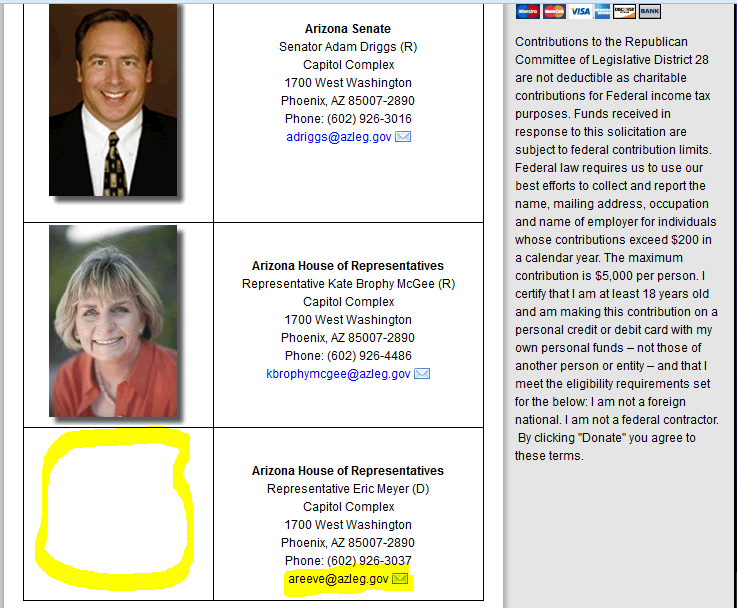
However, it is one of the few districts in the state with a partisan split in its delegation to the legislature (LDs 8 and 9 are the other two).  In 2012, it elected Democrat Eric Meyer and Republican Kate Brophy McGee to the Arizona House of Representatives (Republican Adam Driggs won the district's seat in the Senate).

It should be noted that the LD28 Rs may still be somewhat ticked off by Meyer's victory.

From the LD28 Rs' website -


But I digress... :)

Other district-related data, relating to the 2012 elections (general election; primary election):

- In the 2012 presidential election, Barack Obama lost the district by slightly less than 9% of the vote; he lost the state by slightly more than 9%.

- In the 2012 US Senate race, Richard Carmona lost the district by slightly more than 3%; he also lost the state by slightly more than 3%.

- In the 2012 AZ House race,  Brophy McGee (R) received 46228 votes and Meyer (D) received 43081, defeating Amanda Reeve (R), who received 41102 votes.  All three were unchallenged in their respective primaries.

- In the 2012 AZ Senate race, Adam Driggs (R) received 49160 votes, defeating Eric Shelley (D), who received 39243 votes. Both were unchallenged in their primaries.


The district, while solidly R based on registration, tends to send representatives to the Capitol who are a bit more "middle of the road" than the perception of the caucuses in the legislature -

Rep. Eric Meyer (D) is widely considered to be the most pragmatic/moderate member of the Democratic caucus, which is regarded as the reason he is able to win in the district (well, that and the fact that he works his a** off, both in office and on the campaign trail).

On the other side of the aisle, Rep. Brophy McGee and Sen. Driggs have come under fire for their votes in support of Medicaid restoration in this year's budget.  In addition, while they are thoroughly conservative Republicans, they aren't ideological morons and will, on occasion, do the right thing for their constituents and the state.

Which tends to tick off the ideological morons who make up the majority of the R caucus.


This has all combined to inspire an interesting mix of early entry challengers (all Rs and all House candidates so far) to open committees for legislative runs in the district -

Mary Hamway, a former member of the Paradise Valley Town Council

Shawnna Bolick, a 2010 candidate for the legislature and the wife of Clint Bolick, a senior operative at the corporate lobbying firm "free market think tank" The Goldwater Institute.

John Douglas Wilenchik, who seems to be a political newbie, but a well-connected one - his father is Dennis Wilenchik, who was the personal fixer/hatchet man for disgraced and disbarred former Maricopa County Attorney (and erstwhile 2014 candidate for governor) Andrew Thomas.

Things could change between now and next year, but unlike 2012, a primary battle looks likely here.  Stay tuned...


Evan Wyloge and Hank Stephenson of the Arizona Capitol Times have a more focused piece, on the website of the Arizona Center for Investigative Media.

Sunday, July 28, 2013

Is 2014 going to be a rerun of 2010?

The GOP fear-mongered healthcare reform to a massive electoral tidal wave in 2010, sweeping their way to majorities in the US House of Representatives and state houses across the country.

That year, the GOP took advantage of the astroturf-generated tea party movement with, among other things, a series "town hall meetings" that were filled with anti-immigrant, anti-Democrats, anti-Obama, anti-healthcare reform, and anti-99% propaganda.

And since they've been in office, what little "work" that they've done has been based on the same propaganda (i.e. - the US House's 40th  dog and pony show vote to "repeal" Obamacare is on tap for next week).

It's not just the House Republicans either - the Republicans in the US Senate have filibustered nearly everything to come before them, even normally non-controversial executive branch appointments.

At the state level, they've been enacting voter suppression laws, anti-choice laws, tax cuts for corporations and the wealthy, anti-worker measures, and more, and always against the will of the people of their states.

In short, they've high-handedly postured for the last 2-plus years while doing nothing of substance that's beneficial to the whole country, like looking for ways to shore up the fragile economic recovery (actually, they've done just the opposite of *helping* the economy, but that's a topic for a wonkier post).

Now, the GOPers involved may not be honorable public servants, but neither have they allowed their arrogance to blind them to the reality that most Americans, and most voters, blame them for the decline in the US economy, society's infrastructure (both physical and social) and US influence abroad.

They fully understand that the elections of 2014 could be disastrous for them, in spite of the political truism that historically, the party that doesn't control the White House makes gains in the midterm elections during a president's second term (not absolutely accurate, but still a widely accepted truism).

They know that they can't campaign on their "accomplishments", because they don't have any, or what they consider to be "accomplishments" are things that actually work against the interests of their constituents.

Now, the GOP hasn't had an original idea in generations, so they didn't feel the need to look deep in their repertoire for a plan for forestalling defeat next year.

In other words, they're going to try to tea party likes it's 2010 all over again.

From Crooks & Liars, written by karoli -

July is winding down and our do-nothing House is close to having a month to do nothing but stir up general rage and anger. With that goal in mind, House Republicans have all received their August marching orders and field guides for activities inside their districts. I've put the entire document here below the fold, but here are some of the highlights:
Media Events
  • Invite representatives of 501c3 and c4 groups to speak about how they "could have been targeted by the IRS and explain how house Republicans are conducting oversight hearings to hold the Administration accountable." Members are further instructed to issue media advisories in advance and be sure to hold a press conference afterwards.
  • Have 'conversations' with health care providers, presumably to gin up some more hate for the Affordable Care Act.
  • Host a local jobs fair. Oh, the irony.
  • Target millennials with a health care forum designed to inform them of how screwed they are after Obamacare kicks in
  • Take a Red Tape Tour in connection with the local Chamber of Commerce so businesses can complain about excessive regulations.
Town Hall Meetings
  • Emergency Health Care - Carve out an hour to focus solely on health care, "addressing the myriad effects of ObamaCare on the people in your district."
  • Stopping Government Abuse - This is the "kill the IRS" themed meeting, with a dash of "kill all regulations" tossed in.
The original document is here.


I don't really expect the GOP scheme to work, buuuuuut...

As in 2010, a number of Democratic members of the US House of Representatives from competitive areas seem to think that appearing to be "Republican-lite" will win over some Republican voters.

In recent weeks, they've sided with the House Republicans and (among other things) -

Voted to allow funding for continued NSA spying on Americans (WaPo story)

Voted to support a measure to take the authority to regulate coal ash created by power plants away from the EPA and give it to the more easily cowed states (The Hill story)

Voted to delay full implementation of Obamacare (HuffPo story)

Voted to loosen oversight of the financial industry by giving them a loophole related to overseas operations (Mother Jones story)

Voted to hamstring the SEC (The Hill story)


In 2010, many of the Democrats in competitive districts did the same thing, some even becoming "Blue Dog Democrats (conservative pseudo-Republicans) in a mostly futile attempt to stave off defeat.

OK, "mostly futile" is my tactful way of saying that they got their asses kicked.

Three of the Democratic members of Arizona's delegation - Ann Kirkpatrick, Kyrsten Sinema, and Ron Barber - are members of the group that are going the "Republican-lite" route.

They should all know better - Kirkpatrick was one of the conservaDems ousted in 2010, Barber worked for former Congresswoman Gabby Giffords, who was nearly ousted, and Sinema is simply smart as hell.

But they don't seem to, because they all seem to be pursuing the strategy that failed so miserably in 2010.

And that may be the thing that does the most to guarantee R success in 2014 - as bad as the Republicans have been for the country, too many Democrats will be governing and running in such a way as to give the voters two bad choices on next year's ballot.


Wednesday, July 24, 2013

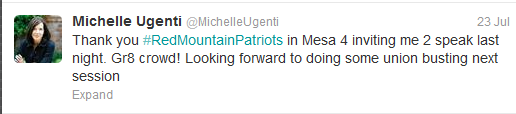
Well, we've been warned: Republican legislators plan more attacks on public employee unions next session


President Obama Speaks on the Economy


Transcript of the speech, courtesy the White House - 

THE PRESIDENT:  Hello, Galesburg!  (Applause.)  Well, it’s good to be home in Illinois!  (Applause.)  It is good to be back. It’s good to be back.  Thank you.  Thank you so much, everybody. (Applause.)  Thank you.  Everybody, have a seat, have a seat.  Well, it is good to be back.

I want to, first of all, thank Knox College -- (applause) -- I want to thank Knox College and your president, Teresa Amott, for having me here today.  Give Teresa a big round of applause.  (Applause.)   I want to thank your Congresswoman, Cheri Bustos, who’s here.  (Applause.)  We've got Governor Quinn here.  (Applause.)  I'm told we've got your Lieutenant Governor, Sheila Simon, is here.  (Applause.)  There she is.  Attorney General Lisa Madigan is here.  (Applause.)

I see a bunch of my former colleagues, some folks who I haven't seen in years and I'm looking forward to saying hi to.  One in particular I've got to mention, one of my favorites from the Illinois Senate -- John Sullivan is in the house.  (Applause.)  John was one of my earliest supporters when I was running for the U.S. Senate, and it came in really handy because he’s got, like, 10 brothers and sisters, and his wife has got 10 brothers and sisters -- (laughter) -- so they’ve got this entire precinct just in their family.  (Laughter.)  And they all look like John -- the brothers do -- so he doesn’t have to go to every event.  He can just send one of his brothers out.  (Laughter.)  It is good to see him.

Dick Durbin couldn’t make it today, but he sends his best. And we love Dick.  (Applause.)  He’s doing a great job.  And we’ve got one of my favorite neighbors, the Senator from Missouri, Claire McCaskill, in the house, because we’re going to Missouri later this afternoon.  (Applause.)

And all of you are here, and it’s great to see you.  (Applause.)  And I hope everybody is having a wonderful summer.  The weather is perfect.  Whoever was in charge of that, good job. (Laughter.)

So, eight years ago, I came here to deliver the commencement address for the class of 2005.  Things were a little different back then.  For example, I had no gray hair -- (laughter) -- or a motorcade.  Didn’t even have a prompter.  In fact, there was a problem in terms of printing out the speech because the printer didn’t work here and we had to drive it in from somewhere.  (Laughter.)  But it was my first big speech as your newest senator.

And on the way here I was telling Cheri and Claire about how important this area was, one of the areas that I spent the most time in outside of Chicago, and how much it represented what’s best in America and folks who were willing to work hard and do right by their families.  And I came here to talk about what a changing economy was doing to the middle class -- and what we, as a country, needed to do to give every American a chance to get ahead in the 21st century.

See, I had just spent a year traveling the state and listening to your stories -- of proud Maytag workers losing their jobs when the plant moved down to Mexico.  (Applause.)  A lot of folks here remember that.  Of teachers whose salaries weren’t keeping up with the rising cost of groceries.  (Applause.)  Of young people who had the drive and the energy, but not the money to afford a college education.  (Applause.)

So these were stories of families who had worked hard, believed in the American Dream, but they felt like the odds were increasingly stacked against them.  And they were right.  Things had changed.

In the period after World War II, a growing middle class was the engine of our prosperity.  Whether you owned a company, or swept its floors, or worked anywhere in between, this country offered you a basic bargain -- a sense that your hard work would be rewarded with fair wages and decent benefits, the chance to buy a home, to save for retirement, and most of all, a chance to hand down a better life for your kids.

But over time, that engine began to stall -- and a lot of folks here saw it -- that bargain began to fray.  Technology made some jobs obsolete.  Global competition sent a lot of jobs overseas.  It became harder for unions to fight for the middle class.  Washington doled out bigger tax cuts to the very wealthy and smaller minimum wage increases for the working poor.

And so what happened was that the link between higher productivity and people’s wages and salaries was broken.  It used to be that, as companies did better, as profits went higher, workers also got a better deal.  And that started changing.  So the income of the top 1 percent nearly quadrupled from 1979 to 2007, but the typical family’s incomes barely budged.

And towards the end of those three decades, a housing bubble, credit cards, a churning financial sector was keeping the economy artificially juiced up, so sometimes it papered over some of these long-term trends.  But by the time I took office in 2009 as your President, we all know the bubble had burst, and it cost millions of Americans their jobs, and their homes, and their savings.  And I know a lot of folks in this area were hurt pretty bad.  And the decades-long erosion that had been taking place -- the erosion of middle-class security -- was suddenly laid bare for everybody to see.

Now, today, five years after the start of that Great Recession, America has fought its way back.  (Applause.)  We fought our way back.  Together, we saved the auto industry; took on a broken health care system.  (Applause.)  We invested in new American technologies to reverse our addiction to foreign oil.  We doubled wind and solar power.  (Applause.)  Together, we put in place tough new rules on the big banks, and protections to crack down on the worst practices of mortgage lenders and credit card companies.  (Applause.)  We changed a tax code too skewed in favor of the wealthiest at the expense of working families -- so we changed that, and we locked in tax cuts for 98 percent of Americans, and we asked those at the top to pay a little bit more.  (Applause.)

So you add it all up, and over the past 40 months, our businesses have created 7.2 million new jobs.  This year, we’re off to our strongest private sector job growth since 1999.

And because we bet on this country, suddenly foreign companies are, too.  Right now, more of Honda’s cars are made in America than anyplace else on Earth.  (Applause.)  Airbus, the European aircraft company, they’re building new planes in Alabama.  (Applause.)  And American companies like Ford are replacing outsourcing with insourcing -- they’re bringing jobs back home.  (Applause.)

We sell more products made in America to the rest of the world than ever before.  We produce more natural gas than any country on Earth.  We’re about to produce more of our own oil than we buy from abroad for the first time in nearly 20 years.  (Applause.)  The cost of health care is growing at its slowest rate in 50 years.  (Applause.)  And our deficits are falling at the fastest rate in 60 years.  (Applause.)

So thanks to the grit and resilience and determination of the American people -- of folks like you -- we’ve been able to clear away the rubble from the financial crisis.  We started to lay a new foundation for stronger, more durable economic growth. And it's happening in our own personal lives as well, right?  A lot of us tightened our belts, shed debt, maybe cut up a couple of credit cards, refocused on those things that really matter.

As a country, we’ve recovered faster and gone further than most other advanced nations in the world.  With new American revolutions in energy and technology and manufacturing and health care, we're actually poised to reverse the forces that battered the middle class for so long, and start building an economy where everyone who works hard can get ahead.

But -- and here's the big “but” -- I’m here to tell you today that we're not there yet.  We all know that.  We're not there yet.  We've got more work to do.  Even though our businesses are creating new jobs and have broken record profits, nearly all the income gains of the past 10 years have continued to flow to the top 1 percent.  The average CEO has gotten a raise of nearly 40 percent since 2009.  The average American earns less than he or she did in 1999.  And companies continue to hold back on hiring those who’ve been out of work for some time.

Today, more students are earning their degree, but soaring costs saddle them with unsustainable debt.  Health care costs are slowing down, but a lot of working families haven’t seen any of those savings yet.  The stock market rebound helped a lot of families get back much of what they had lost in their 401(k)s, but millions of Americans still have no idea how they’re going to be able to retire.

So in many ways, the trends that I spoke about here in 2005 -- eight years ago -- the trend of a winner-take-all economy where a few are doing better and better and better, while everybody else just treads water -- those trends have been made worse by the recession.  And that's a problem.

This growing inequality not just of result, inequality of opportunity -- this growing inequality is not just morally wrong, it’s bad economics.  Because when middle-class families have less to spend, guess what, businesses have fewer consumers.  When wealth concentrates at the very top, it can inflate unstable bubbles that threaten the economy.  When the rungs on the ladder of opportunity grow farther and farther apart, it undermines the very essence of America -- that idea that if you work hard you can make it here.

And that’s why reversing these trends has to be Washington’s highest priority.  (Applause.)  It has to be Washington's highest priority.  (Applause.)  It’s certainly my highest priority.  (Applause.)

Unfortunately, over the past couple of years, in particular, Washington hasn’t just ignored this problem; too often, Washington has made things worse.  (Applause.)

And I have to say that -- because I'm looking around the room -- I've got some friends here not just who are Democrats,  I've got some friends here who are Republicans -- (applause) -- and I worked with in the state legislature and they did great work.  But right now, what we’ve got in Washington, we've seen a sizable group of Republican lawmakers suggest that they wouldn’t vote to pay the very bills that Congress rang up.  And that fiasco harmed a fragile recovery in 2011 and we can't afford to repeat that.

Then, rather than reduce our deficits with a scalpel -- by cutting out programs we don’t need, fixing ones that we do need that maybe are in need of reform, making government more efficient -- instead of doing that, we've got folks who’ve insisted on leaving in place a meat cleaver called the sequester that's cost jobs.  It's harmed growth.  It's hurt our military.  It's gutted investments in education and science and medical research.  (Applause.)

Almost every credible economist will tell you it's been a huge drag on this recovery.  And it means that we're underinvesting in the things that this country needs to make it a magnet for good jobs.

Then, over the last six months, this gridlock has gotten worse.  I didn't think that was possible.  (Laughter.)  The good news is a growing number of Republican senators are looking to join their Democratic counterparts and try to get things done in the Senate.  So that's good news.  (Applause.)  For example, they worked together on an immigration bill that economists say will boost our economy by more than a trillion dollars, strengthen border security, make the system work.

But you've got a faction of Republicans in the House who won’t even give that bill a vote.  And that same group gutted a farm bill that America’s farmers depend on, but also America's most vulnerable children depend on.

AUDIENCE MEMBER:  Booo --

THE PRESIDENT:  And if you ask some of these folks, some of these folks mostly in the House, about their economic agenda how it is that they'll strengthen the middle class, they’ll shift the topic to “out-of-control government spending” –- despite the fact that we've cut the deficit by nearly half as a share of the economy since I took office.  (Applause.)

Or they’ll talk about government assistance for the poor, despite the fact that they’ve already cut early education for vulnerable kids.  They've already cut insurance for people who’ve lost their jobs through no fault of their own.  Or they’ll bring up Obamacare -- this is tried and true -- despite the fact that our businesses have created nearly twice as many jobs in this recovery as businesses had at the same point in the last recovery when there was no Obamacare.  (Applause.)

AUDIENCE MEMBER:  My daughter has insurance now!

THE PRESIDENT:  I appreciate that.  (Applause.)  That’s what this is about.  That’s what this is about.  (Applause.)  That’s what we've been fighting for.

But with this endless parade of distractions and political posturing and phony scandals, Washington has taken its eye off the ball.  And I am here to say this needs to stop.  (Applause.) This needs to stop.

This moment does not require short-term thinking.  It does not require having the same old stale debates.  Our focus has to be on the basic economic issues that matter most to you, the people we represent.  That’s what we have to spend our time on and our energy on and our focus on.  (Applause.)

And as Washington prepares to enter another budget debate, the stakes for our middle class and everybody who is fighting to get into the middle class could not be higher.  The countries that are passive in the face of a global economy, those countries will lose the competition for good jobs.  They will lose the competition for high living standards.  That’s why America has to make the investments necessary to promote long-term growth and shared prosperity -- rebuilding our manufacturing base, educating our workforce, upgrading our transportation systems, upgrading our information networks.  (Applause.)  That’s what we need to be talking about.  That’s what Washington needs to be focused on.

And that’s why, over the next several weeks, in towns across this country, I will be engaging the American people in this debate.  (Applause.)  I'll lay out my ideas for how we build on the cornerstones of what it means to be middle class in America, and what it takes to work your way into the middle class in America:  Job security, with good wages and durable industries.  A good education.   A home to call your own.  Affordable health care when you get sick.  (Applause.)  A secure retirement even if you’re not rich.  Reducing poverty.  Reducing inequality.  Growing opportunity.  That’s what we need.  (Applause.)  That’s what we need.  That’s what we need right now.  That’s what we need to be focused on.  (Applause.)

Now, some of these ideas I’ve talked about before.  Some of the ideas I offer will be new.  Some will require Congress.  Some I will pursue on my own.  (Applause.)  Some ideas will benefit folks right away.  Some will take years to fully implement.  But the key is to break through the tendency in Washington to just bounce from crisis to crisis.  What we need is not a three-month plan, or even a three-year plan; we need a long-term American strategy, based on steady, persistent effort, to reverse the forces that have conspired against the middle class for decades. That has to be our project.  (Applause.)

Now, of course, we’ll keep pressing on other key priorities. I want to get this immigration bill done.  We still need to work on reducing gun violence.  (Applause.)  We’ve got to continue to end the war in Afghanistan, rebalance our fight against al Qaeda. (Applause.)  We need to combat climate change.  We’ve got to standing up for civil rights.  We’ve got to stand up for women’s rights.  (Applause.)

So all those issues are important, and we’ll be fighting on every one of those issues.  But if we don’t have a growing, thriving middle class then we won’t have the resources to solve a lot of these problems.  We won’t have the resolve, the optimism, the sense of unity that we need to solve many of these other issues.

Now, in this effort, I will look to work with Republicans as well as Democrats wherever I can.  And I sincerely believe that there are members of both parties who understand this moment, understand what’s at stake, and I will welcome ideas from anybody across the political spectrum.  But I will not allow gridlock, or inaction, or willful indifference to get in our way.  (Applause.)

That means whatever executive authority I have to help the middle class, I’ll use it.  (Applause.)  Where I can’t act on my own and Congress isn’t cooperating, I’ll pick up the phone -- I’ll call CEOs; I’ll call philanthropists; I’ll call college presidents; I’ll call labor leaders.  I’ll call anybody who can help -- and enlist them in our efforts.  (Applause.)

Because the choices that we, the people, make right now will determine whether or not every American has a fighting chance in the 21st century.  And it will lay the foundation for our children’s future, our grandchildren’s future, for all Americans.
So let me give you a quick preview of what I’ll be fighting for and why.  The first cornerstone of a strong, growing middle class has to be, as I said before, an economy that generates more good jobs in durable, growing industries.  That's how this area was built.  That's how America prospered.  Because anybody who was willing to work, they could go out there and they could find themselves a job, and they could build a life for themselves and their family.

Now, over the past four years, for the first time since the 1990s, the number of American manufacturing jobs has actually gone up instead of down.  That's the good news.  (Applause.)  But we can do more.  So I’m going to push new initiatives to help more manufacturers bring more jobs back to the United States.  (Applause.)  We’re going to continue to focus on strategies to make sure our tax code rewards companies that are not shipping jobs overseas, but creating jobs right here in the United States of America.  (Applause.)

We want to make sure that -- we’re going to create strategies to make sure that good jobs in wind and solar and natural gas that are lowering costs and, at the same time, reducing dangerous carbon pollution happen right here in the United States.  (Applause.)

And something that Cheri and I were talking about on the way over here -- I’m going to be pushing to open more manufacturing innovation institutes that turn regions left behind by global competition into global centers of cutting-edge jobs.  So let’s tell the world that America is open for business.  (Applause.)  I know there’s an old site right here in Galesburg, over on Monmouth Boulevard -- let’s put some folks to work.  (Applause.)

Tomorrow, I’ll also visit the Port of Jacksonville, Florida to offer new ideas for doing what America has always done best, which is building things.  Pat and I were talking before I came  -- backstage -- Pat Quinn -- he was talking about how I came over the Don Moffitt Bridge.  (Applause.)  But we’ve got work to do all across the country.  We’ve got ports that aren’t ready for the new supertankers that are going to begin passing through the new Panama Canal in two years’ time.  If we don’t get that done, those tankers are going to go someplace else.  We’ve got more than 100,000 bridges that are old enough to qualify for Medicare. (Laughter and applause.)

Businesses depend on our transportation systems, on our power grids, on our communications networks.  And rebuilding them creates good-paying jobs right now that can’t be outsourced.  (Applause.)

And by the way, this isn’t a Democratic idea.  Republicans built a lot of stuff.  This is the Land of Lincoln.  Lincoln was all about building stuff -- first Republican President.  (Applause.)  And yet, as a share of our economy, we invest less in our infrastructure than we did two decades ago.  And that’s inefficient at a time when it’s as cheap as it’s been since the 1950s to build things.  It’s inexcusable at a time when so many of the workers who build stuff for a living are sitting at home waiting for a call.

The longer we put this off, the more expensive it will be and the less competitive we will be.  Businesses of tomorrow will not locate near old roads and outdated ports.  They’ll relocate to places with high-speed Internet, and high-tech schools, and systems that move air and auto traffic faster, and not to mention will get parents home quicker from work because we’ll be eliminating some of these traffic jams.  And we can watch all of that happen in other countries, and start falling behind, or we can choose to make it happen right here, in the United States.  (Applause.)

In an age when jobs know no borders, companies are also going to seek out the countries that boast the most talented citizens, and they’ll reward folks who have the skills and the talents they need -- they’ll reward those folks with good pay.

The days when the wages for a worker with a high school degree could keep pace with the earnings of somebody who got some sort of higher education -- those days are over.  Everybody here knows that.  There are a whole bunch of folks here whose dads or grandpas worked at a plant, didn’t need a high school education. You could just go there.  If you were willing to work hard, you might be able to get two jobs.  And you could support your family, have a vacation, own your home.  But technology and global competition, they’re not going away.  Those old days aren’t coming back.

So we can either throw up our hands and resign ourselves to diminishing living standards, or we can do what America has always done, which is adapt, and pull together, and fight back, and win.  That’s what we have to do.  (Applause.)

And that brings me to the second cornerstone of a strong middle class -- and everybody here knows it -- an education that prepares our children and our workers for the global competition that they’re going to face.  (Applause.)  And if you think education is expensive, wait until you see how much ignorance costs in the 21st century.  (Laughter and applause.)

If we don’t make this investment, we’re going to put our kids, our workers, and our country at a competitive disadvantage for decades.  So we have to begin in the earliest years.  And that’s why I’m going to keep pushing to make high-quality preschool available for every 4-year-old in America.  (Applause.) Not just because we know it works for our kids, but because it provides a vital support system for working parents.

And I’m going to take action in the education area to spur innovation that don’t require Congress.  (Applause.)  So, today, for example, as we speak, federal agencies are moving on my plan to connect 99 percent of America’s students to high-speed Internet over the next five years.  We’re making that happen right now.  (Applause.)  We’ve already begun meeting with business leaders and tech entrepreneurs and innovative educators to identify the best ideas for redesigning our high schools so that they teach the skills required for a high-tech economy.

And we’re also going to keep pushing new efforts to train workers for changing jobs.  So here in Galesburg, for example, a lot of the workers that were laid off at Maytag chose to enroll in retraining programs like the one at Carl Sandburg College.  (Applause.)  And while it didn’t pay off for everyone, a lot of the folks who were retrained found jobs that suited them even better and paid even more than the ones they had lost.

And that’s why I’ve asked Congress to start a Community College to Career initiative, so that workers can earn the skills that high-tech jobs demand without leaving their hometown.  (Applause.)  And I’m going to challenge CEOs from some of America’s best companies to hire more Americans who’ve got what it takes to fill that job opening but have been laid off for so long that nobody is giving their résumé an honest look.

AUDIENCE MEMBER:  More talent!

THE PRESIDENT:  That, too.

I’m also going to use the power of my office over the next few months to highlight a topic that’s straining the budgets of just about every American family -- and that’s the soaring cost of higher education.  (Applause.)  Everybody is touched by this, including your President, who had a whole bunch of loans he had to pay off.  (Laughter.)

Three years ago, I worked with Democrats to reform the student loan system so that taxpayer dollars stopped padding the pockets of big banks, and instead helped more kids afford college.  (Applause.)  Then, I capped loan repayments at 10 percent of monthly incomes for responsible borrowers, so that if somebody graduated and they decided to take a teaching job, for example, that didn’t pay a lot of money, they knew that they were never going to have to pay more than 10 percent of their income and they could afford to go into a profession that they loved.  That’s in place right now.  (Applause.)  And this week, we’re working with both parties to reverse the doubling of student loan rates that happened a few weeks ago because of congressional inaction.  (Applause.)

So this is all a good start -- but it isn’t enough.  Families and taxpayers can’t just keep paying more and more and more into an undisciplined system where costs just keep on going up and up and up.  We’ll never have enough loan money, we’ll never have enough grant money, to keep up with costs that are going up 5, 6, 7 percent a year.  We’ve got to get more out of what we pay for.

Now, some colleges are testing new approaches to shorten the path to a degree, or blending teaching with online learning to help students master material and earn credits in less time.  In some states, they’re testing new ways to fund college based not just on how many students enroll, but how many of them graduate, how well did they do.

So this afternoon, I’ll visit the University of Central Missouri to highlight their efforts to deliver more bang for the buck to their students.  And in the coming months, I will lay out an aggressive strategy to shake up the system, tackle rising costs, and improve value for middle-class students and their families.  It is critical that we make sure that college is affordable for every single American who’s willing to work for it.  (Applause.)

Now, so you’ve got a good job; you get a good education -- those have always been the key stepping stones into the middle class.  But a home of your own has always been the clearest expression of middle-class security.  For most families, that’s your biggest asset.  For most families, that’s where your life’s work has been invested.  And that changed during the crisis, when we saw millions of middle-class families experience their home values plummeting.  The good news is over the past four years, we’ve helped more responsible homeowners stay in their homes.  And today, sales are up and prices are up, and fewer Americans see their homes underwater.

But we’re not done yet.  The key now is to encourage homeownership that isn’t based on unrealistic bubbles, but instead is based on a solid foundation, where buyers and lenders play by the same set of rules, rules that are clear and transparent and fair.

So already, I’ve asked Congress to pass a really good, bipartisan idea -- one that was championed, by the way, by Mitt Romney’s economic advisor -- and this is the idea to give every homeowner the chance to refinance their mortgage while rates are still low so they can save thousands of dollars a year.  (Applause.)  It will be like a tax cut for families who can refinance.

I’m also acting on my own to cut red tape for responsible families who want to get a mortgage but the bank is saying no.  We’ll work with both parties to turn the page on Fannie Mae and Freddie Mac, and build a housing finance system that’s rock-solid for future generations.

So we’ve got more work to do to strengthen homeownership in this country.  But along with homeownership, the fourth cornerstone of what it means to be middle class in this country is a secure retirement.  (Applause.)  I hear from too many people across the country, face to face or in letters that they send me, that they feel as if retirement is just receding from their grasp.  It’s getting farther and farther away.  They can't see it.

Now, today, a rising stock market has millions of retirement balances going up, and some of the losses that had taken place during the financial crisis have been recovered.  But we still live with an upside-down system where those at the top, folks like me, get generous tax incentives to save, while tens of millions of hardworking Americans who are struggling, they get none of those breaks at all.  So as we work to reform our tax code, we should find new ways to make it easier for workers to put away money, and free middle-class families from the fear that they won't be able to retire.  (Applause.)

And if Congress is looking for a bipartisan place to get started, I should just say they don’t have to look far.  We mentioned immigration reform before.  Economists show that immigration reform makes undocumented workers pay their full share of taxes, and that actually shores up the Social Security system for years.  So we should get that done.  (Applause.)

Good job; good education for your kids; home of your own; secure retirement.

Fifth, I'm going to keep focusing on health care -- (applause) -- because middle-class families and small business owners deserve the security of knowing that neither an accident or an illness is going to threaten the dreams that you’ve worked a lifetime to build.

As we speak, we're well on our way to fully implementing the Affordable Care Act.  (Applause.)  We're going to implement it.  Now, if you’re one of the 85 percent of Americans who already have health insurance either through the job or Medicare or Medicaid, you don’t have to do anything, but you do have new benefits and better protections than you did before.  You may not know it, but you do.  Free checkups, mammograms, discounted medicines if you're on Medicare -- that’s what the Affordable Care Act means.  You're already getting a better deal.  No lifetime limits.

If you don’t have health insurance, then starting on October 1st, private plans will actually compete for your business, and you'll be able to comparison-shop online.  There will be a marketplace online, just like you’d buy a flat-screen TV or plane tickets or anything else you're doing online, and you'll be able to buy an insurance package that fits your budget and is right for you.

And if you're one of the up to half of all Americans who’ve been sick or have a preexisting condition -- if you look at this auditorium, about half of you probably have a preexisting condition that insurance companies could use to not give you insurance if you lost your job or lost your insurance -- well, this law means that beginning January 1st, insurance companies will finally have to cover you and charge you the same rates as everybody else, even if you have a preexisting condition.  (Applause.)  That’s what the Affordable Care Act does.  That’s what it does.  (Applause.)

Now, look, I know because I've been living it that there are folks out there who are actively working to make this law fail.  And I don’t always understand exactly what their logic is here, why they think giving insurance to folks who don’t have it and making folks with insurance a little more secure, why they think that’s a bad thing.  But despite the politically motivated misinformation campaign, the states that have committed themselves to making this law work are finding that competition and choice are actually pushing costs down.

So just last week, New York announced that premiums for consumers who buy their insurance in these online marketplaces will be at least 50 percent lower than what they're paying today -- 50 percent lower.  (Applause.)  So folks' premiums in the individual market will drop by 50 percent.  And for them and for the millions of Americans who’ve been able to cover their sick kids for the first time -- like this gentlemen who just said his daughter has got health insurance -- or have been able to cover their employees more cheaply, or are able to have their kids who are younger than -- who are 25 or 26 stay on their parents' plan -- (applause) -- for all those folks, you'll have the security of knowing that everything you’ve worked hard for is no longer one illness away from being wiped out.  (Applause.)

Finally, as we work to strengthen these cornerstones of middle-class security -- good job with decent wages and benefits, a good education, home of your own, retirement security, health care security -- I’m going to make the case for why we've got to rebuild ladders of opportunity for all those Americans who haven't quite made it yet -- who are working hard but are still suffering poverty wages, who are struggling to get full-time work.  (Applause.)

There are a lot of folks who are still struggling out here, too many people in poverty.  Here in America, we’ve never guaranteed success -- that's not what we do.  More than some other countries, we expect people to be self-reliant.  Nobody is going to do something for you.  (Applause.)  We've tolerated a little more inequality for the sake of a more dynamic, more adaptable economy.  That's all for the good.  But that idea has always been combined with a commitment to equality of opportunity to upward mobility -- the idea that no matter how poor you started, if you're willing to work hard and discipline yourself and defer gratification, you can make it, too.  That's the American idea.  (Applause.)

Unfortunately, opportunities for upward mobility in America have gotten harder to find over the past 30 years.  And that’s a betrayal of the American idea.  And that’s why we have to do a lot more to give every American the chance to work their way into the middle class.

The best defense against all of these forces -- global competition, economic polarization -- is the strength of the community.  So we need a new push to rebuild rundown neighborhoods.  (Applause.)  We need new partnerships with some of the hardest-hit towns in America to get them back on their feet.  And because no one who works full-time in America should have to live in poverty, I am going to keep making the case that we need to raise the minimum wage -- (applause) -- because it's lower right now than it was when Ronald Reagan took office.  It's time for the minimum wage to go up.  (Applause.)

We're not a people who allow chance of birth to decide life’s biggest winners or losers.  And after years in which we’ve seen how easy it can be for any of us to fall on hard times -- folks in Galesburg, folks in the Quad Cities, you know there are good people who work hard and sometimes they get a bad break.  A plant leaves.  Somebody gets sick.  Somebody loses a home.  We've seen it in our family, in our friends and our neighbors.  We've seen it happen.  And that means we cannot turn our backs when bad breaks hit any of our fellow citizens.

So good jobs; a better bargain for the middle class and the folks who are working to get into the middle class; an economy that grows from the middle out, not the top down -- that's where I will focus my energies.  (Applause.)  That's where I will focus my energies not just for the next few months, but for the remainder of my presidency.

These are the plans that I'll lay out across this country.  But I won’t be able to do it alone, so I'm going to be calling on all of us to take up this cause.  We’ll need our businesses, who are some of the best in the world, to pressure Congress to invest in our future.  And I’ll be asking our businesses to set an example by providing decent wages and salaries to their own employees.  And I’m going to highlight the ones that do just that.

There are companies like Costco, which pays good wages and offers good benefits.  (Applause.)  Companies like -- there are companies like the Container Store, that prides itself on training its employees and on employee satisfaction -- because these companies prove that it’s not just good for the employees, it’s good for their businesses to treat workers well.  It’s good for America.  (Applause.)

So I’m going to be calling on the private sector to step up. I will be saying to Democrats we’ve got to question some of our old assumptions.  We’ve got to be willing to redesign or get rid of programs that don't work as well as they should.  (Applause.) We’ve got to be willing to -- we’ve got to embrace changes to cherished priorities so that they work better in this new age.  We can't just -- Democrats can't just stand pat and just defend whatever government is doing.  If we believe that government can give the middle class a fair shot in this new century -- and I believe that -- we’ve an obligation to prove it.  And that means that we’ve got to be open to new ways of doing things.

And we’ll need Republicans in Congress to set aside short-term politics and work with me to find common ground.  (Applause.)

It’s interesting, in the run-up to this speech, a lot of reporters say that, well, Mr. President, these are all good ideas, but some of you’ve said before; some of them sound great, but you can't get those through Congress.  Republicans won’t agree with you.  And I say, look, the fact is there are Republicans in Congress right now who privately agree with me on a lot of the ideas I’ll be proposing.  I know because they’ve said so.  But they worry they’ll face swift political retaliation for cooperating with me.

Now, there are others who will dismiss every idea I put forward either because they’re playing to their most strident supporters, or in some cases because, sincerely, they have a fundamentally different vision for America -- one that says inequality is both inevitable and just; one that says an unfettered free market without any restraints inevitably produces the best outcomes, regardless of the pain and uncertainty imposed on ordinary families; and government is the problem and we should just shrink it as small as we can.

In either case, I say to these members of Congress:  I’m laying out my ideas to give the middle class a better shot.  So now it’s time for you to lay out your ideas.  (Applause.)  You can't just be against something.  You got to be for something.  (Applause.)

Even if you think I’ve done everything wrong, the trends I just talked about were happening well before I took office.  So it’s not enough for you just to oppose me.  You got to be for something.  What are your ideas?  If you’re willing to work with me to strengthen American manufacturing and rebuild this country’s infrastructure, let’s go.  If you’ve got better ideas to bring down the cost of college for working families, let’s hear them.  If you think you have a better plan for making sure that every American has the security of quality, affordable health care, then stop taking meaningless repeal votes, and share your concrete ideas with the country.  (Applause.)

Repealing Obamacare and cutting spending is not an economic plan.  It’s not.

If you’re serious about a balanced, long-term fiscal plan that replaces the mindless cuts currently in place, or if you’re interested in tax reform that closes corporate loopholes and gives working families a better deal, I’m ready to work.  (Applause.)  But you should know that I will not accept deals that don’t meet the basic test of strengthening the prospects of hardworking families.  This is the agenda we have to be working on.  (Applause.)

We’ve come a long way since I first took office.  (Applause.)  As a country, we’re older and wiser.  I don’t know if I’m wiser, but I’m certainly older.  (Laughter.)  And as long as Congress doesn’t manufacture another crisis -- as long as we don’t shut down the government just because I’m for keeping it open -- (laughter) -- as long as we don’t risk a U.S. default over paying bills that we’ve already racked up, something that we’ve never done -- we can probably muddle along without taking bold action.  If we stand pat and we don’t do any of the things I talked about, our economy will grow, although slower than it should.  New businesses will form.  The unemployment rate will probably tick down a little bit.  Just by virtue of our size and our natural resources and, most of all, because of the talent of our people, America will remain a world power, and the majority of us will figure out how to get by.

But you know what, that’s our choice.  If we just stand by and do nothing in the face of immense change, understand that part of our character will be lost.  Our founding precepts about wide-open opportunity, each generation doing better than the last -- that will be a myth, not reality.  The position of the middle class will erode further.  Inequality will continue to increase. Money’s power will distort our politics even more.

Social tensions will rise, as various groups fight to hold on to what they have, or start blaming somebody else for why their position isn’t improving.  And the fundamental optimism that’s always propelled us forward will give way to cynicism or nostalgia.

And that’s not the vision I have for this country.  It’s not the vision you have for this country.  That’s not the America we know.  That’s not the vision we should be settling for.  That’s not a vision we should be passing on to our children.

I have now run my last campaign.  I do not intend to wait until the next campaign or the next President before tackling the issues that matter.  I care about one thing and one thing only, and that’s how to use every minute -- (applause) -- the only thing I care about is how to use every minute of the remaining 1,276 days of my term -- (laughter) -- to make this country work for working Americans again.  (Applause.)  That’s all I care about.  I don’t have another election.  (Applause.)

Because I’ll tell you, Galesburg, that’s where I believe America needs to go.  I believe that’s where the American people want to go.  And it may seem hard today, but if we’re willing to take a few bold steps -- if Washington will just shake off its complacency and set aside the kind of slash-and-burn partisanship that we’ve just seen for way too long -- if we just make some common-sense decisions, our economy will be stronger a year from now.  It will be stronger five years from now.  It will be stronger 10 years from now.  (Applause.)

If we focus on what matters, then more Americans will know the pride of that first paycheck.  More Americans will have the satisfaction of flipping the sign to “Open” on their own business.  More Americans will have the joy of scratching the height of their kid on that door of their brand-new home.  (Applause.)

And in the end, isn't that what makes us special?  It's not the ability to generate incredible wealth for the few; it's our ability to give everybody a chance to pursue their own true measure of happiness.  (Applause.)  We haven’t just wanted success for ourselves -- we want it for our neighbors, too.  (Applause.)

When we think about our own communities -- we're not a mean people; we're not a selfish people; we're not a people that just looks out for “number one.”  Why should our politics reflect those kinds of values?  That’s why we don’t call it John’s dream or Susie’s dream or Barack’s dream or Pat's dream -- we call it the American Dream.  And that’s what makes this country special  -- the idea that no matter who you are or what you look like or where you come from or who you love, you can make it if you try. (Applause.)  That’s what we're fighting for.

So, yes, Congress is tough right now, but that’s not going to stop me.  We're going to do everything we can, wherever we can, with or without Congress, to make things happen.  We're going to go on the road and talk to you, and you'll have ideas, and we want to see which ones we can implement.  But we're going to focus on this thing that matters.

One of America’s greatest writers, Carl Sandburg, born right here in Galesburg over a century ago -- (applause) -- he saw the railroads bring the world to the prairie, and then the prairie sent out its bounty to the world.  And he saw the advent of new industries, new technologies, and he watched populations shift.  He saw fortunes made and lost.  And he saw how change could be painful -- how a new age could unsettle long-held customs and ways of life.  But he had that frontier optimism, and so he saw something more on the horizon.  And he wrote, “I speak of new cities and new people.  The past is a bucket of ashes.  Yesterday is a wind gone down, a sun dropped in the west.  There is only an ocean of tomorrows, a sky of tomorrows.”

Well, America, we’ve made it through the worst of yesterday’s winds.  We just have to have the courage to keep moving forward.  We've got to set our eyes on the horizon.  We will find an ocean of tomorrows.  We will find a sky of tomorrows for the American people and for this great country that we love.

So thank you.  God bless you.  And God bless the United States of America.  (Applause.)