The speech, as prepared for delivery, courtesy the White House -
Mr. Speaker, Mr. Vice President, Members of Congress, distinguished guests, and fellow Americans:
Tonight I want to begin by congratulating the men and women of the 112th Congress, as well as your new Speaker, John Boehner. And as we mark this occasion, we are also mindful of the empty chair in this Chamber, and pray for the health of our colleague – and our friend – Gabby Giffords.
It’s no secret that those of us here tonight have had our differences over the last two years. The debates have been contentious; we have fought fiercely for our beliefs. And that’s a good thing. That’s what a robust democracy demands. That’s what helps set us apart as a nation.
But there’s a reason the tragedy in Tucson gave us pause. Amid all the noise and passions and rancor of our public debate, Tucson reminded us that no matter who we are or where we come from, each of us is a part of something greater – something more consequential than party or political preference.
We are part of the American family. We believe that in a country where every race and faith and point of view can be found, we are still bound together as one people; that we share common hopes and a common creed; that the dreams of a little girl in Tucson are not so different than those of our own children, and that they all deserve the chance to be fulfilled.
That, too, is what sets us apart as a nation.
Now, by itself, this simple recognition won’t usher in a new era of cooperation. What comes of this moment is up to us. What comes of this moment will be determined not by whether we can sit together tonight, but whether we can work together tomorrow.
I believe we can. I believe we must. That’s what the people who sent us here expect of us. With their votes, they’ve determined that governing will now be a shared responsibility between parties. New laws will only pass with support from Democrats and Republicans. We will move forward together, or not at all – for the challenges we face are bigger than party, and bigger than politics.
At stake right now is not who wins the next election – after all, we just had an election. At stake is whether new jobs and industries take root in this country, or somewhere else. It’s whether the hard work and industry of our people is rewarded. It’s whether we sustain the leadership that has made America not just a place on a map, but a light to the world.
We are poised for progress. Two years after the worst recession most of us have ever known, the stock market has come roaring back. Corporate profits are up. The economy is growing again.
But we have never measured progress by these yardsticks alone. We measure progress by the success of our people. By the jobs they can find and the quality of life those jobs offer. By the prospects of a small business owner who dreams of turning a good idea into a thriving enterprise. By the opportunities for a better life that we pass on to our children.
That’s the project the American people want us to work on. Together.
We did that in December. Thanks to the tax cuts we passed, Americans’ paychecks are a little bigger today. Every business can write off the full cost of the new investments they make this year. These steps, taken by Democrats and Republicans, will grow the economy and add to the more than one million private sector jobs created last year.
But we have more work to do. The steps we’ve taken over the last two years may have broken the back of this recession – but to win the future, we’ll need to take on challenges that have been decades in the making.
Many people watching tonight can probably remember a time when finding a good job meant showing up at a nearby factory or a business downtown. You didn’t always need a degree, and your competition was pretty much limited to your neighbors. If you worked hard, chances are you’d have a job for life, with a decent paycheck, good benefits, and the occasional promotion. Maybe you’d even have the pride of seeing your kids work at the same company.
That world has changed. And for many, the change has been painful. I’ve seen it in the shuttered windows of once booming factories, and the vacant storefronts of once busy Main Streets. I’ve heard it in the frustrations of Americans who’ve seen their paychecks dwindle or their jobs disappear – proud men and women who feel like the rules have been changed in the middle of the game.
They’re right. The rules have changed. In a single generation, revolutions in technology have transformed the way we live, work and do business. Steel mills that once needed 1,000 workers can now do the same work with 100. Today, just about any company can set up shop, hire workers, and sell their products wherever there’s an internet connection.
Meanwhile, nations like China and India realized that with some changes of their own, they could compete in this new world. And so they started educating their children earlier and longer, with greater emphasis on math and science. They’re investing in research and new technologies. Just recently, China became home to the world’s largest private solar research facility, and the world’s fastest computer.
So yes, the world has changed. The competition for jobs is real. But this shouldn’t discourage us. It should challenge us. Remember – for all the hits we’ve taken these last few years, for all the naysayers predicting our decline, America still has the largest, most prosperous economy in the world. No workers are more productive than ours. No country has more successful companies, or grants more patents to inventors and entrepreneurs. We are home to the world’s best colleges and universities, where more students come to study than any other place on Earth.
What’s more, we are the first nation to be founded for the sake of an idea – the idea that each of us deserves the chance to shape our own destiny. That is why centuries of pioneers and immigrants have risked everything to come here. It’s why our students don’t just memorize equations, but answer questions like “What do you think of that idea? What would you change about the world? What do you want to be when you grow up?”
The future is ours to win. But to get there, we can’t just stand still. As Robert Kennedy told us, “The future is not a gift. It is an achievement.” Sustaining the American Dream has never been about standing pat. It has required each generation to sacrifice, and struggle, and meet the demands of a new age.
Now it’s our turn. We know what it takes to compete for the jobs and industries of our time. We need to out-innovate, out-educate, and out-build the rest of the world. We have to make America the best place on Earth to do business. We need to take responsibility for our deficit, and reform our government. That’s how our people will prosper. That’s how we’ll win the future. And tonight, I’d like to talk about how we get there.
The first step in winning the future is encouraging American innovation.
None of us can predict with certainty what the next big industry will be, or where the new jobs will come from. Thirty years ago, we couldn’t know that something called the Internet would lead to an economic revolution. What we can do – what America does better than anyone – is spark the creativity and imagination of our people. We are the nation that put cars in driveways and computers in offices; the nation of Edison and the Wright brothers; of Google and Facebook. In America, innovation doesn’t just change our lives. It’s how we make a living.
Our free enterprise system is what drives innovation. But because it’s not always profitable for companies to invest in basic research, throughout history our government has provided cutting-edge scientists and inventors with the support that they need. That’s what planted the seeds for the Internet. That’s what helped make possible things like computer chips and GPS.
Just think of all the good jobs – from manufacturing to retail – that have come from those breakthroughs.
Half a century ago, when the Soviets beat us into space with the launch of a satellite called Sputnik¸ we had no idea how we’d beat them to the moon. The science wasn’t there yet. NASA didn’t even exist. But after investing in better research and education, we didn’t just surpass the Soviets; we unleashed a wave of innovation that created new industries and millions of new jobs.
This is our generation’s Sputnik moment. Two years ago, I said that we needed to reach a level of research and development we haven’t seen since the height of the Space Race. In a few weeks, I will be sending a budget to Congress that helps us meet that goal. We’ll invest in biomedical research, information technology, and especially clean energy technology – an investment that will strengthen our security, protect our planet, and create countless new jobs for our people.
Already, we are seeing the promise of renewable energy. Robert and Gary Allen are brothers who run a small Michigan roofing company. After September 11th, they volunteered their best roofers to help repair the Pentagon. But half of their factory went unused, and the recession hit them hard.
Today, with the help of a government loan, that empty space is being used to manufacture solar shingles that are being sold all across the country. In Robert’s words, “We reinvented ourselves.”
That’s what Americans have done for over two hundred years: reinvented ourselves. And to spur on more success stories like the Allen Brothers, we’ve begun to reinvent our energy policy. We’re not just handing out money. We’re issuing a challenge. We’re telling America’s scientists and engineers that if they assemble teams of the best minds in their fields, and focus on the hardest problems in clean energy, we’ll fund the Apollo Projects of our time.
At the California Institute of Technology, they’re developing a way to turn sunlight and water into fuel for our cars. At Oak Ridge National Laboratory, they’re using supercomputers to get a lot more power out of our nuclear facilities. With more research and incentives, we can break our dependence on oil with biofuels, and become the first country to have 1 million electric vehicles on the road by 2015.
We need to get behind this innovation. And to help pay for it, I’m asking Congress to eliminate the billions in taxpayer dollars we currently give to oil companies. I don’t know if you’ve noticed, but they’re doing just fine on their own. So instead of subsidizing yesterday’s energy, let’s invest in tomorrow’s.
Now, clean energy breakthroughs will only translate into clean energy jobs if businesses know there will be a market for what they’re selling. So tonight, I challenge you to join me in setting a new goal: by 2035, 80% of America’s electricity will come from clean energy sources. Some folks want wind and solar. Others want nuclear, clean coal, and natural gas. To meet this goal, we will need them all – and I urge Democrats and Republicans to work together to make it happen.
Maintaining our leadership in research and technology is crucial to America’s success. But if we want to win the future – if we want innovation to produce jobs in America and not overseas – then we also have to win the race to educate our kids.
Think about it. Over the next ten years, nearly half of all new jobs will require education that goes beyond a high school degree. And yet, as many as a quarter of our students aren’t even finishing high school. The quality of our math and science education lags behind many other nations. America has fallen to 9th in the proportion of young people with a college degree. And so the question is whether all of us – as citizens, and as parents – are willing to do what’s necessary to give every child a chance to succeed.
That responsibility begins not in our classrooms, but in our homes and communities. It’s family that first instills the love of learning in a child. Only parents can make sure the TV is turned off and homework gets done. We need to teach our kids that it’s not just the winner of the Super Bowl who deserves to be celebrated, but the winner of the science fair; that success is not a function of fame or PR, but of hard work and discipline.
Our schools share this responsibility. When a child walks into a classroom, it should be a place of high expectations and high performance. But too many schools don’t meet this test. That’s why instead of just pouring money into a system that’s not working, we launched a competition called Race to the Top. To all fifty states, we said, “If you show us the most innovative plans to improve teacher quality and student achievement, we’ll show you the money.”
Race to the Top is the most meaningful reform of our public schools in a generation. For less than one percent of what we spend on education each year, it has led over 40 states to raise their standards for teaching and learning. These standards were developed, not by Washington, but by Republican and Democratic governors throughout the country. And Race to the Top should be the approach we follow this year as we replace No Child Left Behind with a law that is more flexible and focused on what’s best for our kids.
You see, we know what’s possible for our children when reform isn’t just a top-down mandate, but the work of local teachers and principals; school boards and communities.
Take a school like Bruce Randolph in Denver. Three years ago, it was rated one of the worst schools in Colorado; located on turf between two rival gangs. But last May, 97% of the seniors received their diploma. Most will be the first in their family to go to college. And after the first year of the school’s transformation, the principal who made it possible wiped away tears when a student said “Thank you, Mrs. Waters, for showing… that we are smart and we can make it.”
Let’s also remember that after parents, the biggest impact on a child’s success comes from the man or woman at the front of the classroom. In South Korea, teachers are known as “nation builders.” Here in America, it’s time we treated the people who educate our children with the same level of respect. We want to reward good teachers and stop making excuses for bad ones. And over the next ten years, with so many Baby Boomers retiring from our classrooms, we want to prepare 100,000 new teachers in the fields of science, technology, engineering, and math.
In fact, to every young person listening tonight who’s contemplating their career choice: If you want to make a difference in the life of our nation; if you want to make a difference in the life of a child – become a teacher. Your country needs you.
Of course, the education race doesn’t end with a high school diploma. To compete, higher education must be within reach of every American. That’s why we’ve ended the unwarranted taxpayer subsidies that went to banks, and used the savings to make college affordable for millions of students. And this year, I ask Congress to go further, and make permanent our tuition tax credit – worth $10,000 for four years of college.
Because people need to be able to train for new jobs and careers in today’s fast-changing economy, we are also revitalizing America’s community colleges. Last month, I saw the promise of these schools at Forsyth Tech in North Carolina. Many of the students there used to work in the surrounding factories that have since left town. One mother of two, a woman named Kathy Proctor, had worked in the furniture industry since she was 18 years old. And she told me she’s earning her degree in biotechnology now, at 55 years old, not just because the furniture jobs are gone, but because she wants to inspire her children to pursue their dreams too. As Kathy said, “I hope it tells them to never give up.”
If we take these steps – if we raise expectations for every child, and give them the best possible chance at an education, from the day they’re born until the last job they take – we will reach the goal I set two years ago: by the end of the decade, America will once again have the highest proportion of college graduates in the world.
One last point about education. Today, there are hundreds of thousands of students excelling in our schools who are not American citizens. Some are the children of undocumented workers, who had nothing to do with the actions of their parents. They grew up as Americans and pledge allegiance to our flag, and yet live every day with the threat of deportation. Others come here from abroad to study in our colleges and universities. But as soon as they obtain advanced degrees, we send them back home to compete against us. It makes no sense.
Now, I strongly believe that we should take on, once and for all, the issue of illegal immigration. I am prepared to work with Republicans and Democrats to protect our borders, enforce our laws and address the millions of undocumented workers who are now living in the shadows. I know that debate will be difficult and take time. But tonight, let’s agree to make that effort. And let’s stop expelling talented, responsible young people who can staff our research labs, start new businesses, and further enrich this nation.
The third step in winning the future is rebuilding America. To attract new businesses to our shores, we need the fastest, most reliable ways to move people, goods, and information – from high-speed rail to high-speed internet.
Our infrastructure used to be the best – but our lead has slipped. South Korean homes now have greater internet access than we do. Countries in Europe and Russia invest more in their roads and railways than we do. China is building faster trains and newer airports. Meanwhile, when our own engineers graded our nation’s infrastructure, they gave us a “D.”
We have to do better. America is the nation that built the transcontinental railroad, brought electricity to rural communities, and constructed the interstate highway system. The jobs created by these projects didn’t just come from laying down tracks or pavement. They came from businesses that opened near a town’s new train station or the new off-ramp.
Over the last two years, we have begun rebuilding for the 21st century, a project that has meant thousands of good jobs for the hard-hit construction industry. Tonight, I’m proposing that we redouble these efforts.
We will put more Americans to work repairing crumbling roads and bridges. We will make sure this is fully paid for, attract private investment, and pick projects based on what’s best for the economy, not politicians.
Within 25 years, our goal is to give 80% of Americans access to high-speed rail, which could allow you go places in half the time it takes to travel by car. For some trips, it will be faster than flying – without the pat-down. As we speak, routes in California and the Midwest are already underway.
Within the next five years, we will make it possible for business to deploy the next generation of high-speed wireless coverage to 98% of all Americans. This isn’t just about a faster internet and fewer dropped calls. It’s about connecting every part of America to the digital age. It’s about a rural community in Iowa or Alabama where farmers and small business owners will be able to sell their products all over the world. It’s about a firefighter who can download the design of a burning building onto a handheld device; a student who can take classes with a digital textbook; or a patient who can have face-to-face video chats with her doctor.
All these investments – in innovation, education, and infrastructure – will make America a better place to do business and create jobs. But to help our companies compete, we also have to knock down barriers that stand in the way of their success.
Over the years, a parade of lobbyists has rigged the tax code to benefit particular companies and industries. Those with accountants or lawyers to work the system can end up paying no taxes at all. But all the rest are hit with one of the highest corporate tax rates in the world. It makes no sense, and it has to change.
So tonight, I’m asking Democrats and Republicans to simplify the system. Get rid of the loopholes. Level the playing field. And use the savings to lower the corporate tax rate for the first time in 25 years – without adding to our deficit.
To help businesses sell more products abroad, we set a goal of doubling our exports by 2014 – because the more we export, the more jobs we create at home. Already, our exports are up. Recently, we signed agreements with India and China that will support more than 250,000 jobs in the United States. And last month, we finalized a trade agreement with South Korea that will support at least 70,000 American jobs. This agreement has unprecedented support from business and labor; Democrats and Republicans, and I ask this Congress to pass it as soon as possible.
Before I took office, I made it clear that we would enforce our trade agreements, and that I would only sign deals that keep faith with American workers, and promote American jobs. That’s what we did with Korea, and that’s what I intend to do as we pursue agreements with Panama and Colombia, and continue our Asia Pacific and global trade talks.
To reduce barriers to growth and investment, I’ve ordered a review of government regulations. When we find rules that put an unnecessary burden on businesses, we will fix them. But I will not hesitate to create or enforce commonsense safeguards to protect the American people. That’s what we’ve done in this country for more than a century. It’s why our food is safe to eat, our water is safe to drink, and our air is safe to breathe. It’s why we have speed limits and child labor laws. It’s why last year, we put in place consumer protections against hidden fees and penalties by credit card companies, and new rules to prevent another financial crisis. And it’s why we passed reform that finally prevents the health insurance industry from exploiting patients.
Now, I’ve heard rumors that a few of you have some concerns about the new health care law. So let me be the first to say that anything can be improved. If you have ideas about how to improve this law by making care better or more affordable, I am eager to work with you. We can start right now by correcting a flaw in the legislation that has placed an unnecessary bookkeeping burden on small businesses.
What I’m not willing to do is go back to the days when insurance companies could deny someone coverage because of a pre-existing condition. I’m not willing to tell James Howard, a brain cancer patient from Texas, that his treatment might not be covered. I’m not willing to tell Jim Houser, a small business owner from Oregon, that he has to go back to paying $5,000 more to cover his employees. As we speak, this law is making prescription drugs cheaper for seniors and giving uninsured students a chance to stay on their parents’ coverage. So instead of re-fighting the battles of the last two years, let’s fix what needs fixing and move forward.
Now, the final step – a critical step – in winning the future is to make sure we aren’t buried under a mountain of debt.
We are living with a legacy of deficit-spending that began almost a decade ago. And in the wake of the financial crisis, some of that was necessary to keep credit flowing, save jobs, and put money in people’s pockets.
But now that the worst of the recession is over, we have to confront the fact that our government spends more than it takes in. That is not sustainable. Every day, families sacrifice to live within their means. They deserve a government that does the same.
So tonight, I am proposing that starting this year, we freeze annual domestic spending for the next five years. This would reduce the deficit by more than $400 billion over the next decade, and will bring discretionary spending to the lowest share of our economy since Dwight Eisenhower was president.
This freeze will require painful cuts. Already, we have frozen the salaries of hardworking federal employees for the next two years. I’ve proposed cuts to things I care deeply about, like community action programs. The Secretary of Defense has also agreed to cut tens of billions of dollars in spending that he and his generals believe our military can do without.
I recognize that some in this Chamber have already proposed deeper cuts, and I’m willing to eliminate whatever we can honestly afford to do without. But let’s make sure that we’re not doing it on the backs of our most vulnerable citizens. And let’s make sure what we’re cutting is really excess weight. Cutting the deficit by gutting our investments in innovation and education is like lightening an overloaded airplane by removing its engine. It may feel like you’re flying high at first, but it won’t take long before you’ll feel the impact.
Now, most of the cuts and savings I’ve proposed only address annual domestic spending, which represents a little more than 12% of our budget. To make further progress, we have to stop pretending that cutting this kind of spending alone will be enough. It won’t.
The bipartisan Fiscal Commission I created last year made this crystal clear. I don’t agree with all their proposals, but they made important progress. And their conclusion is that the only way to tackle our deficit is to cut excessive spending wherever we find it – in domestic spending, defense spending, health care spending, and spending through tax breaks and loopholes.
This means further reducing health care costs, including programs like Medicare and Medicaid, which are the single biggest contributor to our long-term deficit. Health insurance reform will slow these rising costs, which is part of why nonpartisan economists have said that repealing the health care law would add a quarter of a trillion dollars to our deficit. Still, I’m willing to look at other ideas to bring down costs, including one that Republicans suggested last year: medical malpractice reform to rein in frivolous lawsuits.
To put us on solid ground, we should also find a bipartisan solution to strengthen Social Security for future generations. And we must do it without putting at risk current retirees, the most vulnerable, or people with disabilities; without slashing benefits for future generations; and without subjecting Americans’ guaranteed retirement income to the whims of the stock market.
And if we truly care about our deficit, we simply cannot afford a permanent extension of the tax cuts for the wealthiest 2% of Americans. Before we take money away from our schools, or scholarships away from our students, we should ask millionaires to give up their tax break.
It’s not a matter of punishing their success. It’s about promoting America’s success.
In fact, the best thing we could do on taxes for all Americans is to simplify the individual tax code. This will be a tough job, but members of both parties have expressed interest in doing this, and I am prepared to join them.
So now is the time to act. Now is the time for both sides and both houses of Congress – Democrats and Republicans – to forge a principled compromise that gets the job done. If we make the hard choices now to rein in our deficits, we can make the investments we need to win the future.
Let me take this one step further. We shouldn’t just give our people a government that’s more affordable. We should give them a government that’s more competent and efficient. We cannot win the future with a government of the past.
We live and do business in the information age, but the last major reorganization of the government happened in the age of black and white TV. There are twelve different agencies that deal with exports. There are at least five different entities that deal with housing policy. Then there’s my favorite example: the Interior Department is in charge of salmon while they’re in fresh water, but the Commerce Department handles them in when they’re in saltwater. And I hear it gets even more complicated once they’re smoked.
Now, we have made great strides over the last two years in using technology and getting rid of waste. Veterans can now download their electronic medical records with a click of the mouse. We’re selling acres of federal office space that hasn’t been used in years, and we will cut through red tape to get rid of more. But we need to think bigger. In the coming months, my administration will develop a proposal to merge, consolidate, and reorganize the federal government in a way that best serves the goal of a more competitive America. I will submit that proposal to Congress for a vote – and we will push to get it passed.
In the coming year, we will also work to rebuild people’s faith in the institution of government. Because you deserve to know exactly how and where your tax dollars are being spent, you will be able to go to a website and get that information for the very first time in history. Because you deserve to know when your elected officials are meeting with lobbyists, I ask Congress to do what the White House has already done: put that information online. And because the American people deserve to know that special interests aren’t larding up legislation with pet projects, both parties in Congress should know this: if a bill comes to my desk with earmarks inside, I will veto it.
A 21st century government that’s open and competent. A government that lives within its means. An economy that’s driven by new skills and ideas. Our success in this new and changing world will require reform, responsibility, and innovation. It will also require us to approach that world with a new level of engagement in our foreign affairs.
Just as jobs and businesses can now race across borders, so can new threats and new challenges. No single wall separates East and West; no one rival superpower is aligned against us.
And so we must defeat determined enemies wherever they are, and build coalitions that cut across lines of region and race and religion. America’s moral example must always shine for all who yearn for freedom, justice, and dignity. And because we have begun this work, tonight we can say that American leadership has been renewed and America’s standing has been restored.
Look to Iraq, where nearly 100,000 of our brave men and women have left with their heads held high; where American combat patrols have ended; violence has come down; and a new government has been formed. This year, our civilians will forge a lasting partnership with the Iraqi people, while we finish the job of bringing our troops out of Iraq. America’s commitment has been kept; the Iraq War is coming to an end.
Of course, as we speak, al Qaeda and their affiliates continue to plan attacks against us. Thanks to our intelligence and law enforcement professionals, we are disrupting plots and securing our cities and skies. And as extremists try to inspire acts of violence within our borders, we are responding with the strength of our communities, with respect for the rule of law, and with the conviction that American Muslims are a part of our American family.
We have also taken the fight to al Qaeda and their allies abroad. In Afghanistan, our troops have taken Taliban strongholds and trained Afghan Security Forces. Our purpose is clear – by preventing the Taliban from reestablishing a stranglehold over the Afghan people, we will deny al Qaeda the safe-haven that served as a launching pad for 9/11.
Thanks to our heroic troops and civilians, fewer Afghans are under the control of the insurgency. There will be tough fighting ahead, and the Afghan government will need to deliver better governance. But we are strengthening the capacity of the Afghan people and building an enduring partnership with them. This year, we will work with nearly 50 countries to begin a transition to an Afghan lead. And this July, we will begin to bring our troops home.
In Pakistan, al Qaeda’s leadership is under more pressure than at any point since 2001. Their leaders and operatives are being removed from the battlefield. Their safe-havens are shrinking. And we have sent a message from the Afghan border to the Arabian Peninsula to all parts of the globe: we will not relent, we will not waver, and we will defeat you.
American leadership can also be seen in the effort to secure the worst weapons of war. Because Republicans and Democrats approved the New START Treaty, far fewer nuclear weapons and launchers will be deployed. Because we rallied the world, nuclear materials are being locked down on every continent so they never fall into the hands of terrorists.
Because of a diplomatic effort to insist that Iran meet its obligations, the Iranian government now faces tougher and tighter sanctions than ever before. And on the Korean peninsula, we stand with our ally South Korea, and insist that North Korea keeps its commitment to abandon nuclear weapons.
This is just a part of how we are shaping a world that favors peace and prosperity. With our European allies, we revitalized NATO, and increased our cooperation on everything from counter-terrorism to missile defense. We have reset our relationship with Russia, strengthened Asian alliances, and built new partnerships with nations like India. This March, I will travel to Brazil, Chile, and El Salvador to forge new alliances for progress in the Americas. Around the globe, we are standing with those who take responsibility – helping farmers grow more food; supporting doctors who care for the sick; and combating the corruption that can rot a society and rob people of opportunity.
Recent events have shown us that what sets us apart must not just be our power – it must be the purpose behind it. In South Sudan – with our assistance – the people were finally able to vote for independence after years of war. Thousands lined up before dawn. People danced in the streets. One man who lost four of his brothers at war summed up the scene around him: “This was a battlefield for most of my life. Now we want to be free.”
We saw that same desire to be free in Tunisia, where the will of the people proved more powerful than the writ of a dictator. And tonight, let us be clear: the United States of America stands with the people of Tunisia, and supports the democratic aspirations of all people.
We must never forget that the things we’ve struggled for, and fought for, live in the hearts of people everywhere. And we must always remember that the Americans who have borne the greatest burden in this struggle are the men and women who serve our country.
Tonight, let us speak with one voice in reaffirming that our nation is united in support of our troops and their families. Let us serve them as well as they have served us – by giving them the equipment they need; by providing them with the care and benefits they have earned; and by enlisting our veterans in the great task of building our own nation.
Our troops come from every corner of this country – they are black, white, Latino, Asian and Native American. They are Christian and Hindu, Jewish and Muslim. And, yes, we know that some of them are gay. Starting this year, no American will be forbidden from serving the country they love because of who they love. And with that change, I call on all of our college campuses to open their doors to our military recruiters and the ROTC. It is time to leave behind the divisive battles of the past. It is time to move forward as one nation.
We should have no illusions about the work ahead of us. Reforming our schools; changing the way we use energy; reducing our deficit – none of this is easy. All of it will take time. And it will be harder because we will argue about everything. The cost. The details. The letter of every law.
Of course, some countries don’t have this problem. If the central government wants a railroad, they get a railroad – no matter how many homes are bulldozed. If they don’t want a bad story in the newspaper, it doesn’t get written.
And yet, as contentious and frustrating and messy as our democracy can sometimes be, I know there isn’t a person here who would trade places with any other nation on Earth.
We may have differences in policy, but we all believe in the rights enshrined in our Constitution. We may have different opinions, but we believe in the same promise that says this is a place where you can make it if you try. We may have different backgrounds, but we believe in the same dream that says this is a country where anything’s possible. No matter who you are. No matter where you come from.
That dream is why I can stand here before you tonight. That dream is why a working class kid from Scranton can stand behind me. That dream is why someone who began by sweeping the floors of his father’s Cincinnati bar can preside as Speaker of the House in the greatest nation on Earth.
That dream – that American Dream – is what drove the Allen Brothers to reinvent their roofing company for a new era. It’s what drove those students at Forsyth Tech to learn a new skill and work towards the future. And that dream is the story of a small business owner named Brandon Fisher.
Brandon started a company in Berlin, Pennsylvania that specializes in a new kind of drilling technology. One day last summer, he saw the news that halfway across the world, 33 men were trapped in a Chilean mine, and no one knew how to save them.
But Brandon thought his company could help. And so he designed a rescue that would come to be known as Plan B. His employees worked around the clock to manufacture the necessary drilling equipment. And Brandon left for Chile.
Along with others, he began drilling a 2,000 foot hole into the ground, working three or four days at a time with no sleep. Thirty-seven days later, Plan B succeeded, and the miners were rescued. But because he didn’t want all of the attention, Brandon wasn’t there when the miners emerged. He had already gone home, back to work on his next project.
Later, one of his employees said of the rescue, “We proved that Center Rock is a little company, but we do big things.”
We do big things.
From the earliest days of our founding, America has been the story of ordinary people who dare to dream. That’s how we win the future.
We are a nation that says, “I might not have a lot of money, but I have this great idea for a new company. I might not come from a family of college graduates, but I will be the first to get my degree. I might not know those people in trouble, but I think I can help them, and I need to try. I’m not sure how we’ll reach that better place beyond the horizon, but I know we’ll get there. I know we will.”
We do big things.
The idea of America endures. Our destiny remains our choice. And tonight, more than two centuries later, it is because of our people that our future is hopeful, our journey goes forward, and the state of our union is strong.
Thank you, God Bless You, and may God Bless the United States of America.
Tuesday, January 25, 2011


Uncivil discourse update: No injunction in LD20 Republicans' mess
...not yet, anyway...
In what is likely to be only the first court proceeding related to the mess that is the LD20 Republican Party Committee, a judge ruled that while the language used in some emails was "intemperate" and certainly bad, it didn't quite meet the legal threshold of harassment, and thus no injunction against harassment (aka - a restraining order) was warranted.
LD20 (which is mostly Ahwatukee) can perhaps best be described at the "petri dish"* of the discord in the Arizona Republican Party as a whole, is a place where the Tea Party movement has been "feeling its oats" and has been attacking the mainstream of the AZGOP with even more vigor than they've gone after Democrats and Independents who don't drink theKool-Aid tea.
The mess had gained national notice when the recently-reelected chair of the LD20 Republican Committee, Anthony Miller, resigned, citing fears for the safety of his family and himself. The Tea Party types were incensed over his support of the Republican nominee for U.S. Senate, John McCain.
Then last week one of the District officers who resigned along with Miller, Sophia Johnson, asked for an order of protection (the "injunction"), citing harassing emails from one of the Tea Party types, Sandra Miller (no relation to Anthony Miller).
In the Tuesday morning hearing held in the courtroom of the Kyrene Justice Court, Judge Elizabeth Rogers** heard both sides of the issue, examined the evidence presented to her (printed copies of the emails in question) and ruled that while the emails were certainly rude and "intemperate," they didn't rise to the legal threshold to be considered harassment.
Judge Rogers admonished Ms. Miller, advising her that sometimes people need to take a moment before to think about what they are going to say, especially in a subject area like politics that tends to excite emotions.
Personally, I don't think she got the message, but we'll see.
* - The new chair of the Arizona Republican Party, Tom Morrissey, is a Tea Party type from LD20.
** - Full disclosure time: Judge Rogers is a friend of mine, and I helped with her 2010 reelection campaign.
In what is likely to be only the first court proceeding related to the mess that is the LD20 Republican Party Committee, a judge ruled that while the language used in some emails was "intemperate" and certainly bad, it didn't quite meet the legal threshold of harassment, and thus no injunction against harassment (aka - a restraining order) was warranted.
LD20 (which is mostly Ahwatukee) can perhaps best be described at the "petri dish"* of the discord in the Arizona Republican Party as a whole, is a place where the Tea Party movement has been "feeling its oats" and has been attacking the mainstream of the AZGOP with even more vigor than they've gone after Democrats and Independents who don't drink the
The mess had gained national notice when the recently-reelected chair of the LD20 Republican Committee, Anthony Miller, resigned, citing fears for the safety of his family and himself. The Tea Party types were incensed over his support of the Republican nominee for U.S. Senate, John McCain.
Then last week one of the District officers who resigned along with Miller, Sophia Johnson, asked for an order of protection (the "injunction"), citing harassing emails from one of the Tea Party types, Sandra Miller (no relation to Anthony Miller).
In the Tuesday morning hearing held in the courtroom of the Kyrene Justice Court, Judge Elizabeth Rogers** heard both sides of the issue, examined the evidence presented to her (printed copies of the emails in question) and ruled that while the emails were certainly rude and "intemperate," they didn't rise to the legal threshold to be considered harassment.
Judge Rogers admonished Ms. Miller, advising her that sometimes people need to take a moment before to think about what they are going to say, especially in a subject area like politics that tends to excite emotions.
Personally, I don't think she got the message, but we'll see.
* - The new chair of the Arizona Republican Party, Tom Morrissey, is a Tea Party type from LD20.
** - Full disclosure time: Judge Rogers is a friend of mine, and I helped with her 2010 reelection campaign.
The Legislative Crazy Train Is Up To Speed...
...And Is Ready To Derail Arizona's Future...
Less than a week ago, I wrote a post detailing some of the dumber/loonier bill proposals already proposed for the current session of the legislature. While many of the bill proposals are absolute ideological claptrap, a number of the bill proposals are efforts at cleaning up or clarifying already existing laws or are targeted at specific problems.
Turns out, the R caucuses were just getting warmed up, and they haven't even introduced the anti-children/14th Amendment bills yet. Those are coming Thursday, according to the Arizona Capitol Times.
Now that we are into the third week of the session, nearly all pretense of "good governance" is gone.
Bills added just in the last few days:
- HB2544, Rep. Judy Burges' latest "birther" bill
- HCR2030, Rep. Jack Harper's proposed amendment to the Arizona Constitution that would loosen the ban on spending public money for religious purposes. It would create an exception for school vouchers (this one has "Center for ArizonaTheocracy Policy" written all over it)
- HCR2029, Rep. Chester Crandell's proposed amendment to the Arizona Constitution that would create a "sunset" provision for all voter-approved spending initiatives (an attempt to reduce the voters' influence over the direction of the state and their ability to rein in the ideological excess of the legislature)
- SB1231, Sen. Lori Klein's proposal to limit government expenditures and tying future caps on the changes to the cost of living and the state's population. Exempts from the limit payments on debt incurred by the end of the current fiscal year
- SCR1019, Sen. Scott Bundgaard's companion to the above bill. This is a proposed amendment to the Arizona Constitution to reduce the state's expenditure limit. Currently, the limit is 7% of "total personal income of the state" to 6.4%. As of last February, (the date of the most recent analysis) Arizona's spending was at 5.95% of total personal income of the state. This bill would then appear to be harmless, except that the percentage isn't just affected by state spending, it's affected by the economy as a whole. Even if state spending doesn't change, a reduction in residents' ability to earn a living would result in a lower expenditure limit. Possibly leading to a reduction in services just at the moment when more folks need to avail themselves of those services (i.e. - community college and university enrollments generally rise during down economic periods, yet the legislature is focused on decimating higher education in Arizona)
- SB1246, Sen. Nancy Barto's plan to do everything to inhibit a woman's right to choose her own medical care, including abortion services, that is allowable under the strictures of Roe v. Wade
- SCR1018, Sen. Steve Pierce's move to reduce property taxes paid in Arizona. Currently, while there are limits on property tax levels, but there are a number of exceptions to those limits. His measure is a proposed amendment to the Arizona Constitution that would eliminate most of those current exceptions to the limits
Something tells me that even the anti-14th Amendment bills coming later this week from Rep. John Kavanagh, Sen. Ron Gould won't be the end of the nuttiness. I figure there will be material for at least two more posts in this informal series, and that's all before the silly season starts, "silly season" being when strike-everything amendments become the primary reason for existence for certain legislators (Jack Harper, anyone?).
Less than a week ago, I wrote a post detailing some of the dumber/loonier bill proposals already proposed for the current session of the legislature. While many of the bill proposals are absolute ideological claptrap, a number of the bill proposals are efforts at cleaning up or clarifying already existing laws or are targeted at specific problems.
Turns out, the R caucuses were just getting warmed up, and they haven't even introduced the anti-children/14th Amendment bills yet. Those are coming Thursday, according to the Arizona Capitol Times.
Now that we are into the third week of the session, nearly all pretense of "good governance" is gone.
Bills added just in the last few days:
- HB2544, Rep. Judy Burges' latest "birther" bill
- HCR2030, Rep. Jack Harper's proposed amendment to the Arizona Constitution that would loosen the ban on spending public money for religious purposes. It would create an exception for school vouchers (this one has "Center for Arizona
- HCR2029, Rep. Chester Crandell's proposed amendment to the Arizona Constitution that would create a "sunset" provision for all voter-approved spending initiatives (an attempt to reduce the voters' influence over the direction of the state and their ability to rein in the ideological excess of the legislature)
- SB1231, Sen. Lori Klein's proposal to limit government expenditures and tying future caps on the changes to the cost of living and the state's population. Exempts from the limit payments on debt incurred by the end of the current fiscal year
- SCR1019, Sen. Scott Bundgaard's companion to the above bill. This is a proposed amendment to the Arizona Constitution to reduce the state's expenditure limit. Currently, the limit is 7% of "total personal income of the state" to 6.4%. As of last February, (the date of the most recent analysis) Arizona's spending was at 5.95% of total personal income of the state. This bill would then appear to be harmless, except that the percentage isn't just affected by state spending, it's affected by the economy as a whole. Even if state spending doesn't change, a reduction in residents' ability to earn a living would result in a lower expenditure limit. Possibly leading to a reduction in services just at the moment when more folks need to avail themselves of those services (i.e. - community college and university enrollments generally rise during down economic periods, yet the legislature is focused on decimating higher education in Arizona)
- SB1246, Sen. Nancy Barto's plan to do everything to inhibit a woman's right to choose her own medical care, including abortion services, that is allowable under the strictures of Roe v. Wade
- SCR1018, Sen. Steve Pierce's move to reduce property taxes paid in Arizona. Currently, while there are limits on property tax levels, but there are a number of exceptions to those limits. His measure is a proposed amendment to the Arizona Constitution that would eliminate most of those current exceptions to the limits
Something tells me that even the anti-14th Amendment bills coming later this week from Rep. John Kavanagh, Sen. Ron Gould won't be the end of the nuttiness. I figure there will be material for at least two more posts in this informal series, and that's all before the silly season starts, "silly season" being when strike-everything amendments become the primary reason for existence for certain legislators (Jack Harper, anyone?).
Monday, January 24, 2011
Very early campaign committees for 2012
I've been wanting to do one of these for a while, but haven't been able to do so because no one has opened a 2012 campaign committee for statewide, legislative, or Congressional races.
It was kind of baffling for a moment because in previous cycles, candidates for the next cycle started forming campaign committees almost as soon as the voting is complete in the previous cycle.
Then I remembered - we're in a redistricting year, and no one can start a campaign committee because they don't know what district they will be running for. This affects any potential statewide candidates (there are three seats on the Corporation Commission up next year) because the layout of the new districts could affect their decisions on what office to seek.
Still, at the county and local levels, a few committees have been opened or are still open for the 2012 cycle.
An open committee at this point doesn't mean that the candidate listed will be on the 2012 ballot for the office listed, but it allows him/her to raise and expend money in support of a possible candidacy.
Newly opened -
Peter Pingerelli of Peoria opened a $500 Threshold committee for a run at the Peoria Unified School District Governing Board (opened 1/12/2011). He's not an incumbent, and he's not a candidate to fill the vacancy on the current board.
Keith Russell of Mesa has opened a committee for the office of Maricopa County Assessor. He is the current County Assessor (1/6/2011).
Still open -
R Fulton Brock (incumbent) has a committee open for County Supervisor. He's got a little under $100 cash on hand, and his soon-to-be ex-wife Susan is still listed as the committee treasurer, though Fulton filed his most recent report himself. Something will have to change soon - either he won't be running for reelection, or he will find a new treasurer since she's about to become a convicted and imprisoned felon. I'm guessing that he will just find a new treasurer once things settle down, but this being Maricopa County Arizona, anything could happen.
R Don Stapley (incumbent) has a committee open for County Supervisor. He's got a little under $500 cash on hand.
R Andy Kunasek (incumbent) has a committee open for County Supervisor. He has a little more than $34K on hand.
R Max Wilson (incumbent) has a committee open for County Supervisor. He reports $0 cash on hand
D Mary Rose Wilcox (incumbent) has a committee open for County Supervisor. She has a little more than $13K on hand.
R Bill Montgomery (incumbent) has a committee open for County Attorney. He has $28K cash on hand.
R Joe Arpaio (incumbent) has a committee open for County Sheriff. He has $2.8 million in cash on hand.
R Mike Stauffer (challenger) has a committee open for County Sheriff. He has $374 cash on hand. His Facebook campaign page is here.
Local elections, Tempe:
Kolby Granville has a City of Tempe committee open (9/21/2010) with no office specified, but Tempe has City Council and Mayoral elections coming early next year.
The incumbents - Council members Corey Woods, Mark Mitchell, and Joel Navarro, as well as Mayor Hugh Hallman - have open committees. Nothing surprising there, though Hallman may not be running for reelection, depending on term limits (not sure how those affect Tempe offices, if at all) and what the new Congressional districts look like.
Local elections, Scottsdale:
Jim Lane has opened a committee for a run at reelection as Mayor. Again, not surprising.
Later...
It was kind of baffling for a moment because in previous cycles, candidates for the next cycle started forming campaign committees almost as soon as the voting is complete in the previous cycle.
Then I remembered - we're in a redistricting year, and no one can start a campaign committee because they don't know what district they will be running for. This affects any potential statewide candidates (there are three seats on the Corporation Commission up next year) because the layout of the new districts could affect their decisions on what office to seek.
Still, at the county and local levels, a few committees have been opened or are still open for the 2012 cycle.
An open committee at this point doesn't mean that the candidate listed will be on the 2012 ballot for the office listed, but it allows him/her to raise and expend money in support of a possible candidacy.
Newly opened -
Peter Pingerelli of Peoria opened a $500 Threshold committee for a run at the Peoria Unified School District Governing Board (opened 1/12/2011). He's not an incumbent, and he's not a candidate to fill the vacancy on the current board.
Keith Russell of Mesa has opened a committee for the office of Maricopa County Assessor. He is the current County Assessor (1/6/2011).
Still open -
R Fulton Brock (incumbent) has a committee open for County Supervisor. He's got a little under $100 cash on hand, and his soon-to-be ex-wife Susan is still listed as the committee treasurer, though Fulton filed his most recent report himself. Something will have to change soon - either he won't be running for reelection, or he will find a new treasurer since she's about to become a convicted and imprisoned felon. I'm guessing that he will just find a new treasurer once things settle down, but this being Maricopa County Arizona, anything could happen.
R Don Stapley (incumbent) has a committee open for County Supervisor. He's got a little under $500 cash on hand.
R Andy Kunasek (incumbent) has a committee open for County Supervisor. He has a little more than $34K on hand.
R Max Wilson (incumbent) has a committee open for County Supervisor. He reports $0 cash on hand
D Mary Rose Wilcox (incumbent) has a committee open for County Supervisor. She has a little more than $13K on hand.
R Bill Montgomery (incumbent) has a committee open for County Attorney. He has $28K cash on hand.
R Joe Arpaio (incumbent) has a committee open for County Sheriff. He has $2.8 million in cash on hand.
R Mike Stauffer (challenger) has a committee open for County Sheriff. He has $374 cash on hand. His Facebook campaign page is here.
Local elections, Tempe:
Kolby Granville has a City of Tempe committee open (9/21/2010) with no office specified, but Tempe has City Council and Mayoral elections coming early next year.
The incumbents - Council members Corey Woods, Mark Mitchell, and Joel Navarro, as well as Mayor Hugh Hallman - have open committees. Nothing surprising there, though Hallman may not be running for reelection, depending on term limits (not sure how those affect Tempe offices, if at all) and what the new Congressional districts look like.
Local elections, Scottsdale:
Jim Lane has opened a committee for a run at reelection as Mayor. Again, not surprising.
Later...
Judge Armando Gandarilla passed away this weekend

Pic courtesy Judge Gandarilla's family, sent via the Maricopa County Justice Courts
Edited to include the press release issued by the Maricopa County Justice Courts. They did a much better job of writing about this than I did. :)
Armando Gandarilla, Justice of the Peace for the Downtown (Phoenix) Justice Precinct, passed away this weekend.
He had been a Justice of the Peace since 2008, when he was appointed to fill a vacancy, and won election to a full term in November 2010.
Judge Gandarilla was noted for his many neighborhood and civic activities and awards, such as a Hon Kachina Award for Volunteerism (1981).
Prior to his service as Justice of the Peace, he spent more than a quarter of a century with the Maricopa County Adult Probation Office.
A colleague described him with one word - "Sweet."
Arrangements are pending.
My deepest condolences go out to Judge Gandarilla's family and many friends.
Edit begins...
From the press release email -
With great sadness the Maricopa County Justice Courts announce the death of Judge Armando Gandarilla, the Justice of the Peace for the Downtown Justice Precinct. Judge Gandarilla passed away at his home in Phoenix, Arizona on Monday, January 24.At this time, arrangements are still pending.
“It is with great sadness that we announce the passing of our colleague and friend, Armando Gandarilla,” said Presiding Justice of the Peace Lester Pearce. “Those who knew Judge Gandarilla will remember him as a gentle and passionate person, who cared deeply for his profession and those around him”
Judge Gandarilla was first appointed Justice of the Peace for the Downtown Justice Court in 2008, upon the recommendation of Maricopa County Supervisor Mary Rose Wilcox. He ran unopposed and was reelected in 2010. Prior to his appointment, he had more than 30 years of experience in the probation and justice arenas.
Judge Gandarilla held a bachelor’s degree in social work from Arizona State University and completed studies for a master’s degree in organizational management from the University of Phoenix. He was employed as a probation officer/supervisor for the Maricopa County Adult Probation Office from 1975-2002. During his career, Judge Gandarilla received several community honors including the Hon Kachina 12 Who Cares Award, Volunteer Probation Officer of the Year Award and the Spirit of Giving Award.
“Our thoughts and prayers are with Judge Gandarilla’s two daughters and son during this most difficult time,” said Pearce.
There are 25 justice courts in Maricopa County that hear a combined caseload of more than 400,000 cases each year including civil lawsuits where the amount in dispute is $10,000 or less, landlord and tenant controversies, small claims cases and civil and criminal traffic offenses, including DUIs. Justices of the Peace also resolve other types of misdemeanor allegations and handle requests for orders of protection and injunctions against harassment.
End edit...
Sunday, January 23, 2011
Odds and ends...
..."Welcome to the worst state of the union" was the headline (but not the quote)
You are now reading the blog of an internationally-known "Democratic commentator." Take a moment to appreciate your good fortune. Ahhhhhhh....
Seriously, reporter Andrew Purcell, writing for the Sunday Herald (Scotland), contacted me earlier this week for a piece he was putting together on the fiscal crises facing the various states and the federal government here in the U.S. One of the states featured in his article was Arizona, and he spoke to both Rep. John Kavanagh and me. In the published piece, I was quoted as "Democratic commentator Craig McDermott."
It's a solid piece of journalism, and before any R readers jump to conclusions, it's fair and even-handed. Arizona is only a small part of the piece. The focus is mostly divided between the federal goverment, New Jersey, with mentions of some other states. Arizona seems to have received the most attention of the "other states."
I recommend the piece (and not just because I'm quoted in it :) ). Being so close to our own fiscal problems, it can be easy to lose sight of the fact that Arizona isn't the only state in a deep fiscal crisis.
Purcell has posted the article as he wrote it and with a headline more of his choosing (the editors at the Herald chose one that is a little more eye-catching, as editors are wont to do :) ) on his own website, here.
I'm grateful to Purcell for two things.
1. Reaching out and interviewing folks here (yes, even for interviewing Kavanagh).
2. Not making me sound like the babbling idiot that I felt like during the interview. :)
...Apparently, Sen. Linda Gray believes that she and the other people who run the state do so with a divine mandate.
At the beginning of the Special Session Senate floor session on Wednesday, she gave the prayer. Her prayer was a recitation of one listed in George Washington's Prayer Journal, one with the line (emphasis mine) "...bless O Lord, all the people of this land, from the highest to the lowest, particularly those whom thou has appointed to rule over us in church & state..."
The video archive of the session can be found on this page. The line is uttered at approximately the 1:03 mark of the video for "01/19/2011 - Senate Floor - Special Session" (approximately halfway down the page right now).
...On the other hand, that may fit in with the Republican theme of the week - their biennial reorganization meeting was held in a mega-church in north Phoenix.
...This week marked the 50th anniversary of John F. Kennedy's 1960 Inaugural address, the one with the immortal line "ask not what your country can do for you; ask what you can do for your country."
Today, a President uttering such a line would be decried as a "raving socialist" or something else equally false or worse. However, it's a line that anyone who truly considers him- or herself a patriot should take to heart.
...Of course, this week marked another anniversary, one that the screamers probably celebrated far more enthusiastically than they honored JFK's inauguration.
The decision in Citizens United vs. FEC was handed down one year ago, ushering in an age of corporate domination of American elections.
Later...
You are now reading the blog of an internationally-known "Democratic commentator." Take a moment to appreciate your good fortune. Ahhhhhhh....
Seriously, reporter Andrew Purcell, writing for the Sunday Herald (Scotland), contacted me earlier this week for a piece he was putting together on the fiscal crises facing the various states and the federal government here in the U.S. One of the states featured in his article was Arizona, and he spoke to both Rep. John Kavanagh and me. In the published piece, I was quoted as "Democratic commentator Craig McDermott."
It's a solid piece of journalism, and before any R readers jump to conclusions, it's fair and even-handed. Arizona is only a small part of the piece. The focus is mostly divided between the federal goverment, New Jersey, with mentions of some other states. Arizona seems to have received the most attention of the "other states."
I recommend the piece (and not just because I'm quoted in it :) ). Being so close to our own fiscal problems, it can be easy to lose sight of the fact that Arizona isn't the only state in a deep fiscal crisis.
Purcell has posted the article as he wrote it and with a headline more of his choosing (the editors at the Herald chose one that is a little more eye-catching, as editors are wont to do :) ) on his own website, here.
I'm grateful to Purcell for two things.
1. Reaching out and interviewing folks here (yes, even for interviewing Kavanagh).
2. Not making me sound like the babbling idiot that I felt like during the interview. :)
...Apparently, Sen. Linda Gray believes that she and the other people who run the state do so with a divine mandate.
At the beginning of the Special Session Senate floor session on Wednesday, she gave the prayer. Her prayer was a recitation of one listed in George Washington's Prayer Journal, one with the line (emphasis mine) "...bless O Lord, all the people of this land, from the highest to the lowest, particularly those whom thou has appointed to rule over us in church & state..."
The video archive of the session can be found on this page. The line is uttered at approximately the 1:03 mark of the video for "01/19/2011 - Senate Floor - Special Session" (approximately halfway down the page right now).
...On the other hand, that may fit in with the Republican theme of the week - their biennial reorganization meeting was held in a mega-church in north Phoenix.
...This week marked the 50th anniversary of John F. Kennedy's 1960 Inaugural address, the one with the immortal line "ask not what your country can do for you; ask what you can do for your country."
Today, a President uttering such a line would be decried as a "raving socialist" or something else equally false or worse. However, it's a line that anyone who truly considers him- or herself a patriot should take to heart.
...Of course, this week marked another anniversary, one that the screamers probably celebrated far more enthusiastically than they honored JFK's inauguration.
The decision in Citizens United vs. FEC was handed down one year ago, ushering in an age of corporate domination of American elections.
Later...
The coming week - legislative edition
As usual, all info gathered from the website of the Arizona Legislature or other online sources, and subject to change without notice.
"SHR" indicates that a meeting room is a Senate Hearing Room; "HHR" indicates a House Hearing Room.
Committee hearings on the Senate side of the Capitol this week -
- Rules will meet in Caucus Room 1 on Monday upon adjournment of the floor session. The agenda is a long one, but the meeting probably won't be, as the committee exists only as a gatekeeper/rubber stamp. It either refuses to hear any bills that the Senate President doesn't like and to push through those he does approve of. Lowlights this week: SB1136 and SR1001, a bill to block a tribal casino in the West Valley and a resolution opposing that casino. Those bills are being fast-tracked by the anti-Native nativists in the Senate.
- Natural Resources and Transportation will meet in SHR109 on Monday upon adjournment of the Rules meeting. Not many bills on the agenda, but they will consider the first executive nominations of the session. Most of the nominees are big R contributors.
- Education will meet in SHR3 on Monday upon adjournment of Rules. Lowlights: SB1116, Sen. Andy Biggs bid to make permanent "displaced pupils choice grants" (AKA "private school vouchers") and SB1053 and SB1055, Sen. Linda Gray's bills relating to "character education" ("character" is something that cost a former Arizona Treasurer his job).
- Banking and Insurance will meet in SHR3 on Tuesday at 2 p.m. One bill on the agenda thus far: SB1122, Sen. Nancy Barto's move to make "health care sharing ministries" tax exempt.
- Appropriations will meet in SHR109 on Tuesday at 2 p.m. No bills on the agenda. Budget hearings for "statewide debt, community colleges, and Department of Health Services."
- Public Safety and Human Services will meet in SHR3 on Wednesday at 9 a.m. Likely lowight: SB1018, a measure that further privatizes certain Department of Corrections operations (in this case, prisoner transition services).
- Government Reform will meet in SHR1 on Wednesday at 9 a.m. Interesting bill: SB1165, a measure from Sen. Steve Yarbrough, to bar municipalities from contracting with third parties to audit sales tax transactions or for the "collection, administration or processing" of such transactions (referred to in the bill as "transaction privilege" taxes).
- Water, Land Use, and Rural Development will meet in SHR3 on Wednesday at 2 p.m. Agenda looks quiet so far.
- Healthcare and Medical Liability Reform will meet in SHR1 on Wednesday at 2 p.m. Short agenda. The one interesting bill looks to be SB1176, innocuously titled "medical board: omnibus." Among other things, it would serve to reduce public disclosure of the misdeeds of medical professionals.
- Economic Development and Jobs Creation will meet in SHR109 on Wednesday at 2 p.m. Looks quiet so far - one bill, one executive nomination, one presentation (from a business lobbying group, the National Federation of Independent Business - Arizona..
- Finance will meet in SHR1 on Thursday at 9 a.m. A few executive nominations and some tax- and pension-related bills, most of which I do NOT understand well enough to summarize here. Visit the legislature's "Bill Info" page if you want to look up one or more of them.
- Border Security, Federalism, and States Sovereignty will meet in SHR109 on Thursday at 9 a.m. This one is Sen. Sylvia Allen's committee, so it isn't surprising that while the agenda is a short one, it's colorful. They'll start with a "presentation" from a group of anti-immigration ranchers from southern AZ, follow with consideration of SB1178, a Tenth Amendment/"federal government go away!" bill and SCR1006, a resolution supporting the aforementioned ranchers' "border security" plan (a "plan" that includes militarizing the border and roundups of immigrants).
Nothing on the agenda indicates that the assemblage will break into a chorus of the Horst Wessel song, but with this crew, ear plugs and a barf bag might be necessary.
- Various subcommittees of Appropriations will hold budget hearings Friday morning at 9 a.m. Agendas here, here, and here.
On the House side -
- Rules will meet in HHR4 on Monday at 1 p.m. As with its Senate counterpart above, the agenda is long and boring, with the most contentious bills likely to be the House versions of the anti-tribal casino bills.
- Ways and Means will meet in HHR1 on Monday at 2 p.m. As with its Senate counterpart above (Senate Finance Committee), I don't understand most of the bills. Here however, most of the bills have been spawned by Rep. Jack Harper, and anything with his name on it is presumed to be a bad bill. However, one I *do* understand is Harper's HCR2006, a bill to radically raise the amount raise the amount of business property (equipment, etc.) exempted from taxation from the current $50K to "an amount equal to the earnings per employee of twenty workers in this state according to a designated national measure of earnings per employee adjusted annually as provided by law." The most current numbers for per capita income in Arizona (not an exact language match with the measure, but it will do for this post):
$34,335.
20 times that number: $686,700, or an increase of almost 1300%. The real number would almost certainly be higher because I'm sure the Rs would find a "measure" that inflated employee earnings as much as possible.
- Energy and Natural Resources will meet in HHR4 on Monday at 2 p.m. Quiet so far.
- Education will meet in HHR3 on Monday at 2 p.m or upon adjournment of the House floor session. On the agenda: HB2197, Rep. Debbie Lesko's bill to bar the establishment or operation of a charter school "in an age restricted community that is located in unorganized territory." It has an emergency clause to provide for immediate enactment.
- Banking and Insurance will meet in HHR2 on Monday at 2 p.m. Looks quiet so far - a couple of presentations, and a few bill that I mostly don't understand.
- Government will meet in HHR4 on Tuesday at 2 p.m. Lowlight: HB2153, Rep. Steve Montenegro's move to bar municipalities and counties from passing any new ordinances to require that newly-constructed homes have fire sprinklers. Ordinances that were enacted before December 31, 2009 would stand, however.
- Environment will meet in HHR5 on Tuesday at 2 p.m. Presentations only, so far.
- Employment and Regulatory Affairs will meet in HHR3 on Tuesday at 2 p.m. Looks relatively quiet, though the one bill on the agenda is the subject of the first strike-everything amendment of the session. It's a "same subject" amendment and doesn't look to be greatly different than the original bill.
- Higher Education, Innovation, and Reform will meet in HHR2 on Wednesday at 9 a.m. Quiet so far.
- Health and Human Services will meet in HHR4 on Wednesday at 9:45 a.m. Looks pretty quiet so far.
- Commerce will meet in HHR5 on Wednesday at 10 a.m. On the agenda: Rep. John Kavanagh's HB2102, adding "fingerprint clearance card" to the list of documents that cannot be issued to/for people who cannot definitively prove their immigration status.
- Appropriations will meet in HHR1 on Wednesday at 2 p.m. Budget hearings only, so far.
- Transportation will meet in HHR3 on Thursday at 9 a.m. Lowlight: HB2288, Rep. Jeff Dial's scheme to force the state's aiports to abandon the Transportation Security Administration (TSA) and totally privatize their security and screening operations.
There once was an era in American history where airport security was left to the tender mercies of the profit-driven, low-bidder-seeking corporate mentality.
That era ended on September 11, 2001.
- Technology and Infrastructure will meet in HHR1 on Thursday at 9 a.m. Only bill on the agenda: HB2502, Rep. Carl Seel's proposal to mandate that if a public agency advertises some sort of program for the public, the agency must declare the source of its funding.
- Judiciary will meet in HHR4 on Thursday at 9 a.m. Only bill on the agenda: HB2141, a bill from Rep. Jack Harper relating to county realignment. Not sure what he's up to with this one, but it's Jack Harper - his proposals are presumed bad.
- Agriculture and Water will meet in HHR5 on Thursday at 9 a.m. Looks quiet so far.
Other events at or around the Capitol this week:
- It's "National School Choice Week" so in addition to a number of other events, on Wednesday, the American Federation for Children will hold a legislators-only luncheon and movie showing at the Associated General Contractors Building, 1825 W. Adams.
That's a nice sounding name for an organization, but it is dedicated to undermining public education systems by lobbying legislators to siphon more and more money away from publc ed to private schools through vouchers.
- The only event on the Governor's public schedule for the coming week is a press conference on Monday with a "special announcement regarding education reform."
Since the unwritten rules of "political theater" usually call for such events to take place among students in a school and this one will be on the 2nd floor of the Capitol's Executive Tower, it's likely that the about-to-be-proposed "reform" isn't one that is likely to benefit students or schools.
Of course, I'm a cynic of long standing. :)
- Other events can also be found here, courtesy the Arizona Capitol Times.
Later...
"SHR" indicates that a meeting room is a Senate Hearing Room; "HHR" indicates a House Hearing Room.
Committee hearings on the Senate side of the Capitol this week -
- Rules will meet in Caucus Room 1 on Monday upon adjournment of the floor session. The agenda is a long one, but the meeting probably won't be, as the committee exists only as a gatekeeper/rubber stamp. It either refuses to hear any bills that the Senate President doesn't like and to push through those he does approve of. Lowlights this week: SB1136 and SR1001, a bill to block a tribal casino in the West Valley and a resolution opposing that casino. Those bills are being fast-tracked by the anti-Native nativists in the Senate.
- Natural Resources and Transportation will meet in SHR109 on Monday upon adjournment of the Rules meeting. Not many bills on the agenda, but they will consider the first executive nominations of the session. Most of the nominees are big R contributors.
- Education will meet in SHR3 on Monday upon adjournment of Rules. Lowlights: SB1116, Sen. Andy Biggs bid to make permanent "displaced pupils choice grants" (AKA "private school vouchers") and SB1053 and SB1055, Sen. Linda Gray's bills relating to "character education" ("character" is something that cost a former Arizona Treasurer his job).
- Banking and Insurance will meet in SHR3 on Tuesday at 2 p.m. One bill on the agenda thus far: SB1122, Sen. Nancy Barto's move to make "health care sharing ministries" tax exempt.
- Appropriations will meet in SHR109 on Tuesday at 2 p.m. No bills on the agenda. Budget hearings for "statewide debt, community colleges, and Department of Health Services."
- Public Safety and Human Services will meet in SHR3 on Wednesday at 9 a.m. Likely lowight: SB1018, a measure that further privatizes certain Department of Corrections operations (in this case, prisoner transition services).
- Government Reform will meet in SHR1 on Wednesday at 9 a.m. Interesting bill: SB1165, a measure from Sen. Steve Yarbrough, to bar municipalities from contracting with third parties to audit sales tax transactions or for the "collection, administration or processing" of such transactions (referred to in the bill as "transaction privilege" taxes).
- Water, Land Use, and Rural Development will meet in SHR3 on Wednesday at 2 p.m. Agenda looks quiet so far.
- Healthcare and Medical Liability Reform will meet in SHR1 on Wednesday at 2 p.m. Short agenda. The one interesting bill looks to be SB1176, innocuously titled "medical board: omnibus." Among other things, it would serve to reduce public disclosure of the misdeeds of medical professionals.
- Economic Development and Jobs Creation will meet in SHR109 on Wednesday at 2 p.m. Looks quiet so far - one bill, one executive nomination, one presentation (from a business lobbying group, the National Federation of Independent Business - Arizona..
- Finance will meet in SHR1 on Thursday at 9 a.m. A few executive nominations and some tax- and pension-related bills, most of which I do NOT understand well enough to summarize here. Visit the legislature's "Bill Info" page if you want to look up one or more of them.
- Border Security, Federalism, and States Sovereignty will meet in SHR109 on Thursday at 9 a.m. This one is Sen. Sylvia Allen's committee, so it isn't surprising that while the agenda is a short one, it's colorful. They'll start with a "presentation" from a group of anti-immigration ranchers from southern AZ, follow with consideration of SB1178, a Tenth Amendment/"federal government go away!" bill and SCR1006, a resolution supporting the aforementioned ranchers' "border security" plan (a "plan" that includes militarizing the border and roundups of immigrants).
Nothing on the agenda indicates that the assemblage will break into a chorus of the Horst Wessel song, but with this crew, ear plugs and a barf bag might be necessary.
- Various subcommittees of Appropriations will hold budget hearings Friday morning at 9 a.m. Agendas here, here, and here.
On the House side -
- Rules will meet in HHR4 on Monday at 1 p.m. As with its Senate counterpart above, the agenda is long and boring, with the most contentious bills likely to be the House versions of the anti-tribal casino bills.
- Ways and Means will meet in HHR1 on Monday at 2 p.m. As with its Senate counterpart above (Senate Finance Committee), I don't understand most of the bills. Here however, most of the bills have been spawned by Rep. Jack Harper, and anything with his name on it is presumed to be a bad bill. However, one I *do* understand is Harper's HCR2006, a bill to radically raise the amount raise the amount of business property (equipment, etc.) exempted from taxation from the current $50K to "an amount equal to the earnings per employee of twenty workers in this state according to a designated national measure of earnings per employee adjusted annually as provided by law." The most current numbers for per capita income in Arizona (not an exact language match with the measure, but it will do for this post):
$34,335.
20 times that number: $686,700, or an increase of almost 1300%. The real number would almost certainly be higher because I'm sure the Rs would find a "measure" that inflated employee earnings as much as possible.
- Energy and Natural Resources will meet in HHR4 on Monday at 2 p.m. Quiet so far.
- Education will meet in HHR3 on Monday at 2 p.m or upon adjournment of the House floor session. On the agenda: HB2197, Rep. Debbie Lesko's bill to bar the establishment or operation of a charter school "in an age restricted community that is located in unorganized territory." It has an emergency clause to provide for immediate enactment.
- Banking and Insurance will meet in HHR2 on Monday at 2 p.m. Looks quiet so far - a couple of presentations, and a few bill that I mostly don't understand.
- Government will meet in HHR4 on Tuesday at 2 p.m. Lowlight: HB2153, Rep. Steve Montenegro's move to bar municipalities and counties from passing any new ordinances to require that newly-constructed homes have fire sprinklers. Ordinances that were enacted before December 31, 2009 would stand, however.
- Environment will meet in HHR5 on Tuesday at 2 p.m. Presentations only, so far.
- Employment and Regulatory Affairs will meet in HHR3 on Tuesday at 2 p.m. Looks relatively quiet, though the one bill on the agenda is the subject of the first strike-everything amendment of the session. It's a "same subject" amendment and doesn't look to be greatly different than the original bill.
- Higher Education, Innovation, and Reform will meet in HHR2 on Wednesday at 9 a.m. Quiet so far.
- Health and Human Services will meet in HHR4 on Wednesday at 9:45 a.m. Looks pretty quiet so far.
- Commerce will meet in HHR5 on Wednesday at 10 a.m. On the agenda: Rep. John Kavanagh's HB2102, adding "fingerprint clearance card" to the list of documents that cannot be issued to/for people who cannot definitively prove their immigration status.
- Appropriations will meet in HHR1 on Wednesday at 2 p.m. Budget hearings only, so far.
- Transportation will meet in HHR3 on Thursday at 9 a.m. Lowlight: HB2288, Rep. Jeff Dial's scheme to force the state's aiports to abandon the Transportation Security Administration (TSA) and totally privatize their security and screening operations.
There once was an era in American history where airport security was left to the tender mercies of the profit-driven, low-bidder-seeking corporate mentality.
That era ended on September 11, 2001.
- Technology and Infrastructure will meet in HHR1 on Thursday at 9 a.m. Only bill on the agenda: HB2502, Rep. Carl Seel's proposal to mandate that if a public agency advertises some sort of program for the public, the agency must declare the source of its funding.
- Judiciary will meet in HHR4 on Thursday at 9 a.m. Only bill on the agenda: HB2141, a bill from Rep. Jack Harper relating to county realignment. Not sure what he's up to with this one, but it's Jack Harper - his proposals are presumed bad.
- Agriculture and Water will meet in HHR5 on Thursday at 9 a.m. Looks quiet so far.
Other events at or around the Capitol this week:
- It's "National School Choice Week" so in addition to a number of other events, on Wednesday, the American Federation for Children will hold a legislators-only luncheon and movie showing at the Associated General Contractors Building, 1825 W. Adams.
That's a nice sounding name for an organization, but it is dedicated to undermining public education systems by lobbying legislators to siphon more and more money away from publc ed to private schools through vouchers.
- The only event on the Governor's public schedule for the coming week is a press conference on Monday with a "special announcement regarding education reform."
Since the unwritten rules of "political theater" usually call for such events to take place among students in a school and this one will be on the 2nd floor of the Capitol's Executive Tower, it's likely that the about-to-be-proposed "reform" isn't one that is likely to benefit students or schools.
Of course, I'm a cynic of long standing. :)
- Other events can also be found here, courtesy the Arizona Capitol Times.
Later...
Saturday, January 22, 2011
Congratulations to Andrei Cherny, the new Chair of the Arizona Democratic Party
After some procedural wrangling, the Democrats of Arizona united to chose Andrei Cherny, former White House staffer, Assistant Arizona Attorney General, and 2010 Democratic nominee for Arizona Treasurer, to be their chair for the 2011-2012 election cycle.

The race between Andrei and Rodney Glassman was a close one, but after the votes were counted, they shook hands and pledged to work for the best future for Arizona and the Arizona Democratic Party.
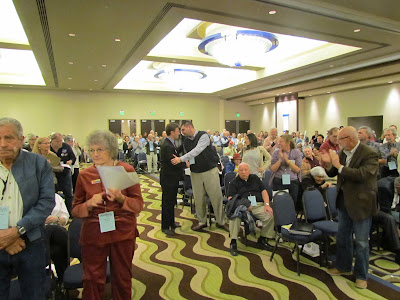

The race between Andrei and Rodney Glassman was a close one, but after the votes were counted, they shook hands and pledged to work for the best future for Arizona and the Arizona Democratic Party.

Friday, January 21, 2011
Keith Olbermann out at MSNBC
From Huffington Post -
Later...
Keith Olbermann and MSNBC have ended their contract, according to a statement from MSNBC. The last episode of "Countdown" will air this evening, Friday, January 21.This news is a little stunning, yet it isn't entirely surprising, given Comcast's recent takeover of MSNBC. Guesses are that Rachel Maddow is next, but we'll see what happens in the coming days and weeks.
MSNBC's statement reads as follows:
MSNBC and Keith Olbermann have ended their contract. The last broadcast of "Countdown with Keith Olbermann" will be this evening. MSNBC thanks Keith for his integral role in MSNBC's success and we wish him well in his future endeavors.
Later...
Arizona Democratic Party chair race: time to close ranks and unite
As most observers have probably already noted, I don't often write about the inner workings of the Arizona Democratic Party (or the Arizona Republican Party, for that matter), mostly because most readers find that kind of "inside baseball" stuff really boring.
Either they're insiders and know this stuff already, or they're not insiders and they don't care about it in the first place.
However, the current jockeying for the chairmanship of the Arizona Democratic Party has made it into the MSM, so the whole thing merits a temporary waiving of my personal policy in this regard.
Every two years, political parties in Arizona reorganize, choosing new leaders for the next election cycle, and that's where the Democrats and Republicans are right now, heading into Saturday's meetings of their respective State Committees.
I'll leave it to the various Republican bloggers to "discuss" what's going on in their party; suffice it to say that anyone that they choose to lead them for the next two years is someone that I'm going to disagree with, on pretty much all significant issues.
Two candidates for ADP chair have emerged - Rodney Glassman, the former Tucson City Council member and 2010 Democratic nominee for U.S. Senate, and Andrei Cherny, the former White House staffer, Assistant Arizona Attorney General, and 2010 Democratic nominee for Arizona Treasurer.
Various pro and con factions have formed, and the "jockeying" has involved more than a few elbows being thrown. The level of rancor has risen to the point where an email went out yesterday, signed by former Attorney General Terry Goddard and current Congressman Raul Grijalva, urging a one month delay in electing a new slate of officers.
I'm not sure I agree with that idea, but I undertstand it. Discussion has become rancorous, and a lot of people are still reeling from the shootings in Tucson two weeks ago. A month's delay may give time for everyone to calm down and to heal a little.
However, putting this off for a month may also give time for the current disagreements to grow into outright rifts.
As a member of the ADP's State Committee, I can state unequivocally that we've been buried in emails trumpeting this or that endorsement, and many of us are getting sick of the noise.
It's time to settle the matter, and regardless of how the votes tally, unite behind the new chair, whoever that might be.
Full disclosure time: As a State Committee member, I will be voting tomorrow, and for a number of reasons, have decided to support Andrei Cherny. He isn't a perfect candidate, but he is a *good* candidate, and even more importantly, he is the *better* candidate.
I've met both candidates, but don't know either one well, so I've relied on the impressions of friends of mine who do know one, the other, or both personally.
Everyone that I've spoken to has been impressed by Andrei's intellect and energy. Everyone that I've spoken to about Rodney, especially the ones who worked on his campaign, are less complimentary of him.
Also impressive was Andrei's performance in a low-profile, downballot race.
Many folks have focused on the ability to raise money, and to be sure, that is a very important ability in a state chair (and one that favors Cherny).
However, an even bigger part of a state chair's job is the ability to reach people, and Andrei did that almost 686K times, including winning his race in Pima County with over 151K votes. Rodney also ran statewide, and received 592K votes. He lost Pima County, receiving only 134K votes there.
Not only was that loss in Pima the first loss in a significant statewide race for a D in years, Pima is Rodney's home county.
He couldn't even reach the people who know him best in an area that tends to vote for Democrats.
That doesn't bode well for what will happen if he is elected state chair.
I like Rodney, based on the few contacts that I've had with him, and I like a lot of his supporters, a few of whom are friends, but on this matter, I am in disagreement with those friends.
I fervently hope that regardless of how the vote goes tomorrow, all of the state's Democrats, friends and strangers alike, will be able to cast their differences aside and unite behind the new chair.
See you tomorrow at the Wyndham, BYOP*.
* - Bring Your Own Popcorn :))
Either they're insiders and know this stuff already, or they're not insiders and they don't care about it in the first place.
However, the current jockeying for the chairmanship of the Arizona Democratic Party has made it into the MSM, so the whole thing merits a temporary waiving of my personal policy in this regard.
Every two years, political parties in Arizona reorganize, choosing new leaders for the next election cycle, and that's where the Democrats and Republicans are right now, heading into Saturday's meetings of their respective State Committees.
I'll leave it to the various Republican bloggers to "discuss" what's going on in their party; suffice it to say that anyone that they choose to lead them for the next two years is someone that I'm going to disagree with, on pretty much all significant issues.
Two candidates for ADP chair have emerged - Rodney Glassman, the former Tucson City Council member and 2010 Democratic nominee for U.S. Senate, and Andrei Cherny, the former White House staffer, Assistant Arizona Attorney General, and 2010 Democratic nominee for Arizona Treasurer.
Various pro and con factions have formed, and the "jockeying" has involved more than a few elbows being thrown. The level of rancor has risen to the point where an email went out yesterday, signed by former Attorney General Terry Goddard and current Congressman Raul Grijalva, urging a one month delay in electing a new slate of officers.
I'm not sure I agree with that idea, but I undertstand it. Discussion has become rancorous, and a lot of people are still reeling from the shootings in Tucson two weeks ago. A month's delay may give time for everyone to calm down and to heal a little.
However, putting this off for a month may also give time for the current disagreements to grow into outright rifts.
As a member of the ADP's State Committee, I can state unequivocally that we've been buried in emails trumpeting this or that endorsement, and many of us are getting sick of the noise.
It's time to settle the matter, and regardless of how the votes tally, unite behind the new chair, whoever that might be.
Full disclosure time: As a State Committee member, I will be voting tomorrow, and for a number of reasons, have decided to support Andrei Cherny. He isn't a perfect candidate, but he is a *good* candidate, and even more importantly, he is the *better* candidate.
I've met both candidates, but don't know either one well, so I've relied on the impressions of friends of mine who do know one, the other, or both personally.
Everyone that I've spoken to has been impressed by Andrei's intellect and energy. Everyone that I've spoken to about Rodney, especially the ones who worked on his campaign, are less complimentary of him.
Also impressive was Andrei's performance in a low-profile, downballot race.
Many folks have focused on the ability to raise money, and to be sure, that is a very important ability in a state chair (and one that favors Cherny).
However, an even bigger part of a state chair's job is the ability to reach people, and Andrei did that almost 686K times, including winning his race in Pima County with over 151K votes. Rodney also ran statewide, and received 592K votes. He lost Pima County, receiving only 134K votes there.
Not only was that loss in Pima the first loss in a significant statewide race for a D in years, Pima is Rodney's home county.
He couldn't even reach the people who know him best in an area that tends to vote for Democrats.
That doesn't bode well for what will happen if he is elected state chair.
I like Rodney, based on the few contacts that I've had with him, and I like a lot of his supporters, a few of whom are friends, but on this matter, I am in disagreement with those friends.
I fervently hope that regardless of how the vote goes tomorrow, all of the state's Democrats, friends and strangers alike, will be able to cast their differences aside and unite behind the new chair.
See you tomorrow at the Wyndham, BYOP*.
* - Bring Your Own Popcorn :))
Redistricting Update: Two Republican replacement nominees selected
The Arizona Commission on Appellate Court Appointments selected Republicans Crystal Russell and Richard Stertz to replace two other Republicans who had been found ineligible for membership on the Arizona Independent Redistricting Commission (AIRC).
The Commission, per its legal duties, had forwarded the names or 10 Republicans, 10 Democrats, and 5 Independent applicants to the AIRC. From that list, the leader of each caucus in each chamber will select one person to serve on the AIRC. The four members so selected will then choose a fifth member from the list of Independents to act as chair of the AIRC (there are other possible variations based on the possiblity that one of the legislators could select someone not of their own party, but most observers consider that to be unlikely).
House Speaker Kirk Adams (R) and Senate President Russell Pearce (R) filed suit over the original list, claiming that three of the 25 names weren't eligible because they held public office. Republicans Stephen Sossaman and Mark Schnepf were/are on irrigation district governing boards and Independent Paul Bender has served as a judge on a couple of tribal courts. Many observers felt that Sossaman and Schnepf were "thrown under the bus" in order to mask the partisan nature of the attack on Bender's qualifications. Bender is a law professor at ASU and a noted progressive. He's also widely considered, even by his detractors, to be brilliant.
The Supreme Court agreed with Pearce and Adams regarding Sossaman and Schnepf, but found that Bender's offices with the courts of sovereign tribal nations didn't qualify as "public offices" under Arizona law.
The meeting went along pretty efficiently. After some brief opening remarks, they immediately and unanimously decided to consider only the five applicants who were interviewed by the Commission but hadn't made it on to the original list of names sent to the leadership of the legislature.
There was concern expressed over the lack of geographic diversity among the nominees, and while the members of the Commission felt that they didn't do anything improper with the formation of the original list, the issue of geographic diversity was clearly on their minds as they proceeded.
After a motion to nominate Russell and Christopher Gleason as the two replacements, the Commission briefly went into executive session to discuss some legal advice.
After that session, the motion was amended to separate the nominations.
Russell was approved unanimously. After discussion over the nature of some of Gleason's political ties, he was nominated. His nomination failed by a 4 - 8 vote.
After that vote, Jeffrey Miller was nominated. His nomination failed, also by a 4 - 8 vote.
The next name considered was Stertz, and his nomination passed by an 11 - 1 vote.
Chief Justice Rebecca White Berch thanked the Commission members for gathering together on such short notice and adjourned the meeting, less than an hour after it began.
Now, let the four-way chess match begin, and a chess match it will be because each selection by a leader of the legislature will constrain the selections that follow.
Later...
The Commission, per its legal duties, had forwarded the names or 10 Republicans, 10 Democrats, and 5 Independent applicants to the AIRC. From that list, the leader of each caucus in each chamber will select one person to serve on the AIRC. The four members so selected will then choose a fifth member from the list of Independents to act as chair of the AIRC (there are other possible variations based on the possiblity that one of the legislators could select someone not of their own party, but most observers consider that to be unlikely).
House Speaker Kirk Adams (R) and Senate President Russell Pearce (R) filed suit over the original list, claiming that three of the 25 names weren't eligible because they held public office. Republicans Stephen Sossaman and Mark Schnepf were/are on irrigation district governing boards and Independent Paul Bender has served as a judge on a couple of tribal courts. Many observers felt that Sossaman and Schnepf were "thrown under the bus" in order to mask the partisan nature of the attack on Bender's qualifications. Bender is a law professor at ASU and a noted progressive. He's also widely considered, even by his detractors, to be brilliant.
The Supreme Court agreed with Pearce and Adams regarding Sossaman and Schnepf, but found that Bender's offices with the courts of sovereign tribal nations didn't qualify as "public offices" under Arizona law.
The meeting went along pretty efficiently. After some brief opening remarks, they immediately and unanimously decided to consider only the five applicants who were interviewed by the Commission but hadn't made it on to the original list of names sent to the leadership of the legislature.
There was concern expressed over the lack of geographic diversity among the nominees, and while the members of the Commission felt that they didn't do anything improper with the formation of the original list, the issue of geographic diversity was clearly on their minds as they proceeded.
After a motion to nominate Russell and Christopher Gleason as the two replacements, the Commission briefly went into executive session to discuss some legal advice.
After that session, the motion was amended to separate the nominations.
Russell was approved unanimously. After discussion over the nature of some of Gleason's political ties, he was nominated. His nomination failed by a 4 - 8 vote.
After that vote, Jeffrey Miller was nominated. His nomination failed, also by a 4 - 8 vote.
The next name considered was Stertz, and his nomination passed by an 11 - 1 vote.
Chief Justice Rebecca White Berch thanked the Commission members for gathering together on such short notice and adjourned the meeting, less than an hour after it began.
Now, let the four-way chess match begin, and a chess match it will be because each selection by a leader of the legislature will constrain the selections that follow.
Later...
Thursday, January 20, 2011
R response to the furor over legislators illegally carrying guns at the legislature: Make it legal
One of the interesting tidbits arising from the opening of the legislature last week was the story of a number of legislators carrying firearms with them on the floors of each chamber. One of them, Sen. Lori Klein, later confirmed to me (and others) that she had a gun with her both in the Senate and in the House when she attended the Governor's speech that day.
While some might attribute this turn of events to the recent shooting in Tucson, where six people were killed and more than another dozen were wounded, including Congresswoman Gabrielle Giffords, but a gunman who attacked a "Congress On Your Corner" gathering, this is hardly the first time in recent memory that a legislator has bragged about "packin' heat" at the Capitol, usually followed a by a statement in a belief that legislators are exempt from the law.
Anyway, after the shootings and the p.r. mess that was the opening of the legislature, the Republicans resisted any efforts to pass sensible firearms safety laws, preferring instead to maintain their embrace of the gun fetishists.
And now, they've doubled down on the insanity.
Sen. Ron Gould has introduced, with "luminaries" such as Sen. Russell Pearce, Sen. Rick Murphy, Rep. Carl Seel, Rep. Jack Harper, and others signed on as sponsors/cosponsors, SB1201.
It's rather innocuously labelled "firearms omnibus," but it is anything but innocuous.
If enacted, it would -
- Remove the section of the law (ARS 13-3102) that makes entering a goverment building while possessing a firearm a crime
- Changes the section of the law (ARS 13-3107) regarding the unlawful discharge of firearms by replacing "with criminal negligence" to "knowing" in the definition
- Removes the provision in the same section as above that allows local police chiefs to evaluate and set policy in "hunting areas" within their jurisdiction
- Changes the law (ARS 13-3108) to disallow the state or any of its agencies from enacting a "rule or ordinance" relating to firearms, with certain exceptions, and GREATLY restricts those exceptions
People in other parts of the country hear talk about the "nuts" in Arizona, and they think we are talking only about people like Jared Loughner.
They have no clue about the cultural insanity here that enables people like Loughner.
Given the timing of this, as in how long it takes to get a bill idea through the Legislative Council and turned into an actual bill, did Gould et. al. even wait for the end of the funerals in Tucson before spawning this abomination?
While some might attribute this turn of events to the recent shooting in Tucson, where six people were killed and more than another dozen were wounded, including Congresswoman Gabrielle Giffords, but a gunman who attacked a "Congress On Your Corner" gathering, this is hardly the first time in recent memory that a legislator has bragged about "packin' heat" at the Capitol, usually followed a by a statement in a belief that legislators are exempt from the law.
Anyway, after the shootings and the p.r. mess that was the opening of the legislature, the Republicans resisted any efforts to pass sensible firearms safety laws, preferring instead to maintain their embrace of the gun fetishists.
And now, they've doubled down on the insanity.
Sen. Ron Gould has introduced, with "luminaries" such as Sen. Russell Pearce, Sen. Rick Murphy, Rep. Carl Seel, Rep. Jack Harper, and others signed on as sponsors/cosponsors, SB1201.
It's rather innocuously labelled "firearms omnibus," but it is anything but innocuous.
If enacted, it would -
- Remove the section of the law (ARS 13-3102) that makes entering a goverment building while possessing a firearm a crime
- Changes the section of the law (ARS 13-3107) regarding the unlawful discharge of firearms by replacing "with criminal negligence" to "knowing" in the definition
- Removes the provision in the same section as above that allows local police chiefs to evaluate and set policy in "hunting areas" within their jurisdiction
- Changes the law (ARS 13-3108) to disallow the state or any of its agencies from enacting a "rule or ordinance" relating to firearms, with certain exceptions, and GREATLY restricts those exceptions
People in other parts of the country hear talk about the "nuts" in Arizona, and they think we are talking only about people like Jared Loughner.
They have no clue about the cultural insanity here that enables people like Loughner.
Given the timing of this, as in how long it takes to get a bill idea through the Legislative Council and turned into an actual bill, did Gould et. al. even wait for the end of the funerals in Tucson before spawning this abomination?
Redistricting update: Friday meeting to select two more Republican nominees for the Independent Redistricting Commission
From the just-released meeting notice for the Arizona Commission on Appellate Court Appointments, the group that screens the applicants for the Arizona Independent Redistricting Commission (AIRC) -
Later...
NOTICE OF EMERGENCY MEETINGNote: The chair of the Appellate Court Appointments Commission is Chief Justice Rebecca White Berch, and historically, when one of her meetings has a specified start time, she starts the meeting at that time. If you plan on attending, be in your seat by 11:29 a.m. or you will miss something significant.
The Commission on Appellate Court Appointments will hold an emergency meeting at 11:30 a.m. on January 21, 2011, to identify two eligible individuals from the Republican candidates for nomination to the Independent Redistricting Commission, as ordered by the Arizona Supreme Court in its Order filed January 19, 2011, in No. CV-10-0405-SA.
The meeting is open to the public. Citizens may address the commission at 11:30 a.m. on January 21, 2011. Public comment cannot be accepted after the 11:30 a.m. hearing on January 21. The meeting will be held in Phoenix in Room 345 of the Arizona State Courts Building, 1501 West Washington.
The agenda may be obtained from the Human Resources Division, Administrative Office of the Courts, 1501 West Washington, Suite 221, Phoenix, Arizona, 85007; by calling (602) 452-3311; or at the Commission=s website at http://www.arizona-redistrictingnominations.com/.
Later...
David Schweikert's vote to repeal health care reform: Impacts on his "constituents"
Yesterday, the U.S. House of Representatives passed H.R. 2, a bill to repeal last year's health care reform legislation, by a vote of 245 - 189. All Republicans, including AZCD5's David Schweikert, voted in favor of the bill.
The bill, the debate, and the vote were a triumph of ideology over reality, because if health care reform is repealed, it will increase the federal deficit and harm people all over the country, including thousands here in CD5.
From the Minority Staff of the House Committee on Energy and Commerce -
The bill, the debate, and the vote were a triumph of ideology over reality, because if health care reform is repealed, it will increase the federal deficit and harm people all over the country, including thousands here in CD5.
From the Minority Staff of the House Committee on Energy and Commerce -
This analysis describes the impact of repeal of the Affordable Care Act in the 5th Congressional District of Arizona, which is represented by Rep. David Schweikert. It finds that repeal of the health reform law would have significant consequences in the district by:Of course, while Schweikert has enthusiastically worked to reduce his constituents and their families' access to health care, he has no problem accepting taxpayer-funded healthcare coverage for himself and his family, nor does he have a problem with shielding from public scrutiny the members of his own caucus who have done the same.
Allowing insurance companies to deny coverage to 122,000 to 320,000 individuals, including 8,000 to 36,000 children, with pre-existing conditions.
Rescinding consumer protections for 469,000 individuals who have health insurance through their employer or the market for private insurance.
Eliminating health care tax credits for up to 15,700 small businesses and 143,000 families.
Increasing prescription drug costs for 10,100 seniors who hit the Part D drug “donut hole” and denying new preventive care benefits to 84,000 seniors.
Increasing the costs of early retiree coverage for up to 11,600 early retirees.
Eliminating new health care coverage options for 4,000 uninsured young adults.
Increasing the number of people without health insurance by 43,000 individuals.
Increasing the costs to hospitals of providing uncompensated care by $50 million annually.
Repeal of Protections Against Insurance Company Abuses
Repeal would eliminate the ban on discrimination on the basis of pre-existing conditions. Under the health reform law, insurance companies can no longer deny coverage to children with pre-existing conditions and will be banned from discriminating against adults with pre-existing conditions in 2014. There are 122,000 to 320,000 residents in Rep. Schweikert’s district with pre-existing conditions like diabetes, heart disease, or cancer, including 8,000 to 36,000 children. Repeal would allow insurance companies to refuse to insure these individuals if they seek coverage in the individual or small-group markets. The consequences would be particularly acute for the 18,000 to 48,000 individuals in the district who currently lack insurance coverage and who would be unable to purchase individual policies if the law is repealed.
Repeal would eliminate the ban on annual and lifetime limits. The health reform law prohibits insurance companies from imposing annual and lifetime limits on health insurance coverage. This provision protects the rights of everyone who receives coverage from their employer or through the market for private insurance. If this protection is repealed, insurers would be able to impose coverage limits on 469,000 individuals in the district with employer or private coverage.
Repeal would eliminate the ban on rescissions. The health reform law prohibits insurers from rescinding coverage for individuals who become ill. Repeal would allow insurance companies to resume the practice of rescinding coverage for the 48,000 district residents who purchase individual health insurance.
Repeal would eliminate other consumer protections. The health reform law protects individuals from soaring insurance costs by requiring reviews of proposed rate increases and limiting the amount insurance companies can spend on administrative expenses, profits, and other overhead. Repeal would deny these new protections to tens of thousands of district residents who either buy their own insurance or receive coverage through employers who do not self-insure.
Repeal of Benefits for Individuals and Families
Repeal would eliminate the requirement that insurance companies provide free preventive care. The health reform law promotes wellness by requiring insurance companies to offer free preventive care as part of any new or revised policies they issue after September 23, 2010. Repeal would allow insurance companies to charge for these essential benefits, which would increase out-of-pocket costs for 98,000 district residents.
Repeal would eliminate health insurance options for young adults. The health reform law allows young adults to remain on their parents’ insurance policies up to age 26. In Rep. Schweikert’s district, 4,000 young adults have or are expected to take advantage of this benefit. Repeal would force these young adults to find other coverage or return to the ranks of the uninsured.
Repeal would eliminate tax credits for buying health insurance. Starting in 2014, the health reform law gives middle class families the largest tax cut for health care in history, providing tax credits to buy coverage for families with incomes up to $88,000 for a family of four. Repeal would deny these credits to 143,000 families in the district.
Repeal would increase the number of uninsured. When fully implemented, the health reform law will extend coverage to 94% of all Americans. If this level of coverage is reached in the district, 43,000 residents who currently do not have health insurance will receive coverage. Repeal would mean these residents would lose their health insurance.
Repeal of Benefits for Seniors
Repeal would increase drug costs for seniors. Beginning in 2011, the health reform law provides a 50% discount for prescription drugs for Medicare beneficiaries who enter the Medicare Part D “donut hole” and lose coverage for their drug expenses. The law then increases the discount to Medicare beneficiaries each year until 2020, when the donut hole is finally eliminated. There are 10,100 Medicare beneficiaries in Rep. Schweikert’s district who are expected to benefit from these provisions. Repeal would increase the average cost of prescription drugs for these Medicare beneficiaries by over $500 in 2011 and by over $3,000 in 2020.
Repeal would deny seniors new preventive care and other benefits. The health reform law improves Medicare by providing free preventive and wellness care, improving primary and coordinated care, and enhancing nursing home care. The law also strengthens the Medicare trust fund, extending its solvency from 2017 to 2029. Repeal would eliminate these benefits for 84,000 Medicare beneficiaries in the district and cause the Medicare trust fund to become insolvent in just six years.
Repeal of Benefits for Small and Large Businesses and Health Care Providers
Repeal would eliminate tax credits for small businesses. The health reform law provides tax credits to small businesses worth up to 35% of the cost of providing health insurance. There are up to 15,700 small businesses in Rep. Schweikert’s district that are eligible for this tax credit. Repeal would force these small businesses to drop coverage or bear the full costs of coverage themselves.
Repeal would increase retiree health care costs for employers. The health reform law provides funding to encourage employers to continue to provide health insurance for their retirees. As many as 11,600 district residents who have retired but are not yet eligible for Medicare could ultimately benefit from this early retiree assistance. Repeal would increase costs for employers and jeopardize the coverage their retirees are receiving.
Repeal would increase the cost of uncompensated care born by hospitals. The health reform law benefits hospitals by covering more Americans and thereby reducing the cost of providing care to the uninsured. Repeal would undo this benefit, increasing the cost of uncompensated care by $50 million annually for hospitals in the district.
Repeal of Benefits for Taxpayers
Repeal would increase the long-term debt by over $1 trillion. The health reform law reduces the nation’s debt by eliminating waste, fraud, and abuse in the health care system, reducing the growth of health care costs, and preventing excessive profit-taking by private insurers. According to the Congressional Budget Office, the bill will reduce the deficit by over $200 billion over the next ten years and by over a trillion dollars in the decade after that. Repeal would eliminate these cost-cutting measures, adding more than $3,000 to the national debt for each American, including the 680,000 residents of the district.
Wednesday, January 19, 2011
Special session: they've got this train running at full speed
...and they're aiming at the state's most vulnerable residents...
Wednesday afternoon, the Arizona Legislature convened a special session in order to pass bills related to Governor Jan Brewer's plan to kick 280,000 people off of AHCCCS.
The first order of business was to declare an "emergency" and suspend the rules related to things like public notice of committee agendas and time requirements.
Under normal conditions, it takes at least three days minimum to pass a bill. However, with the rules suspended, bills can be passed in one day. However, they're taking two for this special session.
Matching bills were "read" ("introduced") in each chamber of the legislature today and went through committee hearings in both chambers.
The bills are SB1001 and HB2001.
The bills will pass, one will be substituted for the other (a parliamentary procedure to speed up the process) and will be forwarded to the Governor, who will then have permission to ask the feds for an eligibility waiver to cut the number of people on AHCCCS.
The expectation around the Capitol is that the feds will say "NO!" but even in the unlikely event that federal permission is forthcoming, with voter approval of 2000's Prop 204 (setting eligibility at 100% of the federal poverty level), the legislature cannot adjust AHCCCS eligibility without voter approval.
Bills, HCR2001 and HCR2002, were introduced to amend the Arizona Constitution to bar the voters from ever expanding AHCCCS coverage again. If either was passed, it would have mandated a special election on May 17, 2011.
Both were introduced by Rep. Jack Harper (R-Surprise!), but neither one was heard in committee, so they are probably dead for now.
Other bills that were introduced for the special session but not heard in committee -
HB2002 (Harper) and SB1002 (Schapira, Sinema, Tovar) would have changed what sort of organ transplants are covered by AHCCCS. Republican Harper's bill would have made the change conditional upon voter approval of his amendment to the AZ Constitution; the bill proposed by Democrats Schapira, Sinema, and Tovar has no such conditional enactment clause, but did include an emergency clause for immediate enactment.
Sinema also introduced SB1003 and SB1004. SB1003 was basically the same as SB1002, while SB1004 would have repealed a specific tax credit and directed the revenue toward paying for AHCCCS transplants.
This special session should be over by around 2:30 p.m. on Thursday, just in time for the legislators to head home for the weekend on their normal schedule.
The other bills...OK, the amendment to the AZ Constitution/special election...can wait until a later special session if the feds throw everyone a curveball and actually give the Governor permission to kick the poorest Arizonans off of AHCCCS. The word is that another special session will be called by the end of the month, one relating to tax cuts for business, masquerading as "economic development."
Stay tuned...
Wednesday afternoon, the Arizona Legislature convened a special session in order to pass bills related to Governor Jan Brewer's plan to kick 280,000 people off of AHCCCS.
The first order of business was to declare an "emergency" and suspend the rules related to things like public notice of committee agendas and time requirements.
Under normal conditions, it takes at least three days minimum to pass a bill. However, with the rules suspended, bills can be passed in one day. However, they're taking two for this special session.
Matching bills were "read" ("introduced") in each chamber of the legislature today and went through committee hearings in both chambers.
The bills are SB1001 and HB2001.
The bills will pass, one will be substituted for the other (a parliamentary procedure to speed up the process) and will be forwarded to the Governor, who will then have permission to ask the feds for an eligibility waiver to cut the number of people on AHCCCS.
The expectation around the Capitol is that the feds will say "NO!" but even in the unlikely event that federal permission is forthcoming, with voter approval of 2000's Prop 204 (setting eligibility at 100% of the federal poverty level), the legislature cannot adjust AHCCCS eligibility without voter approval.
Bills, HCR2001 and HCR2002, were introduced to amend the Arizona Constitution to bar the voters from ever expanding AHCCCS coverage again. If either was passed, it would have mandated a special election on May 17, 2011.
Both were introduced by Rep. Jack Harper (R-Surprise!), but neither one was heard in committee, so they are probably dead for now.
Other bills that were introduced for the special session but not heard in committee -
HB2002 (Harper) and SB1002 (Schapira, Sinema, Tovar) would have changed what sort of organ transplants are covered by AHCCCS. Republican Harper's bill would have made the change conditional upon voter approval of his amendment to the AZ Constitution; the bill proposed by Democrats Schapira, Sinema, and Tovar has no such conditional enactment clause, but did include an emergency clause for immediate enactment.
Sinema also introduced SB1003 and SB1004. SB1003 was basically the same as SB1002, while SB1004 would have repealed a specific tax credit and directed the revenue toward paying for AHCCCS transplants.
This special session should be over by around 2:30 p.m. on Thursday, just in time for the legislators to head home for the weekend on their normal schedule.
The other bills...OK, the amendment to the AZ Constitution/special election...can wait until a later special session if the feds throw everyone a curveball and actually give the Governor permission to kick the poorest Arizonans off of AHCCCS. The word is that another special session will be called by the end of the month, one relating to tax cuts for business, masquerading as "economic development."
Stay tuned...
Subscribe to:
Posts (Atom)