Wednesday, July 24, 2013
President Obama Speaks on the Economy
Transcript of the speech, courtesy the White House -
THE PRESIDENT: Hello, Galesburg! (Applause.) Well, it’s good to be home in Illinois! (Applause.) It is good to be back. It’s good to be back. Thank you. Thank you so much, everybody. (Applause.) Thank you. Everybody, have a seat, have a seat. Well, it is good to be back.
I want to, first of all, thank Knox College -- (applause) -- I want to thank Knox College and your president, Teresa Amott, for having me here today. Give Teresa a big round of applause. (Applause.) I want to thank your Congresswoman, Cheri Bustos, who’s here. (Applause.) We've got Governor Quinn here. (Applause.) I'm told we've got your Lieutenant Governor, Sheila Simon, is here. (Applause.) There she is. Attorney General Lisa Madigan is here. (Applause.)
I see a bunch of my former colleagues, some folks who I haven't seen in years and I'm looking forward to saying hi to. One in particular I've got to mention, one of my favorites from the Illinois Senate -- John Sullivan is in the house. (Applause.) John was one of my earliest supporters when I was running for the U.S. Senate, and it came in really handy because he’s got, like, 10 brothers and sisters, and his wife has got 10 brothers and sisters -- (laughter) -- so they’ve got this entire precinct just in their family. (Laughter.) And they all look like John -- the brothers do -- so he doesn’t have to go to every event. He can just send one of his brothers out. (Laughter.) It is good to see him.
Dick Durbin couldn’t make it today, but he sends his best. And we love Dick. (Applause.) He’s doing a great job. And we’ve got one of my favorite neighbors, the Senator from Missouri, Claire McCaskill, in the house, because we’re going to Missouri later this afternoon. (Applause.)
And all of you are here, and it’s great to see you. (Applause.) And I hope everybody is having a wonderful summer. The weather is perfect. Whoever was in charge of that, good job. (Laughter.)
So, eight years ago, I came here to deliver the commencement address for the class of 2005. Things were a little different back then. For example, I had no gray hair -- (laughter) -- or a motorcade. Didn’t even have a prompter. In fact, there was a problem in terms of printing out the speech because the printer didn’t work here and we had to drive it in from somewhere. (Laughter.) But it was my first big speech as your newest senator.
And on the way here I was telling Cheri and Claire about how important this area was, one of the areas that I spent the most time in outside of Chicago, and how much it represented what’s best in America and folks who were willing to work hard and do right by their families. And I came here to talk about what a changing economy was doing to the middle class -- and what we, as a country, needed to do to give every American a chance to get ahead in the 21st century.
See, I had just spent a year traveling the state and listening to your stories -- of proud Maytag workers losing their jobs when the plant moved down to Mexico. (Applause.) A lot of folks here remember that. Of teachers whose salaries weren’t keeping up with the rising cost of groceries. (Applause.) Of young people who had the drive and the energy, but not the money to afford a college education. (Applause.)
So these were stories of families who had worked hard, believed in the American Dream, but they felt like the odds were increasingly stacked against them. And they were right. Things had changed.
In the period after World War II, a growing middle class was the engine of our prosperity. Whether you owned a company, or swept its floors, or worked anywhere in between, this country offered you a basic bargain -- a sense that your hard work would be rewarded with fair wages and decent benefits, the chance to buy a home, to save for retirement, and most of all, a chance to hand down a better life for your kids.
But over time, that engine began to stall -- and a lot of folks here saw it -- that bargain began to fray. Technology made some jobs obsolete. Global competition sent a lot of jobs overseas. It became harder for unions to fight for the middle class. Washington doled out bigger tax cuts to the very wealthy and smaller minimum wage increases for the working poor.
And so what happened was that the link between higher productivity and people’s wages and salaries was broken. It used to be that, as companies did better, as profits went higher, workers also got a better deal. And that started changing. So the income of the top 1 percent nearly quadrupled from 1979 to 2007, but the typical family’s incomes barely budged.
And towards the end of those three decades, a housing bubble, credit cards, a churning financial sector was keeping the economy artificially juiced up, so sometimes it papered over some of these long-term trends. But by the time I took office in 2009 as your President, we all know the bubble had burst, and it cost millions of Americans their jobs, and their homes, and their savings. And I know a lot of folks in this area were hurt pretty bad. And the decades-long erosion that had been taking place -- the erosion of middle-class security -- was suddenly laid bare for everybody to see.
Now, today, five years after the start of that Great Recession, America has fought its way back. (Applause.) We fought our way back. Together, we saved the auto industry; took on a broken health care system. (Applause.) We invested in new American technologies to reverse our addiction to foreign oil. We doubled wind and solar power. (Applause.) Together, we put in place tough new rules on the big banks, and protections to crack down on the worst practices of mortgage lenders and credit card companies. (Applause.) We changed a tax code too skewed in favor of the wealthiest at the expense of working families -- so we changed that, and we locked in tax cuts for 98 percent of Americans, and we asked those at the top to pay a little bit more. (Applause.)
So you add it all up, and over the past 40 months, our businesses have created 7.2 million new jobs. This year, we’re off to our strongest private sector job growth since 1999.
And because we bet on this country, suddenly foreign companies are, too. Right now, more of Honda’s cars are made in America than anyplace else on Earth. (Applause.) Airbus, the European aircraft company, they’re building new planes in Alabama. (Applause.) And American companies like Ford are replacing outsourcing with insourcing -- they’re bringing jobs back home. (Applause.)
We sell more products made in America to the rest of the world than ever before. We produce more natural gas than any country on Earth. We’re about to produce more of our own oil than we buy from abroad for the first time in nearly 20 years. (Applause.) The cost of health care is growing at its slowest rate in 50 years. (Applause.) And our deficits are falling at the fastest rate in 60 years. (Applause.)
So thanks to the grit and resilience and determination of the American people -- of folks like you -- we’ve been able to clear away the rubble from the financial crisis. We started to lay a new foundation for stronger, more durable economic growth. And it's happening in our own personal lives as well, right? A lot of us tightened our belts, shed debt, maybe cut up a couple of credit cards, refocused on those things that really matter.
As a country, we’ve recovered faster and gone further than most other advanced nations in the world. With new American revolutions in energy and technology and manufacturing and health care, we're actually poised to reverse the forces that battered the middle class for so long, and start building an economy where everyone who works hard can get ahead.
But -- and here's the big “but” -- I’m here to tell you today that we're not there yet. We all know that. We're not there yet. We've got more work to do. Even though our businesses are creating new jobs and have broken record profits, nearly all the income gains of the past 10 years have continued to flow to the top 1 percent. The average CEO has gotten a raise of nearly 40 percent since 2009. The average American earns less than he or she did in 1999. And companies continue to hold back on hiring those who’ve been out of work for some time.
Today, more students are earning their degree, but soaring costs saddle them with unsustainable debt. Health care costs are slowing down, but a lot of working families haven’t seen any of those savings yet. The stock market rebound helped a lot of families get back much of what they had lost in their 401(k)s, but millions of Americans still have no idea how they’re going to be able to retire.
So in many ways, the trends that I spoke about here in 2005 -- eight years ago -- the trend of a winner-take-all economy where a few are doing better and better and better, while everybody else just treads water -- those trends have been made worse by the recession. And that's a problem.
This growing inequality not just of result, inequality of opportunity -- this growing inequality is not just morally wrong, it’s bad economics. Because when middle-class families have less to spend, guess what, businesses have fewer consumers. When wealth concentrates at the very top, it can inflate unstable bubbles that threaten the economy. When the rungs on the ladder of opportunity grow farther and farther apart, it undermines the very essence of America -- that idea that if you work hard you can make it here.
And that’s why reversing these trends has to be Washington’s highest priority. (Applause.) It has to be Washington's highest priority. (Applause.) It’s certainly my highest priority. (Applause.)
Unfortunately, over the past couple of years, in particular, Washington hasn’t just ignored this problem; too often, Washington has made things worse. (Applause.)
And I have to say that -- because I'm looking around the room -- I've got some friends here not just who are Democrats, I've got some friends here who are Republicans -- (applause) -- and I worked with in the state legislature and they did great work. But right now, what we’ve got in Washington, we've seen a sizable group of Republican lawmakers suggest that they wouldn’t vote to pay the very bills that Congress rang up. And that fiasco harmed a fragile recovery in 2011 and we can't afford to repeat that.
Then, rather than reduce our deficits with a scalpel -- by cutting out programs we don’t need, fixing ones that we do need that maybe are in need of reform, making government more efficient -- instead of doing that, we've got folks who’ve insisted on leaving in place a meat cleaver called the sequester that's cost jobs. It's harmed growth. It's hurt our military. It's gutted investments in education and science and medical research. (Applause.)
Almost every credible economist will tell you it's been a huge drag on this recovery. And it means that we're underinvesting in the things that this country needs to make it a magnet for good jobs.
Then, over the last six months, this gridlock has gotten worse. I didn't think that was possible. (Laughter.) The good news is a growing number of Republican senators are looking to join their Democratic counterparts and try to get things done in the Senate. So that's good news. (Applause.) For example, they worked together on an immigration bill that economists say will boost our economy by more than a trillion dollars, strengthen border security, make the system work.
But you've got a faction of Republicans in the House who won’t even give that bill a vote. And that same group gutted a farm bill that America’s farmers depend on, but also America's most vulnerable children depend on.
AUDIENCE MEMBER: Booo --
THE PRESIDENT: And if you ask some of these folks, some of these folks mostly in the House, about their economic agenda how it is that they'll strengthen the middle class, they’ll shift the topic to “out-of-control government spending” –- despite the fact that we've cut the deficit by nearly half as a share of the economy since I took office. (Applause.)
Or they’ll talk about government assistance for the poor, despite the fact that they’ve already cut early education for vulnerable kids. They've already cut insurance for people who’ve lost their jobs through no fault of their own. Or they’ll bring up Obamacare -- this is tried and true -- despite the fact that our businesses have created nearly twice as many jobs in this recovery as businesses had at the same point in the last recovery when there was no Obamacare. (Applause.)
AUDIENCE MEMBER: My daughter has insurance now!
THE PRESIDENT: I appreciate that. (Applause.) That’s what this is about. That’s what this is about. (Applause.) That’s what we've been fighting for.
But with this endless parade of distractions and political posturing and phony scandals, Washington has taken its eye off the ball. And I am here to say this needs to stop. (Applause.) This needs to stop.
This moment does not require short-term thinking. It does not require having the same old stale debates. Our focus has to be on the basic economic issues that matter most to you, the people we represent. That’s what we have to spend our time on and our energy on and our focus on. (Applause.)
And as Washington prepares to enter another budget debate, the stakes for our middle class and everybody who is fighting to get into the middle class could not be higher. The countries that are passive in the face of a global economy, those countries will lose the competition for good jobs. They will lose the competition for high living standards. That’s why America has to make the investments necessary to promote long-term growth and shared prosperity -- rebuilding our manufacturing base, educating our workforce, upgrading our transportation systems, upgrading our information networks. (Applause.) That’s what we need to be talking about. That’s what Washington needs to be focused on.
And that’s why, over the next several weeks, in towns across this country, I will be engaging the American people in this debate. (Applause.) I'll lay out my ideas for how we build on the cornerstones of what it means to be middle class in America, and what it takes to work your way into the middle class in America: Job security, with good wages and durable industries. A good education. A home to call your own. Affordable health care when you get sick. (Applause.) A secure retirement even if you’re not rich. Reducing poverty. Reducing inequality. Growing opportunity. That’s what we need. (Applause.) That’s what we need. That’s what we need right now. That’s what we need to be focused on. (Applause.)
Now, some of these ideas I’ve talked about before. Some of the ideas I offer will be new. Some will require Congress. Some I will pursue on my own. (Applause.) Some ideas will benefit folks right away. Some will take years to fully implement. But the key is to break through the tendency in Washington to just bounce from crisis to crisis. What we need is not a three-month plan, or even a three-year plan; we need a long-term American strategy, based on steady, persistent effort, to reverse the forces that have conspired against the middle class for decades. That has to be our project. (Applause.)
Now, of course, we’ll keep pressing on other key priorities. I want to get this immigration bill done. We still need to work on reducing gun violence. (Applause.) We’ve got to continue to end the war in Afghanistan, rebalance our fight against al Qaeda. (Applause.) We need to combat climate change. We’ve got to standing up for civil rights. We’ve got to stand up for women’s rights. (Applause.)
So all those issues are important, and we’ll be fighting on every one of those issues. But if we don’t have a growing, thriving middle class then we won’t have the resources to solve a lot of these problems. We won’t have the resolve, the optimism, the sense of unity that we need to solve many of these other issues.
Now, in this effort, I will look to work with Republicans as well as Democrats wherever I can. And I sincerely believe that there are members of both parties who understand this moment, understand what’s at stake, and I will welcome ideas from anybody across the political spectrum. But I will not allow gridlock, or inaction, or willful indifference to get in our way. (Applause.)
That means whatever executive authority I have to help the middle class, I’ll use it. (Applause.) Where I can’t act on my own and Congress isn’t cooperating, I’ll pick up the phone -- I’ll call CEOs; I’ll call philanthropists; I’ll call college presidents; I’ll call labor leaders. I’ll call anybody who can help -- and enlist them in our efforts. (Applause.)
Because the choices that we, the people, make right now will determine whether or not every American has a fighting chance in the 21st century. And it will lay the foundation for our children’s future, our grandchildren’s future, for all Americans.
So let me give you a quick preview of what I’ll be fighting for and why. The first cornerstone of a strong, growing middle class has to be, as I said before, an economy that generates more good jobs in durable, growing industries. That's how this area was built. That's how America prospered. Because anybody who was willing to work, they could go out there and they could find themselves a job, and they could build a life for themselves and their family.
Now, over the past four years, for the first time since the 1990s, the number of American manufacturing jobs has actually gone up instead of down. That's the good news. (Applause.) But we can do more. So I’m going to push new initiatives to help more manufacturers bring more jobs back to the United States. (Applause.) We’re going to continue to focus on strategies to make sure our tax code rewards companies that are not shipping jobs overseas, but creating jobs right here in the United States of America. (Applause.)
We want to make sure that -- we’re going to create strategies to make sure that good jobs in wind and solar and natural gas that are lowering costs and, at the same time, reducing dangerous carbon pollution happen right here in the United States. (Applause.)
And something that Cheri and I were talking about on the way over here -- I’m going to be pushing to open more manufacturing innovation institutes that turn regions left behind by global competition into global centers of cutting-edge jobs. So let’s tell the world that America is open for business. (Applause.) I know there’s an old site right here in Galesburg, over on Monmouth Boulevard -- let’s put some folks to work. (Applause.)
Tomorrow, I’ll also visit the Port of Jacksonville, Florida to offer new ideas for doing what America has always done best, which is building things. Pat and I were talking before I came -- backstage -- Pat Quinn -- he was talking about how I came over the Don Moffitt Bridge. (Applause.) But we’ve got work to do all across the country. We’ve got ports that aren’t ready for the new supertankers that are going to begin passing through the new Panama Canal in two years’ time. If we don’t get that done, those tankers are going to go someplace else. We’ve got more than 100,000 bridges that are old enough to qualify for Medicare. (Laughter and applause.)
Businesses depend on our transportation systems, on our power grids, on our communications networks. And rebuilding them creates good-paying jobs right now that can’t be outsourced. (Applause.)
And by the way, this isn’t a Democratic idea. Republicans built a lot of stuff. This is the Land of Lincoln. Lincoln was all about building stuff -- first Republican President. (Applause.) And yet, as a share of our economy, we invest less in our infrastructure than we did two decades ago. And that’s inefficient at a time when it’s as cheap as it’s been since the 1950s to build things. It’s inexcusable at a time when so many of the workers who build stuff for a living are sitting at home waiting for a call.
The longer we put this off, the more expensive it will be and the less competitive we will be. Businesses of tomorrow will not locate near old roads and outdated ports. They’ll relocate to places with high-speed Internet, and high-tech schools, and systems that move air and auto traffic faster, and not to mention will get parents home quicker from work because we’ll be eliminating some of these traffic jams. And we can watch all of that happen in other countries, and start falling behind, or we can choose to make it happen right here, in the United States. (Applause.)
In an age when jobs know no borders, companies are also going to seek out the countries that boast the most talented citizens, and they’ll reward folks who have the skills and the talents they need -- they’ll reward those folks with good pay.
The days when the wages for a worker with a high school degree could keep pace with the earnings of somebody who got some sort of higher education -- those days are over. Everybody here knows that. There are a whole bunch of folks here whose dads or grandpas worked at a plant, didn’t need a high school education. You could just go there. If you were willing to work hard, you might be able to get two jobs. And you could support your family, have a vacation, own your home. But technology and global competition, they’re not going away. Those old days aren’t coming back.
So we can either throw up our hands and resign ourselves to diminishing living standards, or we can do what America has always done, which is adapt, and pull together, and fight back, and win. That’s what we have to do. (Applause.)
And that brings me to the second cornerstone of a strong middle class -- and everybody here knows it -- an education that prepares our children and our workers for the global competition that they’re going to face. (Applause.) And if you think education is expensive, wait until you see how much ignorance costs in the 21st century. (Laughter and applause.)
If we don’t make this investment, we’re going to put our kids, our workers, and our country at a competitive disadvantage for decades. So we have to begin in the earliest years. And that’s why I’m going to keep pushing to make high-quality preschool available for every 4-year-old in America. (Applause.) Not just because we know it works for our kids, but because it provides a vital support system for working parents.
And I’m going to take action in the education area to spur innovation that don’t require Congress. (Applause.) So, today, for example, as we speak, federal agencies are moving on my plan to connect 99 percent of America’s students to high-speed Internet over the next five years. We’re making that happen right now. (Applause.) We’ve already begun meeting with business leaders and tech entrepreneurs and innovative educators to identify the best ideas for redesigning our high schools so that they teach the skills required for a high-tech economy.
And we’re also going to keep pushing new efforts to train workers for changing jobs. So here in Galesburg, for example, a lot of the workers that were laid off at Maytag chose to enroll in retraining programs like the one at Carl Sandburg College. (Applause.) And while it didn’t pay off for everyone, a lot of the folks who were retrained found jobs that suited them even better and paid even more than the ones they had lost.
And that’s why I’ve asked Congress to start a Community College to Career initiative, so that workers can earn the skills that high-tech jobs demand without leaving their hometown. (Applause.) And I’m going to challenge CEOs from some of America’s best companies to hire more Americans who’ve got what it takes to fill that job opening but have been laid off for so long that nobody is giving their résumé an honest look.
AUDIENCE MEMBER: More talent!
THE PRESIDENT: That, too.
I’m also going to use the power of my office over the next few months to highlight a topic that’s straining the budgets of just about every American family -- and that’s the soaring cost of higher education. (Applause.) Everybody is touched by this, including your President, who had a whole bunch of loans he had to pay off. (Laughter.)
Three years ago, I worked with Democrats to reform the student loan system so that taxpayer dollars stopped padding the pockets of big banks, and instead helped more kids afford college. (Applause.) Then, I capped loan repayments at 10 percent of monthly incomes for responsible borrowers, so that if somebody graduated and they decided to take a teaching job, for example, that didn’t pay a lot of money, they knew that they were never going to have to pay more than 10 percent of their income and they could afford to go into a profession that they loved. That’s in place right now. (Applause.) And this week, we’re working with both parties to reverse the doubling of student loan rates that happened a few weeks ago because of congressional inaction. (Applause.)
So this is all a good start -- but it isn’t enough. Families and taxpayers can’t just keep paying more and more and more into an undisciplined system where costs just keep on going up and up and up. We’ll never have enough loan money, we’ll never have enough grant money, to keep up with costs that are going up 5, 6, 7 percent a year. We’ve got to get more out of what we pay for.
Now, some colleges are testing new approaches to shorten the path to a degree, or blending teaching with online learning to help students master material and earn credits in less time. In some states, they’re testing new ways to fund college based not just on how many students enroll, but how many of them graduate, how well did they do.
So this afternoon, I’ll visit the University of Central Missouri to highlight their efforts to deliver more bang for the buck to their students. And in the coming months, I will lay out an aggressive strategy to shake up the system, tackle rising costs, and improve value for middle-class students and their families. It is critical that we make sure that college is affordable for every single American who’s willing to work for it. (Applause.)
Now, so you’ve got a good job; you get a good education -- those have always been the key stepping stones into the middle class. But a home of your own has always been the clearest expression of middle-class security. For most families, that’s your biggest asset. For most families, that’s where your life’s work has been invested. And that changed during the crisis, when we saw millions of middle-class families experience their home values plummeting. The good news is over the past four years, we’ve helped more responsible homeowners stay in their homes. And today, sales are up and prices are up, and fewer Americans see their homes underwater.
But we’re not done yet. The key now is to encourage homeownership that isn’t based on unrealistic bubbles, but instead is based on a solid foundation, where buyers and lenders play by the same set of rules, rules that are clear and transparent and fair.
So already, I’ve asked Congress to pass a really good, bipartisan idea -- one that was championed, by the way, by Mitt Romney’s economic advisor -- and this is the idea to give every homeowner the chance to refinance their mortgage while rates are still low so they can save thousands of dollars a year. (Applause.) It will be like a tax cut for families who can refinance.
I’m also acting on my own to cut red tape for responsible families who want to get a mortgage but the bank is saying no. We’ll work with both parties to turn the page on Fannie Mae and Freddie Mac, and build a housing finance system that’s rock-solid for future generations.
So we’ve got more work to do to strengthen homeownership in this country. But along with homeownership, the fourth cornerstone of what it means to be middle class in this country is a secure retirement. (Applause.) I hear from too many people across the country, face to face or in letters that they send me, that they feel as if retirement is just receding from their grasp. It’s getting farther and farther away. They can't see it.
Now, today, a rising stock market has millions of retirement balances going up, and some of the losses that had taken place during the financial crisis have been recovered. But we still live with an upside-down system where those at the top, folks like me, get generous tax incentives to save, while tens of millions of hardworking Americans who are struggling, they get none of those breaks at all. So as we work to reform our tax code, we should find new ways to make it easier for workers to put away money, and free middle-class families from the fear that they won't be able to retire. (Applause.)
And if Congress is looking for a bipartisan place to get started, I should just say they don’t have to look far. We mentioned immigration reform before. Economists show that immigration reform makes undocumented workers pay their full share of taxes, and that actually shores up the Social Security system for years. So we should get that done. (Applause.)
Good job; good education for your kids; home of your own; secure retirement.
Fifth, I'm going to keep focusing on health care -- (applause) -- because middle-class families and small business owners deserve the security of knowing that neither an accident or an illness is going to threaten the dreams that you’ve worked a lifetime to build.
As we speak, we're well on our way to fully implementing the Affordable Care Act. (Applause.) We're going to implement it. Now, if you’re one of the 85 percent of Americans who already have health insurance either through the job or Medicare or Medicaid, you don’t have to do anything, but you do have new benefits and better protections than you did before. You may not know it, but you do. Free checkups, mammograms, discounted medicines if you're on Medicare -- that’s what the Affordable Care Act means. You're already getting a better deal. No lifetime limits.
If you don’t have health insurance, then starting on October 1st, private plans will actually compete for your business, and you'll be able to comparison-shop online. There will be a marketplace online, just like you’d buy a flat-screen TV or plane tickets or anything else you're doing online, and you'll be able to buy an insurance package that fits your budget and is right for you.
And if you're one of the up to half of all Americans who’ve been sick or have a preexisting condition -- if you look at this auditorium, about half of you probably have a preexisting condition that insurance companies could use to not give you insurance if you lost your job or lost your insurance -- well, this law means that beginning January 1st, insurance companies will finally have to cover you and charge you the same rates as everybody else, even if you have a preexisting condition. (Applause.) That’s what the Affordable Care Act does. That’s what it does. (Applause.)
Now, look, I know because I've been living it that there are folks out there who are actively working to make this law fail. And I don’t always understand exactly what their logic is here, why they think giving insurance to folks who don’t have it and making folks with insurance a little more secure, why they think that’s a bad thing. But despite the politically motivated misinformation campaign, the states that have committed themselves to making this law work are finding that competition and choice are actually pushing costs down.
So just last week, New York announced that premiums for consumers who buy their insurance in these online marketplaces will be at least 50 percent lower than what they're paying today -- 50 percent lower. (Applause.) So folks' premiums in the individual market will drop by 50 percent. And for them and for the millions of Americans who’ve been able to cover their sick kids for the first time -- like this gentlemen who just said his daughter has got health insurance -- or have been able to cover their employees more cheaply, or are able to have their kids who are younger than -- who are 25 or 26 stay on their parents' plan -- (applause) -- for all those folks, you'll have the security of knowing that everything you’ve worked hard for is no longer one illness away from being wiped out. (Applause.)
Finally, as we work to strengthen these cornerstones of middle-class security -- good job with decent wages and benefits, a good education, home of your own, retirement security, health care security -- I’m going to make the case for why we've got to rebuild ladders of opportunity for all those Americans who haven't quite made it yet -- who are working hard but are still suffering poverty wages, who are struggling to get full-time work. (Applause.)
There are a lot of folks who are still struggling out here, too many people in poverty. Here in America, we’ve never guaranteed success -- that's not what we do. More than some other countries, we expect people to be self-reliant. Nobody is going to do something for you. (Applause.) We've tolerated a little more inequality for the sake of a more dynamic, more adaptable economy. That's all for the good. But that idea has always been combined with a commitment to equality of opportunity to upward mobility -- the idea that no matter how poor you started, if you're willing to work hard and discipline yourself and defer gratification, you can make it, too. That's the American idea. (Applause.)
Unfortunately, opportunities for upward mobility in America have gotten harder to find over the past 30 years. And that’s a betrayal of the American idea. And that’s why we have to do a lot more to give every American the chance to work their way into the middle class.
The best defense against all of these forces -- global competition, economic polarization -- is the strength of the community. So we need a new push to rebuild rundown neighborhoods. (Applause.) We need new partnerships with some of the hardest-hit towns in America to get them back on their feet. And because no one who works full-time in America should have to live in poverty, I am going to keep making the case that we need to raise the minimum wage -- (applause) -- because it's lower right now than it was when Ronald Reagan took office. It's time for the minimum wage to go up. (Applause.)
We're not a people who allow chance of birth to decide life’s biggest winners or losers. And after years in which we’ve seen how easy it can be for any of us to fall on hard times -- folks in Galesburg, folks in the Quad Cities, you know there are good people who work hard and sometimes they get a bad break. A plant leaves. Somebody gets sick. Somebody loses a home. We've seen it in our family, in our friends and our neighbors. We've seen it happen. And that means we cannot turn our backs when bad breaks hit any of our fellow citizens.
So good jobs; a better bargain for the middle class and the folks who are working to get into the middle class; an economy that grows from the middle out, not the top down -- that's where I will focus my energies. (Applause.) That's where I will focus my energies not just for the next few months, but for the remainder of my presidency.
These are the plans that I'll lay out across this country. But I won’t be able to do it alone, so I'm going to be calling on all of us to take up this cause. We’ll need our businesses, who are some of the best in the world, to pressure Congress to invest in our future. And I’ll be asking our businesses to set an example by providing decent wages and salaries to their own employees. And I’m going to highlight the ones that do just that.
There are companies like Costco, which pays good wages and offers good benefits. (Applause.) Companies like -- there are companies like the Container Store, that prides itself on training its employees and on employee satisfaction -- because these companies prove that it’s not just good for the employees, it’s good for their businesses to treat workers well. It’s good for America. (Applause.)
So I’m going to be calling on the private sector to step up. I will be saying to Democrats we’ve got to question some of our old assumptions. We’ve got to be willing to redesign or get rid of programs that don't work as well as they should. (Applause.) We’ve got to be willing to -- we’ve got to embrace changes to cherished priorities so that they work better in this new age. We can't just -- Democrats can't just stand pat and just defend whatever government is doing. If we believe that government can give the middle class a fair shot in this new century -- and I believe that -- we’ve an obligation to prove it. And that means that we’ve got to be open to new ways of doing things.
And we’ll need Republicans in Congress to set aside short-term politics and work with me to find common ground. (Applause.)
It’s interesting, in the run-up to this speech, a lot of reporters say that, well, Mr. President, these are all good ideas, but some of you’ve said before; some of them sound great, but you can't get those through Congress. Republicans won’t agree with you. And I say, look, the fact is there are Republicans in Congress right now who privately agree with me on a lot of the ideas I’ll be proposing. I know because they’ve said so. But they worry they’ll face swift political retaliation for cooperating with me.
Now, there are others who will dismiss every idea I put forward either because they’re playing to their most strident supporters, or in some cases because, sincerely, they have a fundamentally different vision for America -- one that says inequality is both inevitable and just; one that says an unfettered free market without any restraints inevitably produces the best outcomes, regardless of the pain and uncertainty imposed on ordinary families; and government is the problem and we should just shrink it as small as we can.
In either case, I say to these members of Congress: I’m laying out my ideas to give the middle class a better shot. So now it’s time for you to lay out your ideas. (Applause.) You can't just be against something. You got to be for something. (Applause.)
Even if you think I’ve done everything wrong, the trends I just talked about were happening well before I took office. So it’s not enough for you just to oppose me. You got to be for something. What are your ideas? If you’re willing to work with me to strengthen American manufacturing and rebuild this country’s infrastructure, let’s go. If you’ve got better ideas to bring down the cost of college for working families, let’s hear them. If you think you have a better plan for making sure that every American has the security of quality, affordable health care, then stop taking meaningless repeal votes, and share your concrete ideas with the country. (Applause.)
Repealing Obamacare and cutting spending is not an economic plan. It’s not.
If you’re serious about a balanced, long-term fiscal plan that replaces the mindless cuts currently in place, or if you’re interested in tax reform that closes corporate loopholes and gives working families a better deal, I’m ready to work. (Applause.) But you should know that I will not accept deals that don’t meet the basic test of strengthening the prospects of hardworking families. This is the agenda we have to be working on. (Applause.)
We’ve come a long way since I first took office. (Applause.) As a country, we’re older and wiser. I don’t know if I’m wiser, but I’m certainly older. (Laughter.) And as long as Congress doesn’t manufacture another crisis -- as long as we don’t shut down the government just because I’m for keeping it open -- (laughter) -- as long as we don’t risk a U.S. default over paying bills that we’ve already racked up, something that we’ve never done -- we can probably muddle along without taking bold action. If we stand pat and we don’t do any of the things I talked about, our economy will grow, although slower than it should. New businesses will form. The unemployment rate will probably tick down a little bit. Just by virtue of our size and our natural resources and, most of all, because of the talent of our people, America will remain a world power, and the majority of us will figure out how to get by.
But you know what, that’s our choice. If we just stand by and do nothing in the face of immense change, understand that part of our character will be lost. Our founding precepts about wide-open opportunity, each generation doing better than the last -- that will be a myth, not reality. The position of the middle class will erode further. Inequality will continue to increase. Money’s power will distort our politics even more.
Social tensions will rise, as various groups fight to hold on to what they have, or start blaming somebody else for why their position isn’t improving. And the fundamental optimism that’s always propelled us forward will give way to cynicism or nostalgia.
And that’s not the vision I have for this country. It’s not the vision you have for this country. That’s not the America we know. That’s not the vision we should be settling for. That’s not a vision we should be passing on to our children.
I have now run my last campaign. I do not intend to wait until the next campaign or the next President before tackling the issues that matter. I care about one thing and one thing only, and that’s how to use every minute -- (applause) -- the only thing I care about is how to use every minute of the remaining 1,276 days of my term -- (laughter) -- to make this country work for working Americans again. (Applause.) That’s all I care about. I don’t have another election. (Applause.)
Because I’ll tell you, Galesburg, that’s where I believe America needs to go. I believe that’s where the American people want to go. And it may seem hard today, but if we’re willing to take a few bold steps -- if Washington will just shake off its complacency and set aside the kind of slash-and-burn partisanship that we’ve just seen for way too long -- if we just make some common-sense decisions, our economy will be stronger a year from now. It will be stronger five years from now. It will be stronger 10 years from now. (Applause.)
If we focus on what matters, then more Americans will know the pride of that first paycheck. More Americans will have the satisfaction of flipping the sign to “Open” on their own business. More Americans will have the joy of scratching the height of their kid on that door of their brand-new home. (Applause.)
And in the end, isn't that what makes us special? It's not the ability to generate incredible wealth for the few; it's our ability to give everybody a chance to pursue their own true measure of happiness. (Applause.) We haven’t just wanted success for ourselves -- we want it for our neighbors, too. (Applause.)
When we think about our own communities -- we're not a mean people; we're not a selfish people; we're not a people that just looks out for “number one.” Why should our politics reflect those kinds of values? That’s why we don’t call it John’s dream or Susie’s dream or Barack’s dream or Pat's dream -- we call it the American Dream. And that’s what makes this country special -- the idea that no matter who you are or what you look like or where you come from or who you love, you can make it if you try. (Applause.) That’s what we're fighting for.
So, yes, Congress is tough right now, but that’s not going to stop me. We're going to do everything we can, wherever we can, with or without Congress, to make things happen. We're going to go on the road and talk to you, and you'll have ideas, and we want to see which ones we can implement. But we're going to focus on this thing that matters.
One of America’s greatest writers, Carl Sandburg, born right here in Galesburg over a century ago -- (applause) -- he saw the railroads bring the world to the prairie, and then the prairie sent out its bounty to the world. And he saw the advent of new industries, new technologies, and he watched populations shift. He saw fortunes made and lost. And he saw how change could be painful -- how a new age could unsettle long-held customs and ways of life. But he had that frontier optimism, and so he saw something more on the horizon. And he wrote, “I speak of new cities and new people. The past is a bucket of ashes. Yesterday is a wind gone down, a sun dropped in the west. There is only an ocean of tomorrows, a sky of tomorrows.”
Well, America, we’ve made it through the worst of yesterday’s winds. We just have to have the courage to keep moving forward. We've got to set our eyes on the horizon. We will find an ocean of tomorrows. We will find a sky of tomorrows for the American people and for this great country that we love.
So thank you. God bless you. And God bless the United States of America. (Applause.)


Monday, July 22, 2013
AG Tom Horne and AZ state government: Do as we say, not as we do
But at least they're consistent about it - no matter what their angle of attack, they are always looking to protect well-connected and deep-pocketed corporate interests to the detriment of public interests.
Last week, Arizona Attorney General Tom Horne (R-Disbarment waiting to happen) joined a group of red state AGs in a lawsuit against the federal Environmental Protection Agency (EPA). Among other things, they are demanding that the EPA release some emails and other documents to them.
From the Chicago Sun-Times, written by Tim Talley (emphasis added) -

So, let me get this straight -
Tom Horne is suing the federal EPA to force the release of emails and other records while (apparently) turning a blind eye to the state's version of the EPA and its non-release of emails and other documents?
How long will it take for this to become the symbol of the Arizona Attorney General's Office?
Last week, Arizona Attorney General Tom Horne (R-Disbarment waiting to happen) joined a group of red state AGs in a lawsuit against the federal Environmental Protection Agency (EPA). Among other things, they are demanding that the EPA release some emails and other documents to them.
From the Chicago Sun-Times, written by Tim Talley (emphasis added) -
Oklahoma Attorney General Scott Pruitt and the attorneys general of 11 other states sued the Environmental Protection Agency Tuesday demanding that the agency turn over documents the states allege will show a pattern of cooperation and collaboration with environmental organizations.
{snip}
The states’ lawsuit seeks to enforce federal Freedom of Information Act guidelines involving the states’ request for letters, emails and any other correspondence between the EPA and environmental organizations before they sue the agency. The attorney generals want to analyze the documents to determine the nature of EPA’s legal strategy concerning environmental groups.In one instance, the lawsuit says the states made a FOIA request to EPA in February seeking records about the agency’s negotiations with environmental groups that led to binding consent decrees concerning state implementation plans for the EPA’s regional haze guidelines under the Clean Air Act.
Horne has even taken to bragging about it on the AZAG's official Twitter account -

Sounds, well, not "good" (at least, not if you like breathing), but at least "straightforward".
Straightforward, that is, until you hear about the story broken by John Dougherty of InvestigativeMEDIA (emphasis added).
From the story -
The Arizona Department of Environmental Quality is refusing to release more than a dozen emails with the governor’s office concerning the issuance of the air pollution permit for the proposed Rosemont copper mine.
Most of the withheld emails are between Kevin Kinsall, Gov. Jan Brewer’s policy advisor for natural resources, and Eric Massey, director of the ADEQ’s Air Quality Division. Kinsall and Massey exchanged a dozen emails between last Aug. 1- 8, 2012, during a crucial period when the state took control of Rosemont’s air pollution permit from Pima County.
The ADEQ announced last Aug. 3 that it was asserting authority over the review and issuance of Rosemont Copper Company’s application for the pollution permit for its massive open pit copper mine planned for the Santa Rita Mountains southeast of Tucson. ADEQ stated it was assuming oversight of the permit to “ensure regulatory certainty and enhanced environmental protection.”
So, let me get this straight -
Tom Horne is suing the federal EPA to force the release of emails and other records while (apparently) turning a blind eye to the state's version of the EPA and its non-release of emails and other documents?
How long will it take for this to become the symbol of the Arizona Attorney General's Office?
 |
| Pic courtesy http://batman.wikia.com/wiki/Two-Face |
Saturday, July 20, 2013
The Rolling Stone cover: glorifying a terrorist or sparking a conversation?
Rolling Stone magazine, long a window providing a view on pop culture and, more than occasionally, social issues, has stirred up a firestorm of controversy with the cover of its latest issue.
It shows a picture of Dzokhar Tsarnaev, one of the people responsible for the bombings at the Boston Marathon in April.
The controversy is not over the fact that they chose to run a pic of him on the cover, but one where he looks so *normal*.
He is viewed by most of society as a monster and people want him to look like one.
Not as one talking head on MSNBC observed on Thursday, someone who looks like they should be "dating Taylor Swift".
While the right-wing has mostly just given vent to the faux outrage that they are known for -
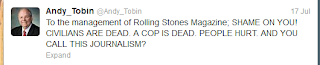 - most of the rest of society has started to examine their discomfort with the cover.
From the Boston Globe, written Jesse Singal -
Don't have much insight to add to the discussion on this issue, other than to say that I'm OK with the cover, both in a "free speech" way and in a "we need to talk about this" way.
I do believe that we need to talk about this, and I think that the RS cover has sparked some discussion of how the evil in the world can often resemble the good in the world.
And that is what I call journalism.
 |
| Pic courtesy Rolling Stone magazine |
The controversy is not over the fact that they chose to run a pic of him on the cover, but one where he looks so *normal*.
He is viewed by most of society as a monster and people want him to look like one.
Not as one talking head on MSNBC observed on Thursday, someone who looks like they should be "dating Taylor Swift".
 |
| from http://www.nbcnews.com/id/52520817/ns/msnbc-all_in_with_chris_hayes/#.UerEzW0pjXs |

From the Boston Globe, written Jesse Singal -
But we don’t want Tsarnaev to be normal. We want him to either be a pawn of abject evil, or to embody abject evil himself. If he were a psychopath, or if he had been seduced by a sprawling international conspiracy, we’d be able to guide ourselves through the bombing’s painful aftermath with a neat, clean story line: us versus them, good versus evil. When a State Police sergeant released photos of Tsarnaev’s apprehension to Boston Magazine on Thursday, it helped sate this need. The images of a bloody Tsarnaev leaving the boat in Watertown offer a rebuttal, an easy way to resolve our cognitive dissonance: No, he isn’t an otherwise normal kid who did a horrible thing. He’s evil!
Don't have much insight to add to the discussion on this issue, other than to say that I'm OK with the cover, both in a "free speech" way and in a "we need to talk about this" way.
I do believe that we need to talk about this, and I think that the RS cover has sparked some discussion of how the evil in the world can often resemble the good in the world.
And that is what I call journalism.
Committees update
...From the "familiar names not going away/trying to make a comeback" department:
- Republican former state rep. Terri Proud, fresh off getting fired from a state job even before she started the job, has formed a committee for another run for the legislature (House, LD11). She actually lives in LD9, but that area is too Democratic-leaning, so she is picking up her carpetbags and sliding over to LD11, where there is a distinct R advantage. There *will* be an R primary there, but the winners of that
- Republican Shawnna Bolick, a 2010 legislative candidate and wife of Goldwater Institute muckety-muck Clint Bolick, has formed a committee for another run at the lege (House LD28). Apparently, this time around she's trying to humanize her campaign, in an "aww, shucks" sort of way - her campaign's listed email address is "forphoenixkids@yahoo.com".
Awwww...
From the "it's early, but it's already getting crowded" department:
- Republican state rep. Justin Pierce, son of former legislator, current corporation commissioner and possible future candidate for governor Gary Pierce, has formed a committee to "explore" a 2014 run for Secretary of State. He joins fellow Republican legislators Rep. Steve Montenegro and Sen. Michele Reagan in the race.
From the "speaking of Michele Reagan" department:
The supporters of the voter-suppression legislation in HB2305, led by Reagan, have formed a committee to fight efforts to refer that measure to the ballot.
Steve at Arizona Eagletarian has some background on the people behind the committee here and here. They include the notorious Republican operative Nathan Sproul, who is well-known for his voter suppression/fraud efforts.
Steve quotes a passage from the Arizona Capitol Times' Yellow Sheet Report where Reagan expresses reservations about Sproul's involvement and speculates that Reagan may be trying to establish "plausible deniability" or something similar if the committee's activities go south (and given Sproul's involvement, that's probably more of a "when" than an "if") and she sees a need to distance herself from the committee.
I can't state definitively that the speculation is accurate, but it seems to fit with her setting up to be on both sides of any controversial issue (see: her voting *for* Medicaid restoration before she voted *against* Medicaid restoration).
What I find interesting is the working name of the committee, "Save Our Secret Ballot".
It's the same name as a 2010 committee that was formed to support an anti-union measure that year.
Now, it is possible that Reagan et. al. have short memories.
Or it's possible that they are lazy and uncreative.
Or it's possible that they plan to confuse their base into supporting the anti-voter measure by conflating it with 2010's anti-union measure.
Maybe I'm being totally cynical here, but I don't think that Reagan et. al. have memory issues or are lazy.
- Republican former state rep. Terri Proud, fresh off getting fired from a state job even before she started the job, has formed a committee for another run for the legislature (House, LD11). She actually lives in LD9, but that area is too Democratic-leaning, so she is picking up her carpetbags and sliding over to LD11, where there is a distinct R advantage. There *will* be an R primary there, but the winners of that
- Republican Shawnna Bolick, a 2010 legislative candidate and wife of Goldwater Institute muckety-muck Clint Bolick, has formed a committee for another run at the lege (House LD28). Apparently, this time around she's trying to humanize her campaign, in an "aww, shucks" sort of way - her campaign's listed email address is "forphoenixkids@yahoo.com".
Awwww...
From the "it's early, but it's already getting crowded" department:
- Republican state rep. Justin Pierce, son of former legislator, current corporation commissioner and possible future candidate for governor Gary Pierce, has formed a committee to "explore" a 2014 run for Secretary of State. He joins fellow Republican legislators Rep. Steve Montenegro and Sen. Michele Reagan in the race.
From the "speaking of Michele Reagan" department:
The supporters of the voter-suppression legislation in HB2305, led by Reagan, have formed a committee to fight efforts to refer that measure to the ballot.
Steve at Arizona Eagletarian has some background on the people behind the committee here and here. They include the notorious Republican operative Nathan Sproul, who is well-known for his voter suppression/fraud efforts.
Steve quotes a passage from the Arizona Capitol Times' Yellow Sheet Report where Reagan expresses reservations about Sproul's involvement and speculates that Reagan may be trying to establish "plausible deniability" or something similar if the committee's activities go south (and given Sproul's involvement, that's probably more of a "when" than an "if") and she sees a need to distance herself from the committee.
I can't state definitively that the speculation is accurate, but it seems to fit with her setting up to be on both sides of any controversial issue (see: her voting *for* Medicaid restoration before she voted *against* Medicaid restoration).
What I find interesting is the working name of the committee, "Save Our Secret Ballot".
It's the same name as a 2010 committee that was formed to support an anti-union measure that year.
Now, it is possible that Reagan et. al. have short memories.
Or it's possible that they are lazy and uncreative.
Or it's possible that they plan to confuse their base into supporting the anti-voter measure by conflating it with 2010's anti-union measure.
Maybe I'm being totally cynical here, but I don't think that Reagan et. al. have memory issues or are lazy.
Friday, July 19, 2013
President Obama Speaks on Trayvon Martin
Update on 7/20 -
State Sen. Al Melvin (R-Slave Labor is a good thing) issued a response to the President's remarks that illustrates that the mentality that caused AZ to be subject to extra scrutiny under the Voting Rights Act still exists, even if the Supreme Court set aside part of the VRA -

"Inflammatory"?? Either Melvin didn't watch the press conference, or he is a complete moron. Not that those are mutually exclusive states of being.
And if "race relations" have actually declined since Obama became President, it isn't because of any action on his part.
Other than, maybe, daring to exist in a world where the Melvins of that world think it should be subject to absolute all-white control.
- End update
Sunday, July 14, 2013
The verdict in the killing of Trayvon Martin: Some people doubling down, AZ Edition
After Saturday night's acquittal of George Zimmerman on charges stemming from his killing of Trayvon Martin, reaction was swift across the country, including in Arizona.
State Sen. Steve Gallardo tweeted this in the aftermath of the announcement of the verdict -
 And this -

Or former State Sen. David Schapira -

Sadly, other Arizona "leaders" aren't quite as thoughtful.
State Sen. Kelli Ward -
 To Sen. Ward: First, it was a "killing", not an "incident". Second, truly, not every incident (read "conflict" in this context) between people of different races is a civil rights violation. Two people arguing over a single parking spot at the local mall, perhaps accompanied by raised voices, mutual flipping of birds, and hurt feelings is probably not a civil rights violation.
The stalking and execution of an unarmed black teen by a white man, the tanking of the investigation and prosecution by white-dominated law enforcement agencies and an acquittal by a mostly (all?) white jury? Probably a civil rights violation or two here (file this under "If it walks like a duck and quacks like a duck...").
Or State Rep. Kelly Townsend, putting a partisan political spin on things -

To Rep. Townsend: I don't know Mr. Zimmerman's ethnic background or political leanings, but even accepting your statement as fact, the response is the same - "So what?".
I don't know every Democrat or Hispanic in the state or country, but I can state unequivocally that none of the Democrats, Hispanics, or Hispanic Democrats that I know feel that partisan affiliation or ethnic background confers an immunity from responsibility for violent acts.
Unlike, say, someone we both know (but I'm guessing that you know him better than I do).
Note to readers: Townsend got into a bit of a Twitter discussion with Steve Muratore, publisher of the Arizona Eagletarian. I don't think she helped her cause with her follow ups, not at all, but you be the judge -

Some of the pearls of wisdom were indirect, repostings of something others wrote and promulgated by AZ types.
For instance, Rep. David Livingston retweeted this one -
 It seems that Rep. Livingston believes that it is unprofessional behavior for prosecutors to look into killings of unarmed teens. As opposed to what the rest of society believes. You know, that it is part of prosecutors' jobs.
It's not just the electeds, either.
For instance, Constantin Querard, noted political hatchet-man "consultant" here in AZ offered up this gem -
 Actually, "not guilty" means "the prosecution didn't prove its case beyond a reasonable doubt". Nothing less, nothing more.
Or Shane Wikfors, another noted political hatchet-man "consultant" here in AZ, serving up this retweet -
 Don't know if he's trying to continue the stereotyping and smearing of Martin (falsely equating Martin's killing to being equivalent to "just another gang-related killing" and hence not something to worry about), criticizing liberals for not "fixing" every social problem, saying Martin's killing is OK because other black teens have died, or if he's maybe multitasking (don't want to insult Wikfors by implying that he can spew only one line of BS at a time).
Any way you cut it though, from Ward's ignorance through to Wikfors' stereotyping, it's despicable.
State Sen. Steve Gallardo tweeted this in the aftermath of the announcement of the verdict -


Or former State Sen. David Schapira -

Sadly, other Arizona "leaders" aren't quite as thoughtful.
State Sen. Kelli Ward -

The stalking and execution of an unarmed black teen by a white man, the tanking of the investigation and prosecution by white-dominated law enforcement agencies and an acquittal by a mostly (all?) white jury? Probably a civil rights violation or two here (file this under "If it walks like a duck and quacks like a duck...").
Or State Rep. Kelly Townsend, putting a partisan political spin on things -

To Rep. Townsend: I don't know Mr. Zimmerman's ethnic background or political leanings, but even accepting your statement as fact, the response is the same - "So what?".
I don't know every Democrat or Hispanic in the state or country, but I can state unequivocally that none of the Democrats, Hispanics, or Hispanic Democrats that I know feel that partisan affiliation or ethnic background confers an immunity from responsibility for violent acts.
Unlike, say, someone we both know (but I'm guessing that you know him better than I do).
Note to readers: Townsend got into a bit of a Twitter discussion with Steve Muratore, publisher of the Arizona Eagletarian. I don't think she helped her cause with her follow ups, not at all, but you be the judge -

Some of the pearls of wisdom were indirect, repostings of something others wrote and promulgated by AZ types.
For instance, Rep. David Livingston retweeted this one -

It's not just the electeds, either.
For instance, Constantin Querard, noted political

Or Shane Wikfors, another noted political

Any way you cut it though, from Ward's ignorance through to Wikfors' stereotyping, it's despicable.
Saturday, July 13, 2013
Let me say this up front: Zimmerman got away with murder. Literally.
And let me be clear: I am not impugning the integrity or intelligence of the jury in this case. They can only evaluate the evidence and testimony laid before them.
First, and most importantly, my deepest condolences go out to Trayvon Martin's friends and family. I can only imagine, but I expect that the pain of today's slap in the face is exceeded only by the pain of Trayvon's actual killing.
The defense team, gloating in a press conference after the verdict, opined that they were glad that the verdict hadn't "turned a tragedy into a travesty".
However, when you see past their lawyers' version of the Snoopy Dance, you see that that's *exactly* what happened.
The investigation and prosecution were tanked from the outset by the Sanford (FL) PD and the state's attorney in Seminole County, and that seemed to impact the quality of the case presented to the jury.
The defense also put Martin on trial. Not an unheard-of tactic, but given the nature of the crime, one that ripped open wounds, not just among Martin's family and friends, but all across the nation.
I don't have the educational or professional background to do a full dissection of this case and verdict here (other than to completely disagree with it, I truly don't have much to add in terms of technical analysis of the verdict), but do have a few observations:
1. Practical understanding of "self defense" now includes "created a conflict and confrontation with someone who wasn't bothering anyone, and used that confrontation to rationalize executing that innocent person" in Florida, and any other areas with similar "kill 'em all and let God sort 'em out" laws and attitudes. Including Arizona.
2. It is now a matter of law, and practice, in Florida that one can use fear of someone, whether or not that fear is rational, as an excuse for killing that someone.
3. Zimmerman may have used an irrational fear as motivation to confront and kill Trayvon Martin, and as a shield from being held accountable for the killing. However. the "not guilty" verdict may end up being the worst thing that could have happened for him.
Now everyone he ever comes into contact with, even if the other party initiates the contact, has a rational, and well-documented, reason to fear him.
 |
| Pic courtesy Facebook. Not sure who actually created it, but it wasn't me and I can't take credit for it. |
First, and most importantly, my deepest condolences go out to Trayvon Martin's friends and family. I can only imagine, but I expect that the pain of today's slap in the face is exceeded only by the pain of Trayvon's actual killing.
The defense team, gloating in a press conference after the verdict, opined that they were glad that the verdict hadn't "turned a tragedy into a travesty".
However, when you see past their lawyers' version of the Snoopy Dance, you see that that's *exactly* what happened.
The investigation and prosecution were tanked from the outset by the Sanford (FL) PD and the state's attorney in Seminole County, and that seemed to impact the quality of the case presented to the jury.
The defense also put Martin on trial. Not an unheard-of tactic, but given the nature of the crime, one that ripped open wounds, not just among Martin's family and friends, but all across the nation.
I don't have the educational or professional background to do a full dissection of this case and verdict here (other than to completely disagree with it, I truly don't have much to add in terms of technical analysis of the verdict), but do have a few observations:
1. Practical understanding of "self defense" now includes "created a conflict and confrontation with someone who wasn't bothering anyone, and used that confrontation to rationalize executing that innocent person" in Florida, and any other areas with similar "kill 'em all and let God sort 'em out" laws and attitudes. Including Arizona.
2. It is now a matter of law, and practice, in Florida that one can use fear of someone, whether or not that fear is rational, as an excuse for killing that someone.
3. Zimmerman may have used an irrational fear as motivation to confront and kill Trayvon Martin, and as a shield from being held accountable for the killing. However. the "not guilty" verdict may end up being the worst thing that could have happened for him.
Now everyone he ever comes into contact with, even if the other party initiates the contact, has a rational, and well-documented, reason to fear him.
Friday, July 12, 2013
Trayvon Martin case: Murder, that's what I call it.
Not quite as tawdry as the Jodi Arias trial but with far greater potential significance for the rest of society, the jury that has been hearing the trial of George Zimmerman for the killing of unarmed teen Trayvon Martin began its deliberations today.
From CBSNews.com -
There are many schools of thought on this matter, but they basically boil down to two sides:
- The NRA, white supremacists, and their apologists saying that Zimmerman was justified in killing Martin, even though Zimmerman created the circumstances and conflict that Zimmerman is using to rationalize the killing.
- Civil society, most of whose members are saying "not so much".
Most of the time, I have the words to sum up a position on an issue, *any* issue. Today, however. I'm going to rely on the words of actor John Wayne. In real life, and even in some of his roles, he was ultraconservative (check out the pro Confederate-era South themes in many of his Westerns, or the shameless pro-Vietnam War propaganda in the movie "The Green Berets"), but occasionally he put forth some genuine pearls of wisdom.
Consider a scene from his film "Rio Bravo".
In the scene,, he plays Sheriff John T. Chance speaking to John Russell (playing character Nathan Burdette) about the arrest of his brother, Joe Burdette (played by Claude Akins).
The dialogue (courtesy IMDB) (emphasis added) -
I call it murder.
From CBSNews.com -
A jury has recessed for the day without reaching a verdict in the case of George Zimmerman, the former neighborhood watch volunteer charged in the shooting death of Florida teen Trayvon Martin.
The jurors were set to return Saturday morning at 9 a.m. to resume deliberations.
The jury, which consists of a panel of six women, is weighing a second-degree murder charge against the 29-year-old, who shot Martin during a confrontation last year in a gated Sanford, Fla. community. Zimmerman is pleading not guilty, claiming he shot Martin in self defense.
The panel of six women, which has been sequestered as the proceedings stretched into the end of their third week, will also weigh a lesser charge of manslaughter.
There are many schools of thought on this matter, but they basically boil down to two sides:
- The NRA, white supremacists, and their apologists saying that Zimmerman was justified in killing Martin, even though Zimmerman created the circumstances and conflict that Zimmerman is using to rationalize the killing.
- Civil society, most of whose members are saying "not so much".
Most of the time, I have the words to sum up a position on an issue, *any* issue. Today, however. I'm going to rely on the words of actor John Wayne. In real life, and even in some of his roles, he was ultraconservative (check out the pro Confederate-era South themes in many of his Westerns, or the shameless pro-Vietnam War propaganda in the movie "The Green Berets"), but occasionally he put forth some genuine pearls of wisdom.
Consider a scene from his film "Rio Bravo".
In the scene,, he plays Sheriff John T. Chance speaking to John Russell (playing character Nathan Burdette) about the arrest of his brother, Joe Burdette (played by Claude Akins).
 |
| (L-R) Wayne, Akins, and Russell (pic courtesy http://www.peterbrown.tv/johnrussell.html) |
John T. Chance: [explaining why Joe got beat up] He didn't take too kindly to being arrested for murder.
Joe Burdette: It wasn't murder.
Nathan Burdette: If he says it wasn't murder, why do you say it was?
John T. Chance: Man gets shot that's got a gun, there's room for reasonable doubt. Man gets shot that hasn't got a gun, what would you call it? But, you knew that already otherwise you wouldn't have set things up the way you did.
I call it murder.
Thursday, July 11, 2013
Karlene Keogh Parks endorsed by Phoenix Mayor Greg Stanton
Karlene Keogh Parks, candidate for Phoenix City Council, District 6, has earned what is perhaps the biggest prize of the campaign season in Phoenix.
From the Arizona Republic, written by Dustin Gardiner -
This doesn't quite offset the deep pockets of DiCiccio's lobbyist supporters, but the endorsement of the most popular elected official in the Phoenix area (yes, respect for Stanton extends far beyond the Phoenix city limits) helps muster grass roots support in a way that can't be bought.
From the Arizona Republic, written by Dustin Gardiner -
Phoenix Mayor Greg Stanton endorses Karlene Keogh Parks in District 6 council race
Phoenix Mayor Greg Stanton made his first public foray into the upcoming City Council elections on Thursday, endorsing insurance executive and District 6 candidate Karlene Keogh Parks.
Keogh Parks is locked in a contentious race with Councilman Sal DiCiccio, who’s running for re-election. The district encompasses Ahwatukee and affluent communities in east Phoenix, including Biltmore and parts of Arcadia and north central.
This doesn't quite offset the deep pockets of DiCiccio's lobbyist supporters, but the endorsement of the most popular elected official in the Phoenix area (yes, respect for Stanton extends far beyond the Phoenix city limits) helps muster grass roots support in a way that can't be bought.
Wednesday, July 10, 2013
Rs eating their own: Tea Party Congressman Calls Out Senator John McCain
I don't usually publish videos of Rs hobnobbing for fun and profit, but this one... :)
Monday, July 08, 2013
Republican State Rep. Kwasman running for Congress
Making official something that had been an open secret for months, State Representative Adam Kwasman announced that he is exploring a run for the CD1 seat in Congress, currently held by Congresswoman Ann Kirkpatrick.
From Roll Call, written by Abby Livington -
His exploratory website is here.
As the article mentioned, Kwasman may be the first GOPer in the CD1 race, but he won't be the last. In fact, 2014 should be an outright brawl on the GOP side of the ballot, with CD1 being at the top of the card.
Kirkpatrick is viewed as the most vulnerable D, with a competitive and heavily rural district. As such, a laundry list of Rs are looking at that race; one of those rumored to be looking is AZSOS Ken Bennett. He's also rumored to be looking at a run for governor. Since there will be an R primary for both offices, he may just go for the one with the one he thinks is the most winnable.
Assuming that both Bennett and Kwasman go for CD1, I expect at least two more "name" candidates to at least strongly consider jumping into the CD1 race, with "name" meaning "current or recent officeholder", two lesser-known but viable candidates, and two "tilting at windmills" candidates.
Kwasman may have one serious issue working against his candidacy - based on the way he has conducted himself in office and the way his (exploratory) campaign has started, he is running as a generic knee-jerk Republican. He could be running in any other district in the state, or even the country. Somebody with strong ties to the rural part of the district might be able to easily turn him aside.
Ties like the ones possessed by Kirkpatrick.
The next target on the R hit parade will probably be the CD4 seat currently held by Republican Paul Gosar. AZ House Speaker Andy Tobin, term-limited out of the AZ House, is said to be mulling this one. Gosar is still seen as a carpetbagger in the district, vulnerable to a challenger with a strong base of support in the district.
Based on current voter registration numbers, CD4 will almost certainly remain in the hands of the Republican party. The only real question is which R will occupy the office.
After that are seats held by Democrats in two competitive districts.
CD9 is currently held by Congresswoman Kyrsten Sinema, who already has three announced R challengers, two of whom also ran in 2012. Vernon Parker and Wendy Rogers have signed on for a return engagement. Newbie Andrew Walter, whose claim to fame thus far is that he was a QB for the ASU football team a few years back, is also in the race. The seat is attainable for the Rs, but Sinema was and is a strong candidate. It will take a combination of factors to defeat her. They will need a mix of Sinema messing up, the R candidate (whoever that may end up being) running a near-perfect campaign, and a national environment that is conducive to R victories. In short, a wave. Not necessarily one of 2010 proportions, but a solid one.
And given that, historically, the mid-term elections of a two-term president's second term usually see Congressional gains by the party that isn't the president's, this third factor seems more likely than not to come to pass.
Given Sinema's strength as a candidate, the race probably won't see a "big name" R, but one or two (or three or four) lower-profile Rs with some game who are willing to take a gamble. The bigger name Rs will look for a surer thing.
After that one comes a district that, while competitive enough that the Rs won't give it a free pass, is going to take pretty near everything going right for the Rs for them to have a serious chance at taking the seat.
Currently held by Congressman Ron Barber (D), CD2 shows a slight R edge in voter registration numbers, making it look like it is ripe for a takeover. However, Barber is a strong candidate in an area where the Democrats are very energetic and involved, leading to high D turnout at the polls.
So far, just Martha McSally, the 2012 R nominee and loser in the general election, has signed on for the race. It's likely that other Rs will get in CD2 race, but each of them will probably have some serious baggage weighing down their candidacies.
One interesting note: with Kwasman's announcement, it becomes official that though all will be running for office, none of the current LD11 legislators will be running for reelection to their current offices next year, and term limits aren't involved.
State Rep. Adam Kwasman - going for Congress.
State Rep. Steve Smith - going for the state senate.
State Sen. Al Melvin - going for governor.
Doesn't mean much - LD11 is still a tough nut for Democratic candidates to crack (doable, but very tough), but it's still interesting.
In a political geek sort of way. :)
From Roll Call, written by Abby Livington -
Republican state Rep. Adam Kwasman announced today an exploratory committee to challenge Rep. Ann Kirkpatrick, D-Ariz., a top target for the House GOP in 2014, according to a press release from his new campaign.
Kwasman is the first Republican enter the 1st District race this cycle, but it is likely other GOP candidates will chase the seat as well. He was also the subject of a recent Roll Call story on potential Republican challengers for Kirkpatrick.
His exploratory website is here.
As the article mentioned, Kwasman may be the first GOPer in the CD1 race, but he won't be the last. In fact, 2014 should be an outright brawl on the GOP side of the ballot, with CD1 being at the top of the card.
Kirkpatrick is viewed as the most vulnerable D, with a competitive and heavily rural district. As such, a laundry list of Rs are looking at that race; one of those rumored to be looking is AZSOS Ken Bennett. He's also rumored to be looking at a run for governor. Since there will be an R primary for both offices, he may just go for the one with the one he thinks is the most winnable.
Assuming that both Bennett and Kwasman go for CD1, I expect at least two more "name" candidates to at least strongly consider jumping into the CD1 race, with "name" meaning "current or recent officeholder", two lesser-known but viable candidates, and two "tilting at windmills" candidates.
Kwasman may have one serious issue working against his candidacy - based on the way he has conducted himself in office and the way his (exploratory) campaign has started, he is running as a generic knee-jerk Republican. He could be running in any other district in the state, or even the country. Somebody with strong ties to the rural part of the district might be able to easily turn him aside.
Ties like the ones possessed by Kirkpatrick.
The next target on the R hit parade will probably be the CD4 seat currently held by Republican Paul Gosar. AZ House Speaker Andy Tobin, term-limited out of the AZ House, is said to be mulling this one. Gosar is still seen as a carpetbagger in the district, vulnerable to a challenger with a strong base of support in the district.
Based on current voter registration numbers, CD4 will almost certainly remain in the hands of the Republican party. The only real question is which R will occupy the office.
After that are seats held by Democrats in two competitive districts.
CD9 is currently held by Congresswoman Kyrsten Sinema, who already has three announced R challengers, two of whom also ran in 2012. Vernon Parker and Wendy Rogers have signed on for a return engagement. Newbie Andrew Walter, whose claim to fame thus far is that he was a QB for the ASU football team a few years back, is also in the race. The seat is attainable for the Rs, but Sinema was and is a strong candidate. It will take a combination of factors to defeat her. They will need a mix of Sinema messing up, the R candidate (whoever that may end up being) running a near-perfect campaign, and a national environment that is conducive to R victories. In short, a wave. Not necessarily one of 2010 proportions, but a solid one.
And given that, historically, the mid-term elections of a two-term president's second term usually see Congressional gains by the party that isn't the president's, this third factor seems more likely than not to come to pass.
Given Sinema's strength as a candidate, the race probably won't see a "big name" R, but one or two (or three or four) lower-profile Rs with some game who are willing to take a gamble. The bigger name Rs will look for a surer thing.
After that one comes a district that, while competitive enough that the Rs won't give it a free pass, is going to take pretty near everything going right for the Rs for them to have a serious chance at taking the seat.
Currently held by Congressman Ron Barber (D), CD2 shows a slight R edge in voter registration numbers, making it look like it is ripe for a takeover. However, Barber is a strong candidate in an area where the Democrats are very energetic and involved, leading to high D turnout at the polls.
So far, just Martha McSally, the 2012 R nominee and loser in the general election, has signed on for the race. It's likely that other Rs will get in CD2 race, but each of them will probably have some serious baggage weighing down their candidacies.
One interesting note: with Kwasman's announcement, it becomes official that though all will be running for office, none of the current LD11 legislators will be running for reelection to their current offices next year, and term limits aren't involved.
State Rep. Adam Kwasman - going for Congress.
State Rep. Steve Smith - going for the state senate.
State Sen. Al Melvin - going for governor.
Doesn't mean much - LD11 is still a tough nut for Democratic candidates to crack (doable, but very tough), but it's still interesting.
In a political geek sort of way. :)
Saturday, July 06, 2013
Committees update
Note: when I write "nothing significant" (or a reasonable facsimile thereof), it's not an insult to the candidate committees that have formed at a particular level. For the purposes of this post, "significant" mostly means "a candidate that we've heard of before"
Committees of note formed recently...
Federal level -
Martha McSally (R) declared her candidacy for the CD2 seat currently held by Ron Barber.
State level -
No significant new candidate committees that I could find, but the end of the legislative session was marked by a flurry of activity on the referendum front -
- Label GMOs Arizona, 201400138, supporting a initiative petition drive regarding the labeling of genetically modified foods.
- Representative Initiatives, 201400149, supporting an as-yet unidentified initiative or referendum petition drive.
- United Republican Alliance of Principled Conservatives, 201400140, seeking to overturn the lege's recent restoration of Medicaid eligibility levels via a referral to the ballot.
- Arizonans for Sensible Health Care, 201400167, opposing the proposed ballot measure above. Fronted by the CEO of the Arizona Hospital and Healthcare Association.
- We The People AZ Against Common Core, 201400168, seeking to refer to the ballot a part of the state's budget that increased the bonding limit for school districts. Fronted by Wes Harris, one of the state's more infamous tea party types.
- Equal Marriage Arizona, 201400163, supporting an initiative petition drive for a measure that would recognize same sex marriages. Fronted by LGBT Republicans.
- Arizona Taxpayers Protection Committee, 201400171, supporting an as-yet unidentified ballot measure. At least, that's how the AZSOS has them categorized on the SOS' website. However, a perusal of the group's website shows that their goal is to support primary challengers to Republicans who supported Medicaid restoration. Fronted by Tom Husband, former chair of the MCGOP and Shane Wikfors, a long-time GOP operative and blogger.
- Protect Your Right To Vote Committee, 201400177, seeking to refer to the ballot and overturn HB2305, the anti-voter measure passed by the Republicans in the waning moments of this year's session of the legislature. Fronted by Julie Erfle.
- Safer Arizona, 201400153, supporting an initiative petition drive for a potential measure legalizing marijuana. Fronted by Dennis Bohlke, a computer programmer who has run afoul of narcotics-related laws in the past.
Steve at Arizona Eagletarian has coverage of the ballot questions committees here.
Maricopa County level -
Nothing significant yet.
Municipal level (Scottsdale, Tempe, Mesa) -
Nothing in Tempe or Mesa as yet. There are a couple of filings of interest in Scottsdale, however.
- Michael Auerbach, operator of a personal chef for hire business, member of Scottsdale's Neighborhood Advisory Commission, and a Republican PC in LD23 (north Scottsdale), filed for a run for City Council.

- John Little, a former Scottsdale City Manager, has filed for a run for City Council.

Little was city manager of Scottsdale until he was fired, allegedly because of "conflicts" with the Council. The interesting part of that firing was the fact that, seemingly, the only people who had a conflict with Little were the four members of the City Council who voted to fire him. I haven't followed Little's career since the firing, but if he still has the same sort of community support, the race will be tough.
For the other candidates.
John Washington of Scottsdale Trails offers his take on Little's candidacy here.
Committees of note formed recently...
Federal level -
Martha McSally (R) declared her candidacy for the CD2 seat currently held by Ron Barber.
State level -
No significant new candidate committees that I could find, but the end of the legislative session was marked by a flurry of activity on the referendum front -
- Label GMOs Arizona, 201400138, supporting a initiative petition drive regarding the labeling of genetically modified foods.
- Representative Initiatives, 201400149, supporting an as-yet unidentified initiative or referendum petition drive.
- United Republican Alliance of Principled Conservatives, 201400140, seeking to overturn the lege's recent restoration of Medicaid eligibility levels via a referral to the ballot.
- Arizonans for Sensible Health Care, 201400167, opposing the proposed ballot measure above. Fronted by the CEO of the Arizona Hospital and Healthcare Association.
- We The People AZ Against Common Core, 201400168, seeking to refer to the ballot a part of the state's budget that increased the bonding limit for school districts. Fronted by Wes Harris, one of the state's more infamous tea party types.
- Equal Marriage Arizona, 201400163, supporting an initiative petition drive for a measure that would recognize same sex marriages. Fronted by LGBT Republicans.
- Arizona Taxpayers Protection Committee, 201400171, supporting an as-yet unidentified ballot measure. At least, that's how the AZSOS has them categorized on the SOS' website. However, a perusal of the group's website shows that their goal is to support primary challengers to Republicans who supported Medicaid restoration. Fronted by Tom Husband, former chair of the MCGOP and Shane Wikfors, a long-time GOP operative and blogger.
- Protect Your Right To Vote Committee, 201400177, seeking to refer to the ballot and overturn HB2305, the anti-voter measure passed by the Republicans in the waning moments of this year's session of the legislature. Fronted by Julie Erfle.
- Safer Arizona, 201400153, supporting an initiative petition drive for a potential measure legalizing marijuana. Fronted by Dennis Bohlke, a computer programmer who has run afoul of narcotics-related laws in the past.
Steve at Arizona Eagletarian has coverage of the ballot questions committees here.
Maricopa County level -
Nothing significant yet.
Municipal level (Scottsdale, Tempe, Mesa) -
Nothing in Tempe or Mesa as yet. There are a couple of filings of interest in Scottsdale, however.
- Michael Auerbach, operator of a personal chef for hire business, member of Scottsdale's Neighborhood Advisory Commission, and a Republican PC in LD23 (north Scottsdale), filed for a run for City Council.

- John Little, a former Scottsdale City Manager, has filed for a run for City Council.

Little was city manager of Scottsdale until he was fired, allegedly because of "conflicts" with the Council. The interesting part of that firing was the fact that, seemingly, the only people who had a conflict with Little were the four members of the City Council who voted to fire him. I haven't followed Little's career since the firing, but if he still has the same sort of community support, the race will be tough.
For the other candidates.
John Washington of Scottsdale Trails offers his take on Little's candidacy here.
Thursday, July 04, 2013

Eight years, or one complete term limits cycle, worth of blogging
The year was 2006, and I was becoming more active politically (the combination of having the highly embarrassing JD Hayworth as my representative in Congress and the highly respected Harry Mitchell challenging him motivated me to get off of my ass). The 2006 election was the first election in Arizona where I paid close attention to most of the races on the ballot.
Earlier this week, I was thinking about term limits (8 years for legislative and statewide offices) and thinking about their impact. Doing the math, I realized that anybody who was first elected to a legislative or statewide office in 2006 and has continuously held that office since would now be term-limited out of that office.
Planning to write up a post on the term-limits status of current electeds, I began by looking at the results of the 2006 election. Anybody who was first elected to a legislative or statewide office that year and has continuously held that office since would now be set to be term-limited out of that office in 2014.
During that research, I was struck by two things:
1. How few of the people elected that year will actually be affected by term limits this time around. By my count, only five people elected that year will be affected by term limits on the office that they were elected to in 2006..
2. And how much pure turnover there has been in those offices since that election.
Much of that turnover has been self-inflicted (AZ does seem to have a number of politicos with domestic violence "issues"), but some is indirectly related to term limits - when one office holder is term-limited out of a particular office, another office holder who isn't term limited out of their own office may choose to run for the soon-to-be vacant office (i.e. - legislators running statewide)
To whit:
Governor - Janet Napolitano easily won reelection in 2006 and would have been termed-out in 2010, but she resigned in 2009 to accept a position in the cabinet of Barack Obama, the newly-elected president of the United States.
Secretary of State - Jan Brewer. She *is* termed out of office this cycle, but not from the SOS job. Her ascension to the governor's office in 2009 started the term limits clock on that office.
Attorney General - Terry Goddard. He won reelection in 2006 but was termed-out in 2010. That year, he ran for governor in a race eventually won by Brewer. Has made noises about running for office in 2014 (SOS or AG). Interestingly, the Republican he defeated in the general election, Bill Montgomery, went on to become Maricopa County Attorney and is now rumored to be mulling another run for AG in 2014.
State Treasurer - Dean Martin. After a 2009 family tragedy (his wife died during childbirth), he challenged Brewer for the R nomination for governor, but came up short in the primary.
State Superintendent of Public Instruction - Tom Horne. He was termed-out of that office in 2010, so he ran for AG and won. He was rumored to be eyeing a 2014 run for governor, but his term as AG has been marked by scandals. Now, he seems to be focused on holding on to the AG spot, but is likely to face strong opponents in both the R primary and the general election.
State Mine Inspector - Joe Hart. First won election to the office in 2006, reelected in 2010, and termed-out next year, and...Who cares? The job is less about inspecting mines than it is about padding an elected official's pension (and hobnobbing with mining industry lobbyists and execs). It isn't in the line of succession for governor in the event of a mid-term vacancy. Bottom line: this shouldn't be an elected office.
State legislature (while the district numbers and lines changed with redistricting after the 2010 census, any member elected to a particular chamber during the 2006 election and still holding office in that chamber now is term-limited in 2014):
Using old LD numbers -
LD1 State Senate - Tom O'Halleran (R). Lost a primary challenge mounted by Steve Pierce in 2008, who campaigned on a platform of "O'Halleran is a liberal!". Ironically, Pierce is facing the same diatribes now over his support of Medicaid restoration.
LD1 State House - Lucy Mason and Andy Tobin (Rs). Mason was termed-out in 2010 and hasn't run for a state-level office since. Tobin is now Speaker of the House, but is termed-out next year. There have been rumors of interest in either a run for Congress or for governor.
LD2 State Senate - Albert Hale (D). Was previously termed-out of the Senate; currently in the House.
LD2 State House - Ann Kirkpatrick and Albert Tom (Ds). Kirkpatrick ran for Congress in 2008 and won, was swept out of Congress in the 2010 Republican wave, and swept back into Congress in the 2012. Tom lost a 2010 primary and remains out of office.
LD3 State Senate - Ron Gould (R). Termed out in 2012, ran for Congress. Lost in the R primary, last seen: fronting an effort put the recent restoration of Medicaid eligibility to previous levels on the 2014 ballot, hoping to overturn it.
LD3 State House -Trish Groe and Nancy McLain (Rs). Groe ran into a DUI-related issue and lost in the 2008 primary. Last seen: moved to Gilbert (I think) and was/is active in the LD Republican party organization there. McLain ran for the state senate in 2012; lost in the primary.
LD4 State Senate - Jack Harper (R). Termed out of the Senate in 2010, ran for and won a seat in the House. Chose not to run for a second term in the House. Currently out of office. I miss him. :)
LD4 State House - Tom Boone and Judy Burges (Rs). Boone was termed out of the House in 2010 and was later caught up in scandal involving conflicts of interest and misuse of funds at the Deer Valley Unified School District, ultimately resigning from the district's governing board. Burges ran for and won the senate seat after now-former legislator Scott Bundgaard (R) was involved in a domestic violence incident by the side of a Phoenix freeway in 2011.
LD5 State Senate - Jake Flake (R). Passed away in June 2008.
LD5 State House - Jack Brown (D) and Bill Konopnicki (R). Brown retired in 2010 after close to four decades in the AZ lege. Konopnicki ran for the Senate seat in 2010 but lost in the R primary. He passed away in 2012.
LD6 State Senate - Pamela Gorman (R). Ran for Congress in 2010, losing in the primary. Last seen lobbying for Big Tobacco.
LD6 State House - Doug Clark and Sam Crump (Rs). Crump ran for Congress in 2010 and came up short in the primary. Crump is working as a lobbyist, based in San Francisco. Clark isn't in office, but I don't know his story.
LD7 State Senate - Jim Waring (R). Ran for Congress in 2010 and lost in the primary. Ran for Phoenix City Council in 2012 and won.
LD7 State House - Nancy Barto and Ray Barnes (Rs). Barto is now in the senate, continuing her work as Big Insurance's chief Arizona lobbyist. Barnes ran for the Senate in 2010 and lost to Barto in the primary. Barnes was colorful, to say the least.
LD8 State Senate - Carolyn Allen. Termed out in 2010 and retired from electoral politics. The last real "moderate" in the Republican caucus. Current GOP "moderates" in the lege make Barry Goldwater, the man who, in 1964, was considered to be to crazy conservative to be president, look like a bleeding heart liberal.
LD8 State House - Michele Reagan and John Kavanagh (Rs). Reagan moved up to the Senate when Allen retired after the 2010 session. She is likely running for SOS in 2014. Kavanagh is termed out of the House, but it likely running for the Senate seat.
LD9 State Senate - Bob Burns (R). Served as President of the State Senate. Termed out after the 2010 session. Won a seat on the Arizona Corporation Commission in 2012.
LD9 State House - Rick Murphy and Bob Stump (Rs). Murphy is currently in the Senate but may be facing term limits of the practical, not statutory, variety - he's facing allegations that he sexually abused some of the foster children placed in his care. Stump ran for and won a seat on the Arizona Corporation Commission in 2008 and won reelection to that body in 2012.
LD10 State Senate - Linda Gray (R). Retired from elected office after 2012.
LD10 State House - Jackie Thrasher (D) and Jim Weiers (R). Thrasher served one term in the lege, falling victim to some Republican dirty tricks in 2008. Weiers, a shill for the payday loan industry, was termed out after 2012.
LD11 State Senate - Barbara Leff (R). Ran for State Treasurer in 2010, coming up short in the Republican primary.
LD11 State House - Adam Driggs (R) and Mark Desimone (D). Driggs is in the Senate now. Desimone resigned from office after an arrest on charges related to a domestic violence incident.
LD12 State Senate - Bob Blendu (R). Did not seek reelection in 2008. Occasionally makes noises about running for office again. Still keeping his hand in, for fun and profit.
LD12 State House - John Nelson and Jerry Weiers (Rs). Nelson moved over to the Senate for a couple of terms, but after redistricting, fellow R senator Don Shooter picked up his carpetbags and left his competitive district and moved to the other side of Yuma, which was placed in a safe R district. He ultimately chose to step aside. Weiers was termed out of the House and is now mayor of Glendale.
LD13 State Senate - Richard Miranda (D). Was eventually termed out of the Senate and ran for and won a seat in the House. He resigned from that office in 2012, citing health and family reasons. Later pleaded guilty to federal fraud and tax evasion charges and sentenced to prison.
LD13 State House - Martha Garcia and Steve Gallardo (Ds). Garcia remained in the House until 2010. Gallardo is now in the Senate.
LD14 State Senate - Debbie McCune-Davis (D). The long-time legislator is now in the House.
LD14 State House - Chad Campbell and Robert Meza. Meza is now in the Senate. Campbell is now Democratic leader in the House and is termed out in 2014. Considering a run for governor in 2014.
LD15 State Senate - Ken Cheuvront (D). Termed out after 2010. Ran for a Justice of the Peace spot. Lost the primary. In 2012, ran for a return to the Senate. Lost the primary.
LD15 State House - David Lujan and Kyrsten Sinema (Ds). Lujan ended up in the Senate, ran for Attorney General in 2010 (lost in the primary), and is running for Phoenix City Council this year. Sinema also ended up moving over to the Senate and then won a seat in Congress after redistricting in 2012.
LD16 State Senate - Leah Landrum-Taylor (D). Still in the Senate, currently serving as Democratic leader. Termed out in 2014, exploring a run at SOS.
LD16 State House - Cloves Campbell, Jr. and Ben Miranda (Ds). Campbell served two terms in the House before being defeated in the 2010 primary. Last seen: publishing the Arizona Informant. Miranda left the House after the 2010 session. Last seen: practicing law in Phoenix.
LD17 State Senate - Meg Burton Cahill. Served in the Senate through the 2010 session. Now serving as a Justice of the Peace in Maricopa County.
LD17 State House - Ed Ableser and David Schapira. Ableser is now serving in the Senate. Schapira moved to the Senate after the 2010 election, and ran for Congress in 2012, coming in second behind Sinema in the D primary. Currently working as the Assistant Superintendent of the East Valley Institute of Technology (EVIT).
LD18 State Senate - Karen Johnson (R). Served through the 2008 session. Retired after that. Occasionally flirts with running for something. Last seen: living in Show Low.
LD18 State House - Mark Anderson and Russell Pearce (Rs). Anderson served through 2008, ran for Congress in 2008 and lost in the primary. Currently a Justice of the Peace. Pearce moved to the Senate after 2008. Became president of the Senate after the 2010 elections. Became the first Arizona legislator ever recalled from office in 2011. Making noises about attempting to return to office in 2014.
LD19 State Senate - Chuck Gray. Briefly ran for Congress in 2012. Last seen working for the eventual victor in that race, Matt Salmon, as Salmon's district director.
LD19 State House - Kirk Adams and Rich Crandall (Rs). Adams later became Speaker of the House, eventually resigning to run for a seat in Congress. He lost to Salmon in that primary. Crandall eventually moved to the Senate and will soon be moving to Wyoming for a job.
LD20 State Senate - John Huppenthal (R). Ran for and won the office of State Superintendent of Public Instruction in 2010.
LD20 State House - John McComish and Bob Robson (Rs). McComish is currently in the State Senate. Robson termed out after the 2008 session, took a term off (resetting his term limits clock) and returned to the House after the 2010 elections.
LD21 State Senate - Jay Tibshraeny (R). The then-former mayor of Chandler served in the Senate through 2010, then made a return to the mayor's office in Chandler.
LD21 State House - Steve Yarbrough and Warde Nichols (Rs). Yarbrough moved to the Senate, where he continues to undermine public education funding. Nichols termed out after the 2010 session. Last seen working as alobbyist "business consultant".
LD22 State Senate - Thayer Verschoor (R). Left the Senate after the 2010 session. Ran for State Treasurer in 2010, losing in the primary; also spent time working as the executive director of the Arizona Republican Party.
LD22 State House - Andy Biggs and Eddie Farnsworth (Rs). Verschoor and Farnsworth later faced off for the Senate seat, with Verschoor winning. Farnsworth later returned to the House. Biggs ran for the Senate in 2010 and won. He is the current President of the State Senate.
LD23 State Senate - Rebecca Rios (D). Swept out of office in the 2010 GOP wave. Last seen working as a lobbyist/executive for a copper mining multinational.
LD23 State House - Barbara McGuire and Pete Rios (Ds). McGuire was also swept out in the 2010 GOP wave, but has returned to the lege in the State Senate. Pete Rios served in the House through 2008, later going on to serve on the Pinal County Board of Supervisors.
LD24 State Senate - Amanda Aguirre (D). Held the Senate seat until 2010 when she was swept out of office by the GOP wave that year. In 2012, she ran for Congress, losing in the primary.
LD24 State House - Lynne Pancrazi and Theresa Ulmer (Ds). Ulmer lost her bid for reelection in 2008 but remains politically active. Pancrazi is now serving in the State Senate.
LD25 State Senate - Marsha Arzberger (D). Served in the Senate through 2008 and retired. Still politically active.
LD25 State House - Jennifer Burns (R) and Manny Alvarez (D). The relatively moderate Burns was hounded into not running for reelection in 2008 by the extreme wing of the Republican Party. Burns is active with the Arizona Bar Association. Alvarez moved to the Senate in the 2008 elections, but was swept out in the 2010 R wave. Now apparently retired.
LD26 State Senate - Charlene Pesquiera. Chose to not run for reelection in 2008.
LD26 State House - Lena Saradnik (D) and Pete Hershberger (R). Saradnik resigned from office due to medical issues. Hershberger ran for the Senate in 2008; lost in the primary to eventual general election victor "Atomic" Al Melvin.
LD27 State Senate - Jorge Luis Garcia. Served as Democratic leader until he was termed out after the 2010 session. Ran for Arizona Corporation Commission in 2010, but passed away suddenly during the campaign.
LD27 State House - Olivia Cajero Bedford and Phil Lopes (Ds). Cajero Bedford moved to the Senate in 2010. Lopes is retired from elected office, but is still politically active, serving as a Vice-Chair of the Arizona Democratic Party.
LD28 State Senate - Paula Aboud (D). Stayed in the Senate through the 2012 session. Briefly ran for Congress in 2012.
LD28 State House - David Bradley and Steve Farley (Ds). Bradley was one of the Democratic nominees for Arizona Corporation Commission in 2010 (have I mentioned that was an R wave year? :) ). He returned to the lege this year, winning a Senate seat last November. Farley remained in the House, until he also won a seat in the Senate in November 2012. Yes, due to redistricting, the House seatmates ended up in different districts for the 2012 elections.
LD29 State Senate - Victor Soltero (D). Retired after the 2008 session.
LD29 State House - Linda Lopez and Tom Prezelski (Ds). Lopez moved to the Senate after the 2008 election. Prezelski was defeated in a wide-open 2008 primary. Among other things, he has picked up blogging at the blog his brother started, Rum, Romanism, and Rebellion, cross-posting (like me) at Blog for Arizona.
LD30 State Senate - Tim Bee (R). Served as President of the Senate, until he chose to run for Congress. He lost in the primary. Last seen: working as a lobbyist for U of A.
LD30 State House - Marian McClure and Jonathan Paton (Rs). McClure ran for Arizona Corporation Commission in 2008, losing in the general election. Paton moved over to the Senate, then became a perennial candidate for Congress, losing in the primary in 2010 and losing in the general election in 2012.
Looking at this, is it any wonder that the professional lobbyists make up the institutional memory at the Capitol?
Earlier this week, I was thinking about term limits (8 years for legislative and statewide offices) and thinking about their impact. Doing the math, I realized that anybody who was first elected to a legislative or statewide office in 2006 and has continuously held that office since would now be term-limited out of that office.
Planning to write up a post on the term-limits status of current electeds, I began by looking at the results of the 2006 election. Anybody who was first elected to a legislative or statewide office that year and has continuously held that office since would now be set to be term-limited out of that office in 2014.
During that research, I was struck by two things:
1. How few of the people elected that year will actually be affected by term limits this time around. By my count, only five people elected that year will be affected by term limits on the office that they were elected to in 2006..
2. And how much pure turnover there has been in those offices since that election.
Much of that turnover has been self-inflicted (AZ does seem to have a number of politicos with domestic violence "issues"), but some is indirectly related to term limits - when one office holder is term-limited out of a particular office, another office holder who isn't term limited out of their own office may choose to run for the soon-to-be vacant office (i.e. - legislators running statewide)
To whit:
Governor - Janet Napolitano easily won reelection in 2006 and would have been termed-out in 2010, but she resigned in 2009 to accept a position in the cabinet of Barack Obama, the newly-elected president of the United States.
Secretary of State - Jan Brewer. She *is* termed out of office this cycle, but not from the SOS job. Her ascension to the governor's office in 2009 started the term limits clock on that office.
Attorney General - Terry Goddard. He won reelection in 2006 but was termed-out in 2010. That year, he ran for governor in a race eventually won by Brewer. Has made noises about running for office in 2014 (SOS or AG). Interestingly, the Republican he defeated in the general election, Bill Montgomery, went on to become Maricopa County Attorney and is now rumored to be mulling another run for AG in 2014.
State Treasurer - Dean Martin. After a 2009 family tragedy (his wife died during childbirth), he challenged Brewer for the R nomination for governor, but came up short in the primary.
State Superintendent of Public Instruction - Tom Horne. He was termed-out of that office in 2010, so he ran for AG and won. He was rumored to be eyeing a 2014 run for governor, but his term as AG has been marked by scandals. Now, he seems to be focused on holding on to the AG spot, but is likely to face strong opponents in both the R primary and the general election.
State Mine Inspector - Joe Hart. First won election to the office in 2006, reelected in 2010, and termed-out next year, and...Who cares? The job is less about inspecting mines than it is about padding an elected official's pension (and hobnobbing with mining industry lobbyists and execs). It isn't in the line of succession for governor in the event of a mid-term vacancy. Bottom line: this shouldn't be an elected office.
State legislature (while the district numbers and lines changed with redistricting after the 2010 census, any member elected to a particular chamber during the 2006 election and still holding office in that chamber now is term-limited in 2014):
Using old LD numbers -
LD1 State Senate - Tom O'Halleran (R). Lost a primary challenge mounted by Steve Pierce in 2008, who campaigned on a platform of "O'Halleran is a liberal!". Ironically, Pierce is facing the same diatribes now over his support of Medicaid restoration.
LD1 State House - Lucy Mason and Andy Tobin (Rs). Mason was termed-out in 2010 and hasn't run for a state-level office since. Tobin is now Speaker of the House, but is termed-out next year. There have been rumors of interest in either a run for Congress or for governor.
LD2 State Senate - Albert Hale (D). Was previously termed-out of the Senate; currently in the House.
LD2 State House - Ann Kirkpatrick and Albert Tom (Ds). Kirkpatrick ran for Congress in 2008 and won, was swept out of Congress in the 2010 Republican wave, and swept back into Congress in the 2012. Tom lost a 2010 primary and remains out of office.
LD3 State Senate - Ron Gould (R). Termed out in 2012, ran for Congress. Lost in the R primary, last seen: fronting an effort put the recent restoration of Medicaid eligibility to previous levels on the 2014 ballot, hoping to overturn it.
LD3 State House -Trish Groe and Nancy McLain (Rs). Groe ran into a DUI-related issue and lost in the 2008 primary. Last seen: moved to Gilbert (I think) and was/is active in the LD Republican party organization there. McLain ran for the state senate in 2012; lost in the primary.
LD4 State Senate - Jack Harper (R). Termed out of the Senate in 2010, ran for and won a seat in the House. Chose not to run for a second term in the House. Currently out of office. I miss him. :)
LD4 State House - Tom Boone and Judy Burges (Rs). Boone was termed out of the House in 2010 and was later caught up in scandal involving conflicts of interest and misuse of funds at the Deer Valley Unified School District, ultimately resigning from the district's governing board. Burges ran for and won the senate seat after now-former legislator Scott Bundgaard (R) was involved in a domestic violence incident by the side of a Phoenix freeway in 2011.
LD5 State Senate - Jake Flake (R). Passed away in June 2008.
LD5 State House - Jack Brown (D) and Bill Konopnicki (R). Brown retired in 2010 after close to four decades in the AZ lege. Konopnicki ran for the Senate seat in 2010 but lost in the R primary. He passed away in 2012.
LD6 State Senate - Pamela Gorman (R). Ran for Congress in 2010, losing in the primary. Last seen lobbying for Big Tobacco.
LD6 State House - Doug Clark and Sam Crump (Rs). Crump ran for Congress in 2010 and came up short in the primary. Crump is working as a lobbyist, based in San Francisco. Clark isn't in office, but I don't know his story.
LD7 State Senate - Jim Waring (R). Ran for Congress in 2010 and lost in the primary. Ran for Phoenix City Council in 2012 and won.
LD7 State House - Nancy Barto and Ray Barnes (Rs). Barto is now in the senate, continuing her work as Big Insurance's chief Arizona lobbyist. Barnes ran for the Senate in 2010 and lost to Barto in the primary. Barnes was colorful, to say the least.
LD8 State Senate - Carolyn Allen. Termed out in 2010 and retired from electoral politics. The last real "moderate" in the Republican caucus. Current GOP "moderates" in the lege make Barry Goldwater, the man who, in 1964, was considered to be to crazy conservative to be president, look like a bleeding heart liberal.
LD8 State House - Michele Reagan and John Kavanagh (Rs). Reagan moved up to the Senate when Allen retired after the 2010 session. She is likely running for SOS in 2014. Kavanagh is termed out of the House, but it likely running for the Senate seat.
LD9 State Senate - Bob Burns (R). Served as President of the State Senate. Termed out after the 2010 session. Won a seat on the Arizona Corporation Commission in 2012.
LD9 State House - Rick Murphy and Bob Stump (Rs). Murphy is currently in the Senate but may be facing term limits of the practical, not statutory, variety - he's facing allegations that he sexually abused some of the foster children placed in his care. Stump ran for and won a seat on the Arizona Corporation Commission in 2008 and won reelection to that body in 2012.
LD10 State Senate - Linda Gray (R). Retired from elected office after 2012.
LD10 State House - Jackie Thrasher (D) and Jim Weiers (R). Thrasher served one term in the lege, falling victim to some Republican dirty tricks in 2008. Weiers, a shill for the payday loan industry, was termed out after 2012.
LD11 State Senate - Barbara Leff (R). Ran for State Treasurer in 2010, coming up short in the Republican primary.
LD11 State House - Adam Driggs (R) and Mark Desimone (D). Driggs is in the Senate now. Desimone resigned from office after an arrest on charges related to a domestic violence incident.
LD12 State Senate - Bob Blendu (R). Did not seek reelection in 2008. Occasionally makes noises about running for office again. Still keeping his hand in, for fun and profit.
LD12 State House - John Nelson and Jerry Weiers (Rs). Nelson moved over to the Senate for a couple of terms, but after redistricting, fellow R senator Don Shooter picked up his carpetbags and left his competitive district and moved to the other side of Yuma, which was placed in a safe R district. He ultimately chose to step aside. Weiers was termed out of the House and is now mayor of Glendale.
LD13 State Senate - Richard Miranda (D). Was eventually termed out of the Senate and ran for and won a seat in the House. He resigned from that office in 2012, citing health and family reasons. Later pleaded guilty to federal fraud and tax evasion charges and sentenced to prison.
LD13 State House - Martha Garcia and Steve Gallardo (Ds). Garcia remained in the House until 2010. Gallardo is now in the Senate.
LD14 State Senate - Debbie McCune-Davis (D). The long-time legislator is now in the House.
LD14 State House - Chad Campbell and Robert Meza. Meza is now in the Senate. Campbell is now Democratic leader in the House and is termed out in 2014. Considering a run for governor in 2014.
LD15 State Senate - Ken Cheuvront (D). Termed out after 2010. Ran for a Justice of the Peace spot. Lost the primary. In 2012, ran for a return to the Senate. Lost the primary.
LD15 State House - David Lujan and Kyrsten Sinema (Ds). Lujan ended up in the Senate, ran for Attorney General in 2010 (lost in the primary), and is running for Phoenix City Council this year. Sinema also ended up moving over to the Senate and then won a seat in Congress after redistricting in 2012.
LD16 State Senate - Leah Landrum-Taylor (D). Still in the Senate, currently serving as Democratic leader. Termed out in 2014, exploring a run at SOS.
LD16 State House - Cloves Campbell, Jr. and Ben Miranda (Ds). Campbell served two terms in the House before being defeated in the 2010 primary. Last seen: publishing the Arizona Informant. Miranda left the House after the 2010 session. Last seen: practicing law in Phoenix.
LD17 State Senate - Meg Burton Cahill. Served in the Senate through the 2010 session. Now serving as a Justice of the Peace in Maricopa County.
LD17 State House - Ed Ableser and David Schapira. Ableser is now serving in the Senate. Schapira moved to the Senate after the 2010 election, and ran for Congress in 2012, coming in second behind Sinema in the D primary. Currently working as the Assistant Superintendent of the East Valley Institute of Technology (EVIT).
LD18 State Senate - Karen Johnson (R). Served through the 2008 session. Retired after that. Occasionally flirts with running for something. Last seen: living in Show Low.
LD18 State House - Mark Anderson and Russell Pearce (Rs). Anderson served through 2008, ran for Congress in 2008 and lost in the primary. Currently a Justice of the Peace. Pearce moved to the Senate after 2008. Became president of the Senate after the 2010 elections. Became the first Arizona legislator ever recalled from office in 2011. Making noises about attempting to return to office in 2014.
LD19 State Senate - Chuck Gray. Briefly ran for Congress in 2012. Last seen working for the eventual victor in that race, Matt Salmon, as Salmon's district director.
LD19 State House - Kirk Adams and Rich Crandall (Rs). Adams later became Speaker of the House, eventually resigning to run for a seat in Congress. He lost to Salmon in that primary. Crandall eventually moved to the Senate and will soon be moving to Wyoming for a job.
LD20 State Senate - John Huppenthal (R). Ran for and won the office of State Superintendent of Public Instruction in 2010.
LD20 State House - John McComish and Bob Robson (Rs). McComish is currently in the State Senate. Robson termed out after the 2008 session, took a term off (resetting his term limits clock) and returned to the House after the 2010 elections.
LD21 State Senate - Jay Tibshraeny (R). The then-former mayor of Chandler served in the Senate through 2010, then made a return to the mayor's office in Chandler.
LD21 State House - Steve Yarbrough and Warde Nichols (Rs). Yarbrough moved to the Senate, where he continues to undermine public education funding. Nichols termed out after the 2010 session. Last seen working as a
LD22 State Senate - Thayer Verschoor (R). Left the Senate after the 2010 session. Ran for State Treasurer in 2010, losing in the primary; also spent time working as the executive director of the Arizona Republican Party.
LD22 State House - Andy Biggs and Eddie Farnsworth (Rs). Verschoor and Farnsworth later faced off for the Senate seat, with Verschoor winning. Farnsworth later returned to the House. Biggs ran for the Senate in 2010 and won. He is the current President of the State Senate.
LD23 State Senate - Rebecca Rios (D). Swept out of office in the 2010 GOP wave. Last seen working as a lobbyist/executive for a copper mining multinational.
LD23 State House - Barbara McGuire and Pete Rios (Ds). McGuire was also swept out in the 2010 GOP wave, but has returned to the lege in the State Senate. Pete Rios served in the House through 2008, later going on to serve on the Pinal County Board of Supervisors.
LD24 State Senate - Amanda Aguirre (D). Held the Senate seat until 2010 when she was swept out of office by the GOP wave that year. In 2012, she ran for Congress, losing in the primary.
LD24 State House - Lynne Pancrazi and Theresa Ulmer (Ds). Ulmer lost her bid for reelection in 2008 but remains politically active. Pancrazi is now serving in the State Senate.
LD25 State Senate - Marsha Arzberger (D). Served in the Senate through 2008 and retired. Still politically active.
LD25 State House - Jennifer Burns (R) and Manny Alvarez (D). The relatively moderate Burns was hounded into not running for reelection in 2008 by the extreme wing of the Republican Party. Burns is active with the Arizona Bar Association. Alvarez moved to the Senate in the 2008 elections, but was swept out in the 2010 R wave. Now apparently retired.
LD26 State Senate - Charlene Pesquiera. Chose to not run for reelection in 2008.
LD26 State House - Lena Saradnik (D) and Pete Hershberger (R). Saradnik resigned from office due to medical issues. Hershberger ran for the Senate in 2008; lost in the primary to eventual general election victor "Atomic" Al Melvin.
LD27 State Senate - Jorge Luis Garcia. Served as Democratic leader until he was termed out after the 2010 session. Ran for Arizona Corporation Commission in 2010, but passed away suddenly during the campaign.
LD27 State House - Olivia Cajero Bedford and Phil Lopes (Ds). Cajero Bedford moved to the Senate in 2010. Lopes is retired from elected office, but is still politically active, serving as a Vice-Chair of the Arizona Democratic Party.
LD28 State Senate - Paula Aboud (D). Stayed in the Senate through the 2012 session. Briefly ran for Congress in 2012.
LD28 State House - David Bradley and Steve Farley (Ds). Bradley was one of the Democratic nominees for Arizona Corporation Commission in 2010 (have I mentioned that was an R wave year? :) ). He returned to the lege this year, winning a Senate seat last November. Farley remained in the House, until he also won a seat in the Senate in November 2012. Yes, due to redistricting, the House seatmates ended up in different districts for the 2012 elections.
LD29 State Senate - Victor Soltero (D). Retired after the 2008 session.
LD29 State House - Linda Lopez and Tom Prezelski (Ds). Lopez moved to the Senate after the 2008 election. Prezelski was defeated in a wide-open 2008 primary. Among other things, he has picked up blogging at the blog his brother started, Rum, Romanism, and Rebellion, cross-posting (like me) at Blog for Arizona.
LD30 State Senate - Tim Bee (R). Served as President of the Senate, until he chose to run for Congress. He lost in the primary. Last seen: working as a lobbyist for U of A.
LD30 State House - Marian McClure and Jonathan Paton (Rs). McClure ran for Arizona Corporation Commission in 2008, losing in the general election. Paton moved over to the Senate, then became a perennial candidate for Congress, losing in the primary in 2010 and losing in the general election in 2012.
Looking at this, is it any wonder that the professional lobbyists make up the institutional memory at the Capitol?
Sunday, June 30, 2013
State Sen. Jack Jackson leaving to take a job in D.C.
From the Arizona Republic, written by Mary Jo Pitzl -
Jackson's LD7 covers a significant portion of northern Arizona, extending from a small part of Mohave County east to the New Mexico border and encompassing part of Flagstaff and the portion of the Navajo reservation that's within Arizona.
Good luck to Sen. Jackson with his new job...except that I hope he fails in any effort to push the Keystone XL pipeline.
Sen. Jack Jackson Jr. is trading in his legislative credentials for a newly created post in the U.S. Department of State.
The second-term state senator is moving to Washington, D.C., to become the first-ever liaison to Native American tribes on environmental issues. It’s a presidential appointment, and one that came looking for him.
Jackson, D-Window Rock, started the year by taking the oath of office for his second term as a state senator. About the same time, a colleague in Washington mentioned the State Department was looking for a Native American to fill a new senior-adviser position that would serve as the go-between for the Obama administration and tribes on environmental and cross-boundary issues.
Jackson's LD7 covers a significant portion of northern Arizona, extending from a small part of Mohave County east to the New Mexico border and encompassing part of Flagstaff and the portion of the Navajo reservation that's within Arizona.
Good luck to Sen. Jackson with his new job...except that I hope he fails in any effort to push the Keystone XL pipeline.
Subscribe to:
Posts (Atom)